


Self-supervised machine learning using adult inpatient data produces effective models for pediatric clinical prediction tasks
- PMID: 37639620
- PMCID: PMC10654865
- DOI: 10.1093/jamia/ocad175
Self-supervised machine learning using adult inpatient data produces effective models for pediatric clinical prediction tasks
Abstract
Objective: Development of electronic health records (EHR)-based machine learning models for pediatric inpatients is challenged by limited training data. Self-supervised learning using adult data may be a promising approach to creating robust pediatric prediction models. The primary objective was to determine whether a self-supervised model trained in adult inpatients was noninferior to logistic regression models trained in pediatric inpatients, for pediatric inpatient clinical prediction tasks.
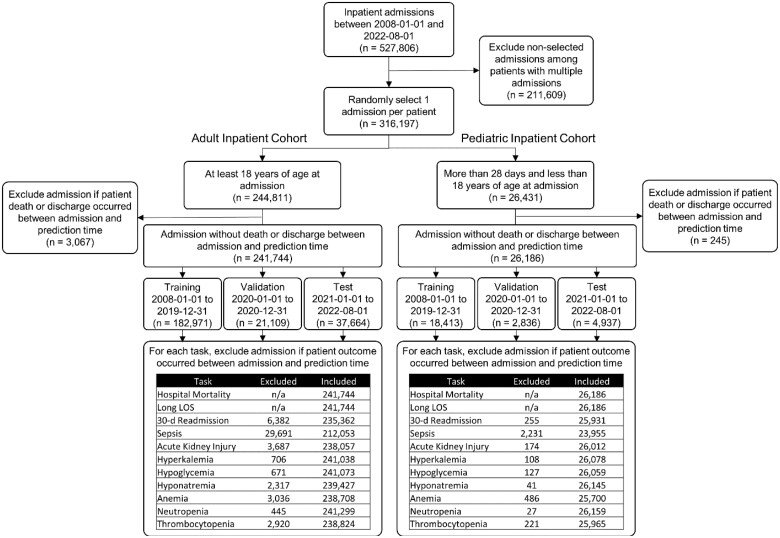
Materials and methods: This retrospective cohort study used EHR data and included patients with at least one admission to an inpatient unit. One admission per patient was randomly selected. Adult inpatients were 18 years or older while pediatric inpatients were more than 28 days and less than 18 years. Admissions were temporally split into training (January 1, 2008 to December 31, 2019), validation (January 1, 2020 to December 31, 2020), and test (January 1, 2021 to August 1, 2022) sets. Primary comparison was a self-supervised model trained in adult inpatients versus count-based logistic regression models trained in pediatric inpatients. Primary outcome was mean area-under-the-receiver-operating-characteristic-curve (AUROC) for 11 distinct clinical outcomes. Models were evaluated in pediatric inpatients.
Results: When evaluated in pediatric inpatients, mean AUROC of self-supervised model trained in adult inpatients (0.902) was noninferior to count-based logistic regression models trained in pediatric inpatients (0.868) (mean difference = 0.034, 95% CI=0.014-0.057; P < .001 for noninferiority and P = .006 for superiority).
Conclusions: Self-supervised learning in adult inpatients was noninferior to logistic regression models trained in pediatric inpatients. This finding suggests transferability of self-supervised models trained in adult patients to pediatric patients, without requiring costly model retraining.
Keywords: electronic health records; foundation model; machine learning; model robustness; self-supervised learning; transfer learning.
© The Author(s) 2023. Published by Oxford University Press on behalf of the American Medical Informatics Association. All rights reserved. For permissions, please email: journals.permissions@oup.com.
Conflict of interest statement
None declared.
Figures

References
-
- Hong JC, Eclov NCW, Dalal NH, et al. System for high-intensity evaluation during radiation therapy (SHIELD-RT): a prospective randomized study of machine learning-directed clinical evaluations during radiation and chemoradiation. J Clin Oncol. 2020;38(31):3652-3661. - PubMed
MeSH terms
LinkOut - more resources
Full Text Sources
