. 2023 Aug 28;11(4):e2200510.
doi: 10.9745/GHSP-D-22-00510. Print 2023 Aug 28.

The Journey Toward Establishing Inpatient Care for Small and Sick Newborns in Ethiopia, India, Malawi, and Rwanda

Affiliations

The Journey Toward Establishing Inpatient Care for Small and Sick Newborns in Ethiopia, India, Malawi, and Rwanda

Patricia S Coffey et al. Glob Health Sci Pract. .

Abstract

Background: Limited information is available about the approaches used and lessons learned from low- and middle-income countries that have implemented inpatient services for small and sick newborns. We developed descriptive case studies to compare the journeys to establish inpatient newborn care across Ethiopia, India, Malawi, and Rwanda.

Methods: A total of 57 interviews with stakeholders in Ethiopia (n=12), India (n=12), Malawi (n=16), and Rwanda (n=17) informed the case studies. Our heuristic data analysis followed a deductive organizing framework approach. We informed our data analysis via targeted literature searches to uncover details related to key events. We used the NEST360 Theory of Change for facility-based care, which reflects the World Health Organization (WHO) Health Systems Framework as a starting point and added, as necessary, in an edit processing format until data saturation was achieved.

Findings: Results highlight the strategies and innovation used to establish small and sick newborn care by health system building block and by country. We conducted a gap analysis of implementation of WHO Standards for Improving Facility-Based Care. The journeys to establish inpatient newborn care across the 4 countries are similar in terms of trajectory yet unique in their implementation. Unifying themes include leadership and governance at national level to consolidate and coordinate action to improve newborn quality of care, investment to build staff skills on data collection and use, and institutionalization of regular neonatal data reviews to identify gaps and propose relevant strategies.

Conclusion: Efforts to establish and scale inpatient care for small and sick newborns in Ethiopia, India, Malawi, and Rwanda over the last decade have led to remarkable success. These country examples can inspire more nascent initiatives that other low- and middle-income countries may undertake. Documentation should give voice to lived country experience, not all of which is fully captured in existing, peer-reviewed published literature.


Conflict of interest statement

None declared.

Figures

FIGURE 1
FIGURE 1
WHO Health System Building Blocks Used as Organizing Principle for Case Studies on Small and Sick Newborn Care in 4 Countries Abbreviation: WHO, World Health Organization. Credit: © NEST360/UNICEF Implementation Toolkit for Small and Sick Newborn Care.
FIGURE 2
FIGURE 2
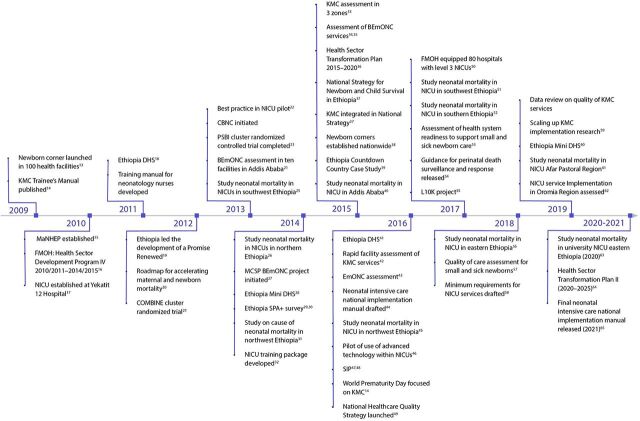
Ethiopia Timeline Showing Significant Activities Undertaken to Establish Small and Sick Newborn Care, 2009–2021 Abbreviations: BEmONC; basic emergency obstretric and newborn care; CBNC, community-based newborn care; DHS, Demographic and Health Survey; EmONC; emergency obstetric and newborn care; FMOH, Federal Ministry of Health; KMC, kangaroo mother care; L10K, Last 10 Kilometers; MaNHEP, Maternal and Newborn Health Ethiopia Partnership; MCSP, Maternal and Child Survival Program; NICU, newborn intensive care unit; PSBI, possible severe bacterial infections; SIP, Study of Illness in Preterms; SPA+, Service Provision Assessment Plus.
FIGURE 3
FIGURE 3
India Timeline Showing Significant Activities Undertaken to Establish Small and Sick Newborn Care, 2005–2021 Abbreviations: HBNC, home-based newborn care; HMBCON, Human Milk Bank Conference; F-IMNCI; Facility Based Integrated Management of Neonatal and Childhood Illness; JSY, Janani Suraksha Yojana; NSSK, Navajat Shishu Surkisha Karyakram; RBSK, Rashtriya Bal Swasthya Karyakam; RMNCH+, reproductive, maternal, newborn and child health plus; SAANS, Social Action and Awareness to Neutralize Pneumonia; SNCU, special newborn care unit.
FIGURE 4
FIGURE 4
Malawi Timeline Showing Significant Activities Undertaken to Establish Small and Sick Newborn Care, 2010–2021 Abbreviations: BCC, behavior change communication; COIN, Care for the Infant and Newborn; CPAP, continuous positive air pressure; ENAP, Every Newborn Action Plan; IMCHA, Innovating for Maternal and Child Health; KMC, kangaroo mother care; MNH, maternal and newborn health; MOH, Ministry of Health; PDSR, perinatal death surveillance and response; SNL, Saving Newborn Lives.
FIGURE 5
FIGURE 5
Rwanda Timeline Showing Significant Activities Undertaken to Establish Small and Sick Newborn Care, 2009–2020 Abbreviations: ABC, All Babies Count; CHP, community health program; COINN, Council of Internal Neonatal Nurses; DHS, Demographic and Health Survey; HB-MNCHP, home-based maternal and neonatal health care package; KMC, kangaroo mother care; MCH, maternal and child health; MPDSR, maternal and perinatal death surveillance and response; MNCAH, maternal, newborn, child, and adolescent health; MNCH, maternal, newborn, and child health; MOH, Ministry of Health; PHIT, Population Health Implementation and Training; TSAM, Training Support and Access Model.
FIGURE 6
FIGURE 6
Scaling Up Kangaroo Mother Care in Malawi, 1999–2009 Abbreviations: KMC, kangaroo mother care; QECH, Queen Elizabeth Central Hospital.
FIGURE 7
FIGURE 7
Scaling Up bCPAP in Malawi, 2012–2021 Abbreviations: bCPAP, bubble continuous positive airway pressure; CHAM, Christian Health Association of Malawi; MOH, Ministry of Health; QECH, Queen Elizabeth Central Hospital.
FIGURE 8
FIGURE 8
Scaling Up Neonatal Care in Malawi, 2016–2020 Abbreviations: MOH, Ministry of Health; NICU, newborn intensive care unit.
FIGURE 9
FIGURE 9
Scaling Up Kangaroo Mother Care in Rwanda, 2007–2014 Abbreviations: CHUK, Centre Hospitalier Universitaire de Kigali; KMC, kangaroo mother care.
FIGURE 10
FIGURE 10
Scaling Up Small and Sick Newborn Care in Rwanda, 2009–2014
FIGURE 11
FIGURE 11
Scaling Up Facility-Based Newborn Care in India, 2003–2020 Abbreviation: SNCU, special newborn care unit. Source: Gupta G. The NICU story of India: pilot to national scale in 10 years. https://youtu.be/WdXHsC-cks4
FIGURE 12
FIGURE 12
Initial Roll-Out of Newborn Care Corners to 100 Health Facilities in Ethiopia, 2009–2020 Source: Nigussie and Worku.
FIGURE 13
FIGURE 13
Phased Scale-Up of Community-Based Newborn Care in Ethiopia, 2013–2014 Abbreviation: CBNC, community-based newborn care.

References

    1. United Nations Inter-Agency Group for Child Mortality Estimation. Levels and Trends in Child Mortality. 2021 Report. UNICEF; 2021. Accessed June 22, 2023. https://data.unicef.org/resources/levels-and-trends-in-child-mortality/
    1. Neonatal Survival Series. Lancet; 2005. Accessed June 22, 2023. https://www.thelancet.com/series/neonatal-survival
    1. Every Newborn Series. Lancet; 2014. Accessed June 22, 2023. https://www.thelancet.com/series/everynewborn
    1. World Health Organization (WHO); UNICEF. Every Newborn: An Action Plan to End Preventable Deaths. WHO; 2014. Accessed June 22, 2023. https://www.who.int/publications/i/item/9789241507448
    1. World Health Organization (WHO). WHO Recommendations on Newborn Health: Guidelines Approved by the WHO Guidelines Review Committee. WHO; 2017. Accessed June 22, 2023. https://www.who.int/publications/i/item/WHO-MCA-17.07

Publication types

LinkOut - more resources