. 2023 Aug 28;13(1):14054.
doi: 10.1038/s41598-023-41008-5.

New mutation in the β1 propeller domain of LRP4 responsible for congenital myasthenic syndrome associated with Cenani-Lenz syndrome

Affiliations

New mutation in the β1 propeller domain of LRP4 responsible for congenital myasthenic syndrome associated with Cenani-Lenz syndrome

Marion Masingue et al. Sci Rep. .

Abstract

Congenital myasthenic syndromes (CMS) are a clinically and genetically heterogeneous group of rare diseases due to mutations in neuromuscular junction (NMJ) protein-coding genes. Until now, many mutations encoding postsynaptic proteins as Agrin, MuSK and LRP4 have been identified as responsible for increasingly complex CMS phenotypes. The majority of mutations identified in LRP4 gene causes bone diseases including CLS and sclerosteosis-2 and rare cases of CMS with mutations in LRP4 gene has been described so far. In the French cohort of CMS patients, we identified a novel LRP4 homozygous missense mutation (c.1820A > G; p.Thy607Cys) within the β1 propeller domain in a patient presenting CMS symptoms, including muscle weakness, fluctuating fatigability and a decrement in compound muscle action potential in spinal accessory nerves, associated with congenital agenesis of the hands and feet and renal malformation. Mechanistic expression studies show a significant decrease of AChR aggregation in cultured patient myotubes, as well as altered in vitro binding of agrin and Wnt11 ligands to the mutated β1 propeller domain of LRP4 explaining the dual phenotype characterized clinically and electoneuromyographically in the patient. These results expand the LRP4 mutations spectrum associated with a previously undescribed clinical association involving impaired neuromuscular transmission and limb deformities and highlighting the critical role of a yet poorly described domain of LRP4 at the NMJ. This study raises the question of the frequency of this rare neuromuscular form and the future diagnosis and management of these cases.


Conflict of interest statement

The authors declare no competing interests.

Figures
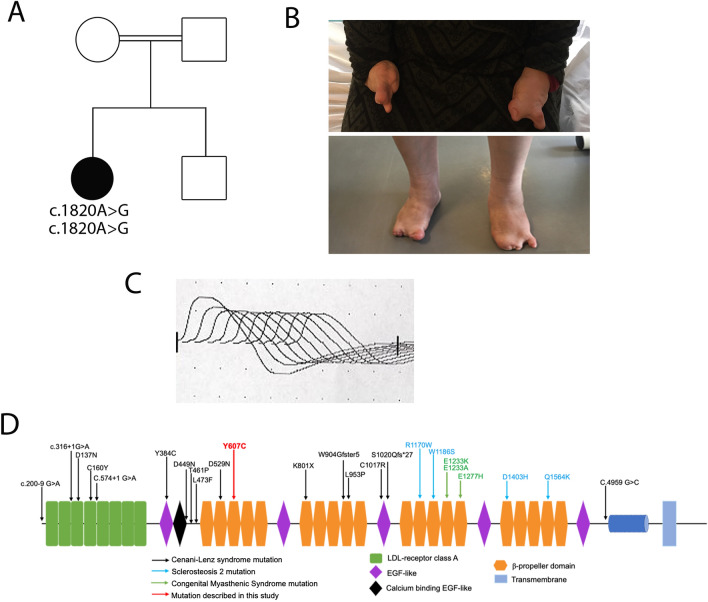
Figure 1
Figure 1
Genetic and electrophysiologic features of recessive LRP4 mutation. (A) The family pedigree from the consanguineous family at first degree revealed that the proband (in black) is affected. (B) Image of the patient’s congenital agenesis of the hands and feet. (C) Decrement at RNS (3 Hz) was observed from 25 to 28% in spinal accessory nerves. (D) Position of the identified mutation on the structure of human LRP4 protein. Missense mutation identified in the β1 propeller domain in this study is indicated in red (Y607C), whereas mutations described in CMS are indicated in green. Mutations described in Cenani Lenz syndrome are represented in black and mutations described in sclerosteosis 2 are represented in blue. For A and B figures were drawn by using BioRender.com.
Figure 2
Figure 2
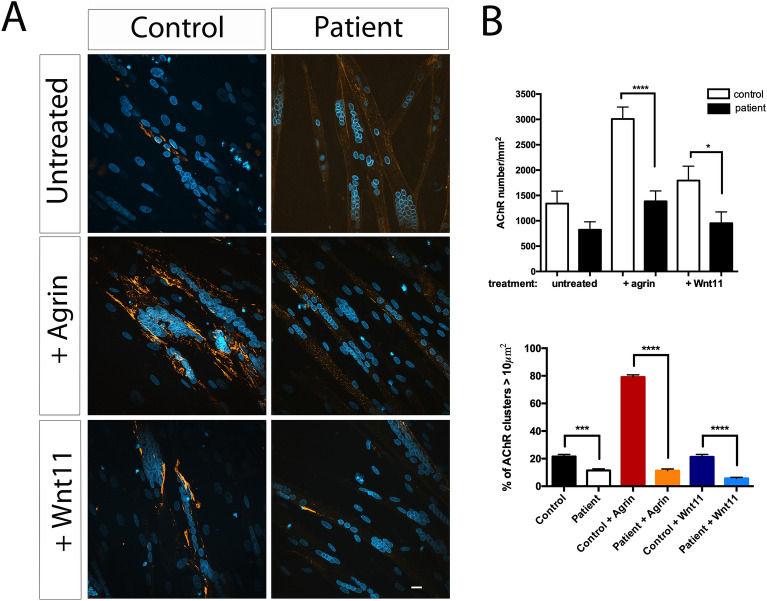
Neural agrin- and Wnt11-induced AChR aggregation in cultured patient myotubes. (A) Primary culture of human myotubes from the patient and healthy control differentiated into myotubes. After treatment or not with neural agrin (0.4 μg/ml) or Wnt11 (10 ng/ml) during 16 h, AChR aggregates and nucleus are labelled with α-BGT-TRITC and DAPI respectively and visualized with ApoTom microscope. At least, 70 myotubes were analyzed for each condition, Scale bar 10 µm. (B) Histogram of AChRs number per mm2 and percentage of AChR clusters > 10 μm2. No effect of the agrin or Wnt11 treatment in AChR clustering was observed on the patient's myotubes compared with the control. A decrease of AChR cluster size was observed in the patient’s myotubes compared with controls (*p < .05, **p < 0.01, ***p < 0.001 and ****p < 0.0001, Student’s test).
Figure 3
Figure 3
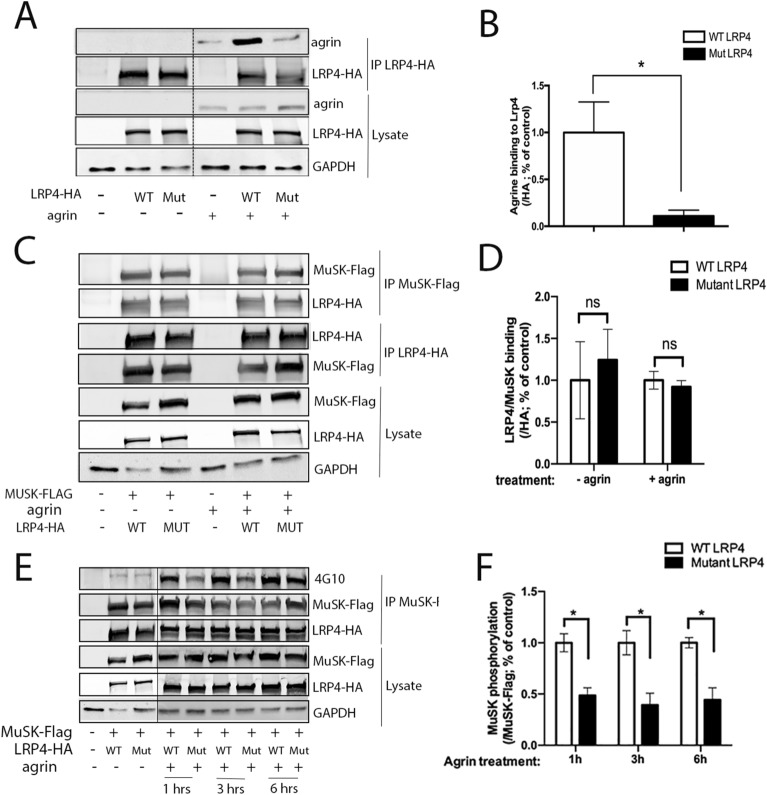
Alteration of agrin- mediated MuSK signaling induced by mutation in LRP4. (A) The LRP4 mutant inhibits agrin binding in vitro. HEK293T cells were transfected with wild-type (WT) or mutant (Mut) LRP4-HA plasmids. After immunoprecipitation of LRP4-HA and incubation with or without neural agrin (1 μg/ml), the level of agrin binding to LRP4 is followed by immunobloting with anti-agrin antibody. Lines indicate that intervening lanes have been spliced out. (B) Agrin binding to LRP4 shows a significant impairment of agrin binding to LRP4 mutated in vitro. (C) The LRP4 mutant does not affect its binding to its coreceptor MuSK. After co-expression of MuSK-Flag and LRP4-HA in HEK293T cells and immunoprecipitation of MuSK-Flag or LRP4-HA with anti-Flag and anti-HA respectively, the level of MuSK or LRP4 is followed by immunoblotting with anti-Flag or anti-HA antibodies. (D) LRP4 binding to MuSK doesn’t show significant changes of LRP4/MuSK binding when LRP4 is mutated in vitro. (E) The mutation in LRP4 inhibits agrin-mediated regulation of MuSK phosphorylation. HEK293T cells were transfected with MuSK-Flag and WT LRP4-HA or mutant LRP4-HA with or without agrin (0.4 μg/ml) for various times (1, 3 or 6 h). Phosphorylated MuSK was detected by immunoprecipitation of MuSK-Flag and followed by immunoblotting with anti-4G10 (MuSK phosphorylation), anti-Flag and anti-HA antibodies. Lines indicate that intervening lanes have been spliced out. (F) MuSK phosphorylation induced by agrin is significantly impaired when LRP4 is mutated in vitro. p < 0.05, Student’s test. N = 3 blots for each condition. Source data are provided as a Source Data file.
Figure 4
Figure 4
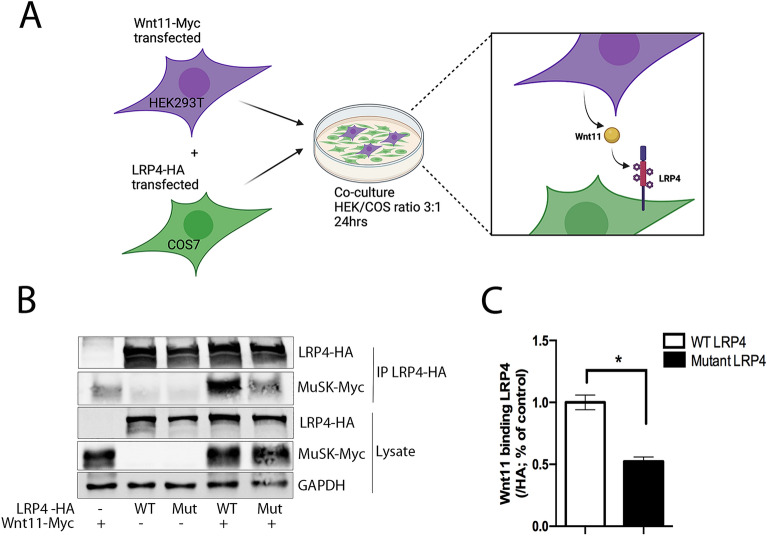
Mutation localized in the β1 propeller domain of LRP4 inhibits its binding to Wnt11 in vitro. (A) Wild-type (WT) or mutant (Mut) LRP4/Wnt11 co-culture and immunoprecipitation experiment. (B) Immunoprecipitation of LRP4-HA with Wnt11-Myc in COS7/HEK293T co-culture. Western blot using anti-HA and anti-Myc antibodies were realized on cell lysates in order to estimate the effect of the mutation in LRP4 on its binding to Wnt11. (C) Wnt11 binding to mutated LRP4 shows a significant decrease compared with control. N = 3 co-culture and immunoprecipitation for each condition. p < 0.05, Student’s test. Source data are provided as a Source Data file. For A the figure was drawn by using BioRender.com.
Figure 5
Figure 5
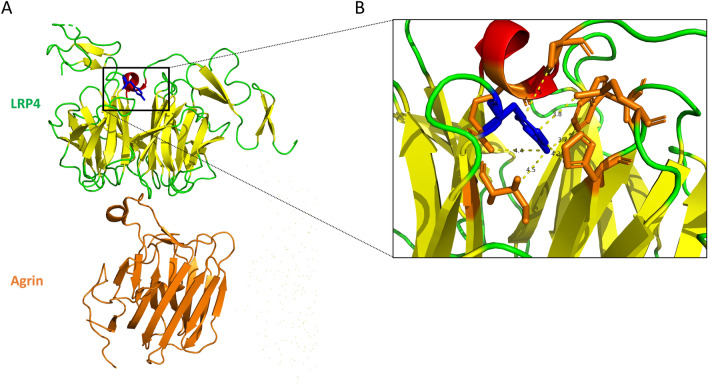
3D view of β1 propeller domain of LRP4 in complex with agrin involving Tyr607 mutation. (A) Backbone representation extracted from the crystal structure of LRP4, in complex with agrin (colored in orange), using PDB accession number 3V64. Tyr607 mutation is colored in blue. (B) Zoom view of the side chain interactions between Tyr607 (colored in blue) and neighbor residues (colored in orange). Inter side-chain distances lower than 5 Å are indicated by dash lines. For A and B figures were extracted from PyMol software.

References

    1. Li Y, et al. LRP4 mutations alter Wnt/b-catenin signaling and cause limb and kidney malformations in Cenani–Lenz syndrome. Am. J. Hum. Genet. 2010;86:696–706. doi: 10.1016/j.ajhg.2010.03.004. - DOI - PMC - PubMed
    1. Kariminejad A, et al. Severe Cenani–Lenz syndrome caused by loss of LRP4 function. Am. J. Med. Genet. A. 2013;161:1475–1479. doi: 10.1002/ajmg.a.35920. - DOI - PubMed
    1. Halevy RS, et al. Mutations in the fourth β-propeller domain of LRP4 are associated with isolated syndactyly with fusion of the third and fourth fingers. Hum. Mutat. 2017;39:811–815. doi: 10.1002/humu.23417. - DOI - PMC - PubMed
    1. Khan H, et al. Novel variations in the LRP4 underlying Cenani–Lenz syndactyly syndrome. J. Hum. Genet. 2022;67:253–259. doi: 10.1038/s10038-021-00995-x. - DOI - PubMed
    1. Ohkawara B, et al. LRP4 third β-propeller domain mutations cause novel congenital myasthenia by compromising agrin-mediated MuSK signaling in a position-specific manner. Hum. Mol. Genet. 2014;23:1856–1868. doi: 10.1093/hmg/ddt578. - DOI - PMC - PubMed

Publication types

Supplementary concepts