


Rhodiola rosea as an adaptogen to enhance exercise performance: a review of the literature
- PMID: 37641937
- PMCID: PMC10784128
- DOI: 10.1017/S0007114523001988
Rhodiola rosea as an adaptogen to enhance exercise performance: a review of the literature
Abstract
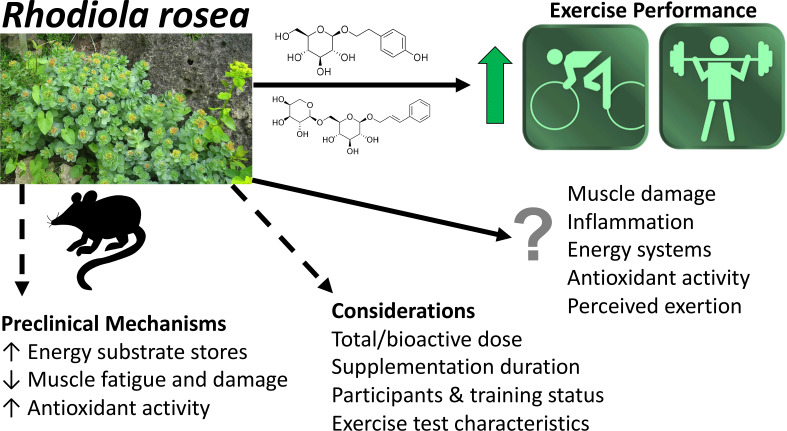
Rhodiola rosea (RR) is a plant whose bioactive components may function as adaptogens, thereby increasing resistance to stress and improving overall resilience. Some of these effects may influence exercise performance and adaptations. Based on studies of rodents, potential mechanisms for the ergogenic effects of RR include modulation of energy substrate stores and use, reductions in fatigue and muscle damage and altered antioxidant activity. At least sixteen investigations in humans have explored the potential ergogenicity of RR. These studies indicate acute RR supplementation (∼200 mg RR containing ∼1 % salidroside and ∼3 % rosavin, provided 60 min before exercise) may prolong time-to-exhaustion and improve time trial performance in recreationally active males and females, with limited documented benefits of chronic supplementation. Recent trials providing higher doses (∼1500 to 2400 mg RR/d for 4–30 d) have demonstrated ergogenic effects during sprints on bicycle ergometers and resistance training in trained and untrained adults. The effects of RR on muscle damage, inflammation, energy system modulation, antioxidant activity and perceived exertion are presently equivocal. Collectively, it appears that adequately dosed RR enhances dimensions of exercise performance and related outcomes for select tasks. However, the current literature does not unanimously show that RR is ergogenic. Variability in supplementation dose and duration, concentration of bioactive compounds, participant characteristics, exercise tests and statistical considerations may help explain these disparate findings. Future research should build on the longstanding use of RR and contemporary clinical trials to establish the conditions in which supplementation facilitates exercise performance and adaptations.
Keywords: Arctic root; Dietary supplement; Golden root; Physical performance; Rosavin; Roseroot; Salidroside.
References
-
- Panossian A, Wikman G & Sarris J (2010) Rosenroot (Rhodiola rosea): traditional use, chemical composition, pharmacology and clinical efficacy. Phytomedicine 17, 481–493. - PubMed
-
- Tao H, Wu X, Cao J, et al. (2019) Rhodiola species: a comprehensive review of traditional use, phytochemistry, pharmacology, toxicity, and clinical study. Med Res Rev 39, 1779–1850. - PubMed
-
- Brekhman II & Dardymov IV (1969) New substances of plant origin which increase nonspecific resistance. Annu Rev Pharmacol 9, 419–430. - PubMed
-
- Global Market Insights (2023) Adaptogens Market Size & Share | Forecast Report, 2023–2032. https://www.gminsights.com/industry-analysis/adaptogens-market-statistics (accessed April 2023).
-
- Yousef GG, Grace MH, Cheng DM, et al. (2006) Comparative phytochemical characterization of three Rhodiola species. Phytochemistry 67, 2380–2391. - PubMed
Publication types
MeSH terms
Substances
LinkOut - more resources
Full Text Sources
