. 2023 Aug 27;15(16):8518-8527.
doi: 10.18632/aging.204002. Epub 2023 Aug 27.

miR-153-3p suppresses the differentiation and proliferation of neural stem cells via targeting GPR55

Affiliations

miR-153-3p suppresses the differentiation and proliferation of neural stem cells via targeting GPR55

Xiaolin Dong et al. Aging (Albany NY). .

Abstract

Alzheimer's disease is the most frequent neurodegenerative disease and is characterized by progressive cognitive impairment and decline. NSCs (neural stem cells) serve as beneficial and promising adjuncts to treat Alzheimer's disease. This study aimed to determine the role of miR-153-3p expression in NSC differentiation and proliferation. We illustrated that miR-153-3p was decreased and GPR55 was upregulated during NSC differentiation. IL-1β can induce miR-153-3p expression. Luciferase reporter analysis noted that elevated expression of miR-153-3p significantly inhibited the luciferase value of the WT reporter plasmid but did not change the luciferase value of the mut reporter plasmid. Ectopic miR-153-3p expression suppressed GPR55 expression in NSCs and identified GPR55 as a direct target gene of miR-153-3p. Ectopic expression of miR-153-3p inhibited NSC growth and differentiation into astrocytes and neurons. Elevated expression of miR-153-3p induced the release of proinflammatory cytokines, such as TNF-α, IL-1β and IL-6, in NSCs. Furthermore, miR-153-3p inhibited NSC differentiation and proliferation by targeting GPR55 expression. These data suggested that miR-153-3p may act as a clinical target for the therapeutics of neurodegenerative diseases.

Keywords: Alzheimer's disease; GPR55; miR-153-3p; neurodegenerative diseases.


Conflict of interest statement

CONFLICTS OF INTEREST: The authors declare that they have no conflicts of interest.

Figures

Figure 1
Figure 1
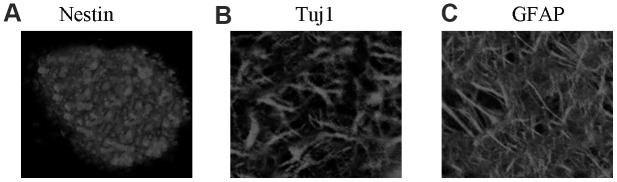
NSC identification and culture. (A) Immunocytochemical staining of purified neural stem cells with Nestin. (B) Immunocytochemical staining of neurons with Tuj1. (C) Immunocytochemical staining of astrocytes with GFAP.
Figure 2
Figure 2
miR-153-3p is decreased and GPR55 is overexpressed during NSC differentiation. (A) The expression of miR-153-3p was measured by qRT-PCR. (B) The expression of GPR55 was measured by qRT-PCR. (C) IL-1β induces miR-153-3p expression in NSCs. (D) The expression of GPR55 is determined by qRT-PCR. *p<0.05, **p<0.01 and ***p<0.001. Error bars represent the s.d. of relative experiment from n=3 replicates.
Figure 3
Figure 3
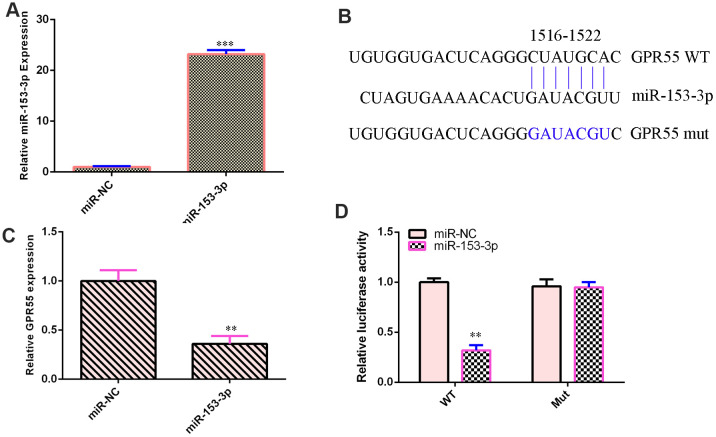
GPR55 is a direct gene target of miR-153-3p. (A) The expression of GPR55 was determined by qRT-PCR. (B) One potential target site was found between miR-153-3p and GPR55. These sequences were conserved between different species. (C) The expression of GPR55 was determined by qRT-PCR. (D) Luciferase reporter analysis noted that elevated expression of miR-153-3p significantly inhibited the luciferase value of the WT reporter plasmid but did not change the luciferase value of the mut reporter plasmid. **p<0.01 and ***p<0.001. Error bars represent the s.d. of relative experiment from n=3 replicates.
Figure 4
Figure 4
miR-153-3p suppresses NSC differentiation and proliferation. (A) Ectopic expression of miR-153-3p inhibited NSC proliferation. (B) Overexpression of miR-153-3p decreased nestin expression. (C) The expression of Tuj1 was detected by qRT-PCR. (D) The expression of GFAP was measured by qRT-PCR. (E) The expression of miR-153-3p was measured by qRT-PCR. (F) The suppression of miR-153-3p increased NSC growth. (G) Nestin expression was measured by qRT-PCR. (H) The expression of Tuj1 was detected by qRT-PCR. (I) The expression of GFAP was measured by qRT-PCR. *p<0.05, **p<0.01 and ***p<0.001. Error bars represent the s.d. of relative experiment from n=3 replicates.
Figure 5
Figure 5
miR-153-3p induces proinflammatory cytokine release. (A) The concentration levels of TNF-α, IL-1β and IL-6 were upregulated in NSCs after treatment with the miR-153-3p mimic. (B) Knockdown of miR-153-3p suppressed the concentration levels of TNF-α, IL-1β and IL-6 in NSCs. **p<0.01 and ***p<0.001. Error bars represent the s.d. of relative experiment from n=3 replicates.
Figure 6
Figure 6
miR-153-3p inhibits NSC differentiation and proliferation by targeting GPR55 expression. (A) Cell proliferation was measured using CCK-8 analysis. (B) Nestin expression was determined by qRT-PCR. (C) The expression of Tuj1 was detected by qRT-PCR. (D) The expression of GFAP was measured by qRT-PCR. (E) The GPR55 antagonist ML-193 inhibited cell growth compared with the vehicle group in miR-153-3p-treated NSCs. (F) Nestin expression was determined by qRT-PCR analysis. (G) The expression of Tuj1 was detected by qRT-PCR. (H) The expression of GFAP was measured by qRT-PCR. *p<0.05 and **p<0.01. Error bars represent the s.d. of relative experiment from n=3 replicates.

References

    1. Zhang R, Zhang Q, Niu J, Lu K, Xie B, Cui D, Xu S. Screening of microRNAs associated with Alzheimer’s disease using oxidative stress cell model and different strains of senescence accelerated mice. J Neurol Sci. 2014; 338:57–64. 10.1016/j.jns.2013.12.017 - DOI - PubMed
    1. Fang M, Wang J, Zhang X, Geng Y, Hu Z, Rudd JA, Ling S, Chen W, Han S. The miR-124 regulates the expression of BACE1/β-secretase correlated with cell death in Alzheimer’s disease. Toxicol Lett. 2012; 209:94–105. 10.1016/j.toxlet.2011.11.032 - DOI - PubMed
    1. Long JM, Ray B, Lahiri DK. MicroRNA-153 physiologically inhibits expression of amyloid-β precursor protein in cultured human fetal brain cells and is dysregulated in a subset of Alzheimer disease patients. J Biol Chem. 2012; 287:31298–310. 10.1074/jbc.M112.366336 - DOI - PMC - PubMed
    1. Meng F, Dai E, Yu X, Zhang Y, Chen X, Liu X, Wang S, Wang L, Jiang W. Constructing and characterizing a bioactive small molecule and microRNA association network for Alzheimer’s disease. J R Soc Interface. 2013; 11:20131057. 10.1098/rsif.2013.1057 - DOI - PMC - PubMed
    1. Cheng C, Li W, Zhang Z, Yoshimura S, Hao Q, Zhang C, Wang Z. MicroRNA-144 is regulated by activator protein-1 (AP-1) and decreases expression of Alzheimer disease-related a disintegrin and metalloprotease 10 (ADAM10). J Biol Chem. 2013; 288:13748–61. 10.1074/jbc.M112.381392 - DOI - PMC - PubMed

Publication types