Triage Procedures for Critical Care Resource Allocation During Scarcity
- PMID: 37642967
- PMCID: PMC10466166
- DOI: 10.1001/jamanetworkopen.2023.29688
Triage Procedures for Critical Care Resource Allocation During Scarcity
Abstract
Importance: During the COVID-19 pandemic, many US states issued or revised pandemic preparedness plans guiding allocation of critical care resources during crises. State plans vary in the factors used to triage patients and have faced criticism from advocacy groups due to the potential for discrimination.
Objective: To analyze the role of comorbidities and long-term prognosis in state triage procedures.
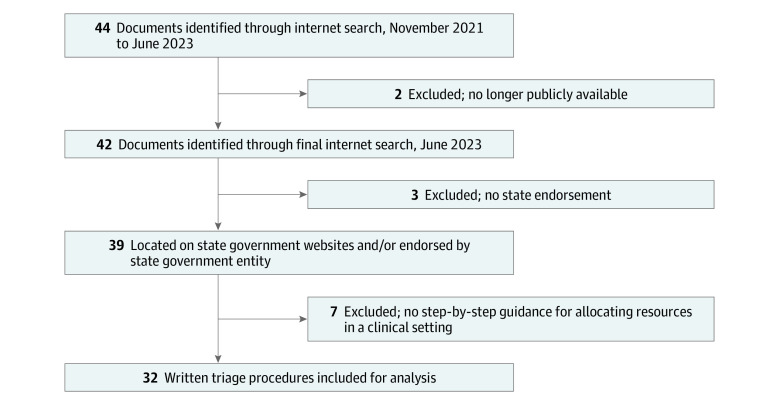
Design, setting, and participants: This cross-sectional study used data gathered from parallel internet searches for state-endorsed pandemic preparedness plans for the 50 US states, District of Columbia, and Puerto Rico (hereafter referred to as states), which were conducted between November 25, 2021, and June 16, 2023. Plans available on June 16, 2023, that provided step-by-step instructions for triaging critically ill patients were categorized for use of comorbidities and prognostication.
Main outcomes and measures: Prevalence and contents of lists of comorbidities and their stated function in triage and instructions to predict duration of postdischarge survival.
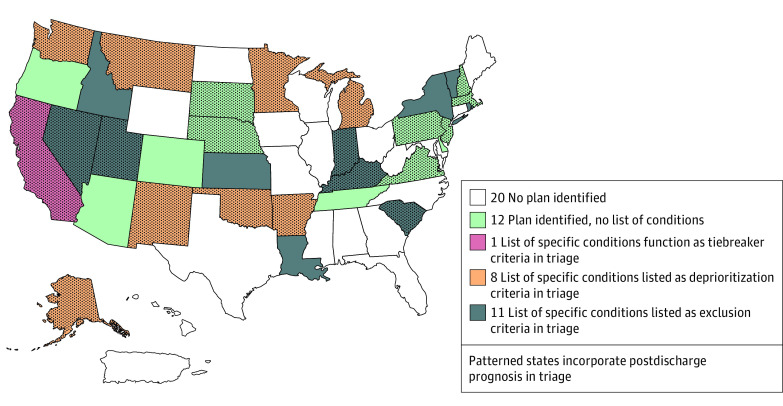
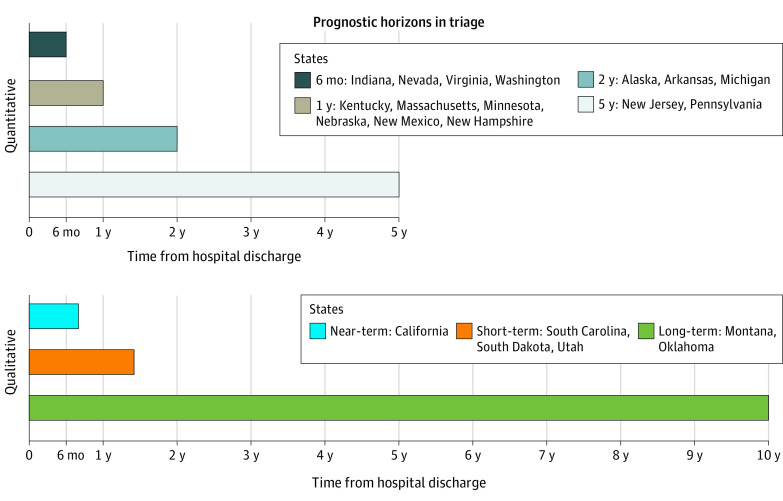
Results: Overall, 32 state-promulgated pandemic preparedness plans included triage procedures specific enough to guide triage in clinical practice. Twenty of these (63%) included lists of comorbidities that excluded (11 of 20 [55%]) or deprioritized (8 of 20 [40%]) patients during triage; one state's list was formulated to resolve ties between patients with equal triage scores. Most states with triage procedures (21 of 32 [66%]) considered predicted survival beyond hospital discharge. These states proposed different prognostic time horizons; 15 of 21 (71%) were numeric (ranging from 6 months to 5 years after hospital discharge), with the remaining 6 (29%) using descriptive terms, such as long-term.
Conclusions and relevance: In this cross-sectional study of state-promulgated critical care triage policies, most plans restricted access to scarce critical care resources for patients with listed comorbidities and/or for patients with less-than-average expected postdischarge survival. This analysis raises concerns about access to care during a public health crisis for populations with high burdens of chronic illness, such as individuals with disabilities and minoritized racial and ethnic groups.
Conflict of interest statement
Figures
Comment in
-
The Unresolved Challenge of Triage.JAMA Netw Open. 2023 Aug 1;6(8):e2329676. doi: 10.1001/jamanetworkopen.2023.29676. JAMA Netw Open. 2023. PMID: 37642969 No abstract available.
References
-
- Bebinger M. Thinking through the unthinkable: how Mass. hospitals may decide who gets a ventilator in the COVID-19 surge. WBUR. April 8, 2020. Accessed December 1, 2022. https://www.wbur.org/news/2020/04/07/icu-ventilator-triage-massachusetts...
-
- Pfeiffer S. US hospitals prepare guidelines for who gets care amid coronavirus surge. NPR. March 21, 2020. Accessed December 1, 2022. https://www.npr.org/2020/03/21/819645036/u-s-hospitals-prepare-guideline...
-
- Institute of Medicine . Guidance for Establishing Crisis Standards of Care for Use in Disaster Situations: A Letter Report. The National Academies Press; 2009. - PubMed
-
- Center for Public Representation. COVID-19 medical rationing & facility visitation policies. Accessed December 5, 2022. https://www.centerforpublicrep.org/covid-19-medical-rationing/
-
- Sheets C. Alabama limit on ventilators discriminates against intellectually disabled, advocates claim. AL.com. March 27, 2020. Accessed December 5, 2022. https://www.al.com/news/2020/03/alabama-limit-on-ventilators-discriminat...
Publication types
MeSH terms
Grants and funding
LinkOut - more resources
Full Text Sources
Medical