


Stress Management Apps: Systematic Search and Multidimensional Assessment of Quality and Characteristics
- PMID: 37642999
- PMCID: PMC10498318
- DOI: 10.2196/42415
Stress Management Apps: Systematic Search and Multidimensional Assessment of Quality and Characteristics
Abstract
Background: Chronic stress poses risks for physical and mental well-being. Stress management interventions have been shown to be effective, and stress management apps (SMAs) might help to transfer strategies into everyday life.
Objective: This review aims to provide a comprehensive overview of the quality and characteristics of SMAs to give potential users or health professionals a guideline when searching for SMAs in common app stores.
Methods: SMAs were identified with a systematic search in the European Google Play Store and Apple App Store. SMAs were screened and checked according to the inclusion criteria. General characteristics and quality were assessed by 2 independent raters using the German Mobile Application Rating Scale (MARS-G). The MARS-G assesses quality (range 1 to 5) on the following four dimensions: (1) engagement, (2) functionality, (3) esthetics, and (4) information. In addition, the theory-based stress management strategies, evidence base, long-term availability, and common characteristics of the 5 top-rated SMAs were assessed and derived.
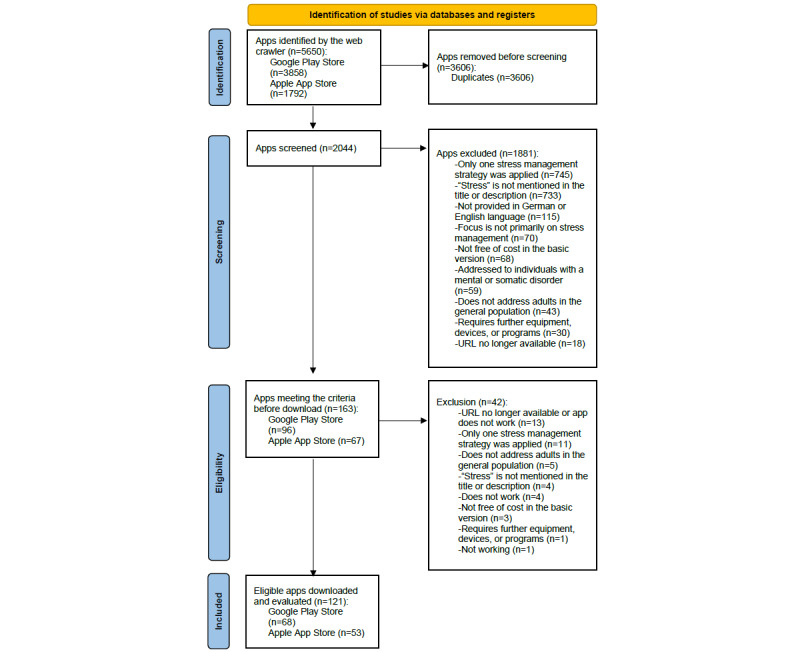
Results: Of 2044 identified apps, 121 SMAs were included. Frequently implemented strategies (also in the 5 top-rated SMAs) were psychoeducation, breathing, and mindfulness, as well as the use of monitoring and reminder functions. Of the 121 SMAs, 111 (91.7%) provided a privacy policy, but only 44 (36.4%) required an active confirmation of informed consent. Data sharing with third parties was disclosed in only 14.0% (17/121) of the SMAs. The average quality of the included apps was above the cutoff score of 3.5 (mean 3.59, SD 0.50). The MARS-G dimensions yielded values above this cutoff score (functionality: mean 4.14, SD 0.47; esthetics: mean 3.76, SD 0.73) and below this score (information: mean 3.42, SD 0.46; engagement: mean 3.05, SD 0.78). Most theory-based stress management strategies were regenerative stress management strategies. The evidence base for 9.1% (11/121) of the SMAs could be identified, indicating significant group differences in several variables (eg, stress or depressive symptoms) in favor of SMAs. Moreover, 38.0% (46/121) of the SMAs were no longer available after a 2-year period.
Conclusions: The moderate information quality, scarce evidence base, constraints in data privacy and security features, and high volatility of SMAs pose challenges for users, health professionals, and researchers. However, owing to the scalability of SMAs and the few but promising results regarding their effectiveness, they have a high potential to reach and help a broad audience. For a holistic stress management approach, SMAs could benefit from a broader repertoire of strategies, such as more instrumental and mental stress management strategies. The common characteristics of SMAs with top-rated quality can be used as guidance for potential users and health professionals, but owing to the high volatility of SMAs, enhanced evaluation frameworks are needed.
Keywords: availability; evidence base; mHealth; mobile app; mobile health; quality assessment; review; stress management.
©Sarah Paganini, Evelyn Meier, Yannik Terhorst, Ramona Wurst, Vivien Hohberg, Dana Schultchen, Jana Strahler, Max Wursthorn, Harald Baumeister, Eva-Maria Messner. Originally published in JMIR mHealth and uHealth (https://mhealth.jmir.org), 29.08.2023.
Conflict of interest statement
Conflicts of Interest: HB and EMM received payments for talks and workshops in the context of e-mental health. All other authors declare that they have no competing interests.
Figures
References
-
- Hapke U, Maske UE, Scheidt-Nave C, Bode L, Schlack R, Busch MA. Chronischer Stress bei Erwachsenen in Deutschland [Chronic stress among adults in Germany: results of the German Health Interview and Examination Survey for Adults (DEGS1)] Bundesgesundheitsblatt. 2013;56(5-6):749–754. doi: 10.1007/s00103-013-1690-9. - DOI - PubMed
-
- Yaribeygi H, Panahi Y, Sahraei H, Johnston TP, Sahebkar A. The impact of stress on body function: A review. EXCLI J. 2017;16:1057–1072. doi: 10.17179/excli2017-480. https://europepmc.org/abstract/MED/28900385 2017-480 - DOI - PMC - PubMed
-
- Cohen S, Murphy MLM, Prather AA. Ten Surprising Facts About Stressful Life Events and Disease Risk. Annu Rev Psychol. 2019;70:577–597. doi: 10.1146/annurev-psych-010418-102857. https://europepmc.org/abstract/MED/29949726 - DOI - PMC - PubMed
-
- Harvey SB, Modini M, Joyce S, Milligan-Saville JS, Tan L, Mykletun A, Bryant RA, Christensen H, Mitchell PB. Can work make you mentally ill? A systematic meta-review of work-related risk factors for common mental health problems. Occup Environ Med. 2017;74(4):301–310. doi: 10.1136/oemed-2016-104015.oemed-2016-104015 - DOI - PubMed
-
- Schneiderman N, Ironson G, Siegel SD. Stress and health: psychological, behavioral, and biological determinants. Annu Rev Clin Psychol. 2005;1:607–628. doi: 10.1146/annurev.clinpsy.1.102803.144141. https://europepmc.org/abstract/MED/17716101 - DOI - PMC - PubMed
Publication types
MeSH terms
LinkOut - more resources
Full Text Sources
Miscellaneous
