


Assessing the Genomic Landscape of Cervical Cancers: Clinical Opportunities and Therapeutic Targets
- PMID: 37643132
- PMCID: PMC10644000
- DOI: 10.1158/1078-0432.CCR-23-1078
Assessing the Genomic Landscape of Cervical Cancers: Clinical Opportunities and Therapeutic Targets
Abstract
Purpose: Tumor genomic profiling is increasingly used to guide treatment strategy in patients with cancer. We integrated tumor genomic, clinical demographic, and treatment response data to assess how prospective tumor-normal sequencing impacted treatment selection in patients with cervical cancer.
Experimental design: Cervical cancers were prospectively analyzed using the MSK-IMPACT (Memorial Sloan Kettering Cancer Center - Integrated Mutation Profiling of Actionable Cancer Targets) next-generation sequencing panel. Clinical data, including histology, stage at diagnosis, treatment history, clinical trial enrollment and outcomes, date of last follow-up, and survival status were obtained from medical records.
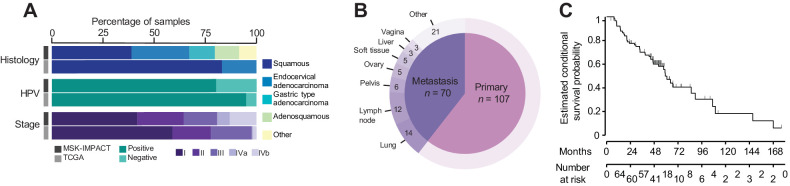
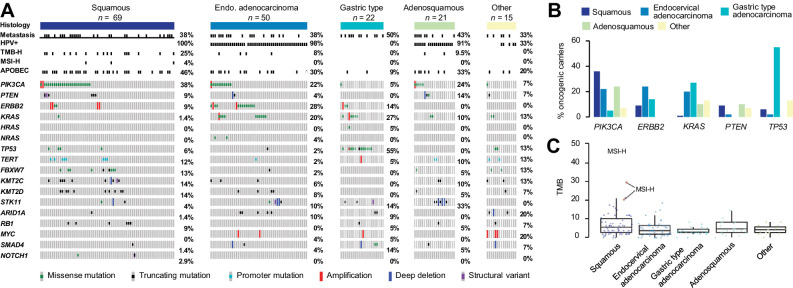
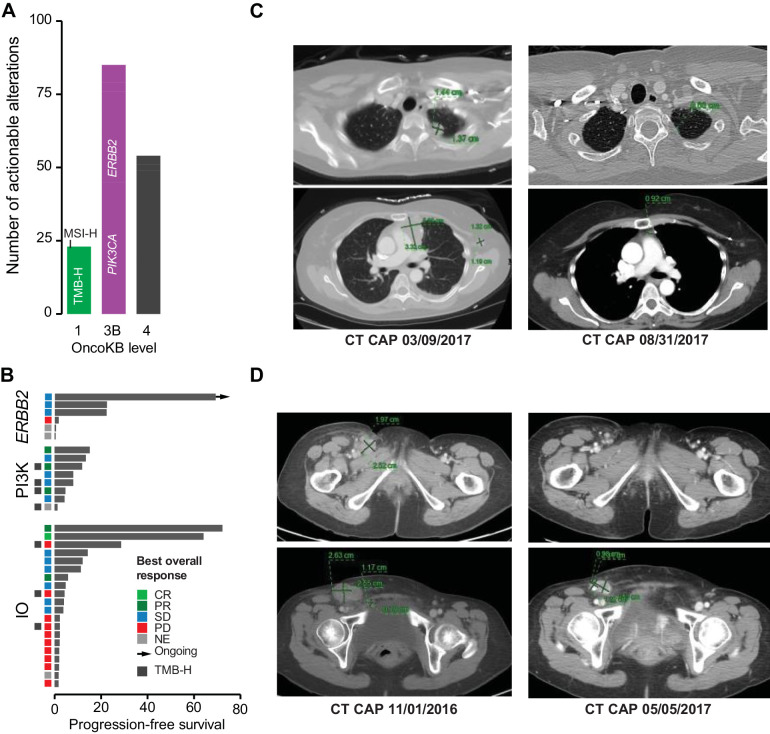
Results: A total of 177 patients with cervical cancer (squamous, 69; endocervical adenocarcinoma, 50; gastric type, 22; adenosquamous, 21; and other, 15) underwent MSK-IMPACT testing. The most prevalent genomic alterations were somatic mutations or amplifications in PIK3CA (25%), ERBB2 (12%), KMT2C (10%), and KMT2D (9%). Furthermore, 13% of patients had high tumor mutational burden (TMB >10 mut/Mb), 3 of which were also microsatellite instability-high (MSI-H). Thirty-seven percent of cases had at least one potentially actionable alteration designated as a level 3B mutational event according to the FDA-recognized OncoKB tumor mutation database and treatment classification system. A total of 30 patients (17%) were enrolled on a therapeutic clinical trial, including 18 (10%) who were matched with a study based on their MSK-IMPACT results. Twenty patients (11%) participated in an immune checkpoint inhibition study for metastatic disease; 2 remain progression free at >5 years follow-up.
Conclusions: Tumor genomic profiling can facilitate the selection of targeted/immunotherapies, as well as clinical trial enrollment, for patients with cervical cancer.
©2023 The Authors; Published by the American Association for Cancer Research.
Figures
References
-
- Siegel RL, Miller KD, Fuchs HE, Jemal A. Cancer statistics, 2022. CA Cancer J Clin 2022;72:7–33. - PubMed
-
- Moore DH, Blessing JA, McQuellon RP, Thaler HT, Cella D, Benda J, et al. Phase III study of cisplatin with or without paclitaxel in stage IVB, recurrent, or persistent squamous cell carcinoma of the cervix: a gynecologic oncology group study. J Clin Oncol 2004;22:3113–9. - PubMed
-
- Chung HC, Ros W, Delord JP, Perets R, Italiano A, Shapira-Frommer R, et al. Efficacy and safety of pembrolizumab in previously treated advanced cervical cancer: results from the phase II KEYNOTE-158 Study. J Clin Oncol 2019;37:1470–8. - PubMed
-
- Colombo N, Dubot C, Lorusso D, Caceres MV, Hasegawa K, Shapira-Frommer R, et al. Pembrolizumab for persistent, recurrent, or metastatic cervical cancer. N Engl J Med 2021;385:1856–67. - PubMed
-
- Stoler MH, Bergeron C, Colgan TJ. Tumours of the uterine cervix. In:Kurman R, Carcangiu M, Herrington C, editors. Classification of tumours of female reproductive organs. 4th ed.Lyon, France: IARC Press; 2014. p. 184.
Publication types
MeSH terms
Substances
Grants and funding
LinkOut - more resources
Full Text Sources
Medical
Research Materials
Miscellaneous
