


Translation and psychometric evaluation of the Persian version of Knee Outcome Survey-Activities of Daily Living Scale (KOS-ADLS)
- PMID: 37644479
- PMCID: PMC10464003
- DOI: 10.1186/s12891-023-06823-x
Translation and psychometric evaluation of the Persian version of Knee Outcome Survey-Activities of Daily Living Scale (KOS-ADLS)
Retraction in
-
Retraction Note: Translation and psychometric evaluation of the Persian version of Knee Outcome Survey-Activities of Daily Living Scale (KOS-ADLS).BMC Musculoskelet Disord. 2025 Sep 24;26(1):856. doi: 10.1186/s12891-025-09200-y. BMC Musculoskelet Disord. 2025. PMID: 40993692 Free PMC article. No abstract available.
Abstract
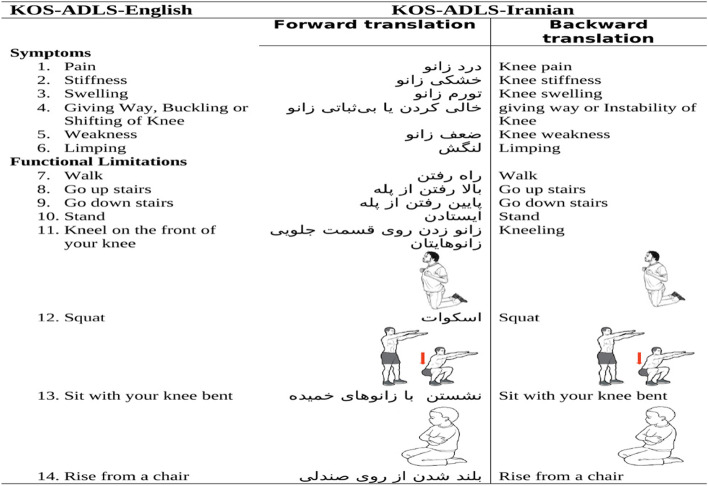
Background: The present study aimed to translate and validate the Knee Outcome Survey-Activities of Daily Living Scale (KOS-ADLS) in Iran.
Methods: Following standard forward and backward translation procedure, content and face validity were tested by specialists and a sample of 32 patients. Then, in a cross sectional study, a sample of patients with knee disorders, recruited through simple sampling, completed the KOS-ADLS and the Short-Form Health Survey (SF-36) in their first visit to physiotherapy clinics in Tehran. Regarding construct validity, the Spearman's correlation (rs) and one-way ANOVA were employed to evaluate the correlations between the Persian KOS-ADLS and SF-36 subscales (convergent validity) and known groups comparison, respectively. Test-retest reliability and internal consistency were evaluated by intraclass correlation coefficient (ICC) and the Cronbach's α coefficient.
Results: In total 101 patients were included in the study. The mean age of patients was 42.39 (SD = 9.2). The finding indicated that the KOS-ADLS had strong correlations with SF-36 physical functioning, bodily pain subscales, and also physical component summary while it had lower correlations with other subscales of the SF-36 as expected. The KOS-ADLS was able to differentiate between the subgroups of patients who differed in BMI. The acceptable level of intraclass correlation coefficient (ICC = 0.91) and Cronbach's α coefficient (α = 0.91) was obtained for the Persian KOS-ADLS. Also no floor and ceiling effects were observed for the questionnaire.
Conclusions: The Persian version of KOS-ADLS was found to be a reliable and valid outcome measure for assessing daily living activities in patients who suffer from knee pathological conditions.
Keywords: ADLS; Cross-cultural adaptation; Knee outcome survey; Persian version; Reliability; Validation.
© 2023. BioMed Central Ltd., part of Springer Nature.
Conflict of interest statement
The authors declare no competing interests.
Figures
References
-
- Szczepanik M, Bejer A, Snela S, Szymczyk D, Jabłoński J, Majewska J, et al. Polish cross-cultural adaptation and validation of the knee outcome survey activities of daily living scale (KOS-ADLS) in patients undergoing total knee arthroplasty. Med Sci Monit. 2018;24:5309. doi: 10.12659/MSM.908094. - DOI - PMC - PubMed
-
- Bellamy N, Buchanan WW, Goldsmith CH, Campbell J, Stitt LW. Validation study of WOMAC: a health status instrument for measuring clinically important patient relevant outcomes to antirheumatic drug therapy in patients with osteoarthritis of the hip or knee. J Rheumatol. 1988;15(12):1833–1840. - PubMed
Publication types
MeSH terms
LinkOut - more resources
Full Text Sources
