


High-intensity walking in midlife is associated with improved memory in physically capable older adults
- PMID: 37644550
- PMCID: PMC10463890
- DOI: 10.1186/s13195-023-01293-8
High-intensity walking in midlife is associated with improved memory in physically capable older adults
Abstract
Background: Little is known about the associations of midlife- and late life-initiated walking with Alzheimer's disease (AD)-related cognitive decline in humans. We aimed to investigate whether high-intensity, prolonged, midlife-initiated walking is associated with changes in AD-related cognitive decline in physically capable older adults.
Methods: We studied 188 physically capable participants aged 65-90 years without dementia who underwent comprehensive clinical assessment, including of their walking modality (i.e., intensity, duration, midlife- or late life-onset), memory- or non-memory and total cognitive performance, and blood or nutritional biomarkers.
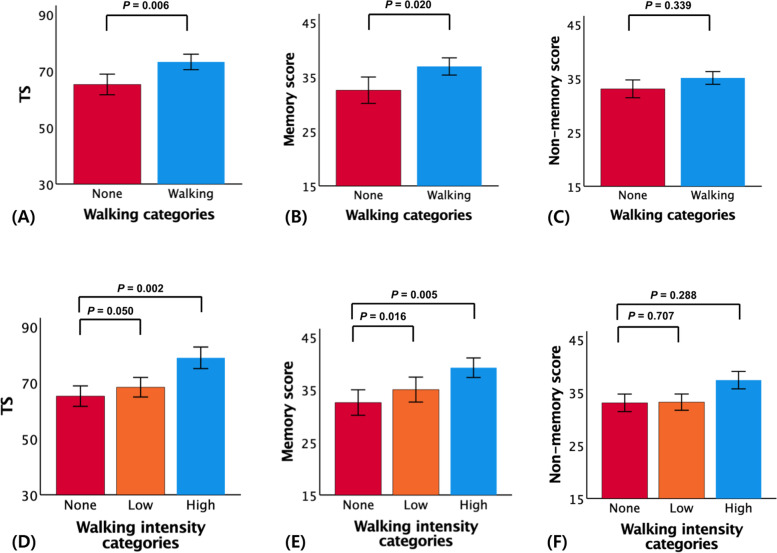
Results: The walking group showed better episodic memory (B = 2.852, SE = 1.214, β = 0.144, p = 0.020), but not non-memory cognition, than the non-walking group. High-intensity walking starting in midlife was significantly associated with better episodic memory (B = 9.360, SE = 3.314, β = 0.446, p = 0.005) compared to the non-walking group. In contrast, there were no differences in cognition according to walking duration, regardless of the onset time. The walking group also showed a similar association with overall cognition.
Conclusions: Among physically capable older adults without dementia, walking, particularly at high intensity and starting in midlife, is associated with improved episodic memory, an AD-related cognitive domain. Further attention should be paid to the role of walking in terms of AD prevention.
Keywords: Alzheimer’s disease; Intensity; Memory; Midlife-initiated; Walking.
© 2023. BioMed Central Ltd., part of Springer Nature.
Conflict of interest statement
The authors declare no competing interests.
Figures
References
-
- Hardy J, Selkoe DJ. The amyloid hypothesis of Alzheimer’s disease: progress and problems on the road to therapeutics. Science. 2002;297(5580):353–356. - PubMed
-
- Howieson DB, Dame A, Camicioli R, Sexton G, Payami H, Kaye JA. Cognitive markers preceding Alzheimer’s dementia in the healthy oldest old. J Am Geriatr Soc. 1997;45(5):584–589. - PubMed
-
- Backman L, Small BJ, Fratiglioni L. Stability of the preclinical episodic memory deficit in Alzheimer’s disease. Brain. 2001;124(Pt 1):96–102. - PubMed
-
- Backman L, Jones S, Berger AK, Laukka EJ, Small BJ. Cognitive impairment in preclinical Alzheimer’s disease: a meta-analysis. Neuropsychology. 2005;19(4):520–531. - PubMed
Publication types
MeSH terms
Substances
LinkOut - more resources
Full Text Sources
Medical
