Two-dimensional shear wave elastography (ElastQ) accurately rules out liver fibrosis and rules in advanced chronic liver disease across liver disease etiologies: a prospective multicenter study
- PMID: 37644806
- PMCID: PMC10555684
- DOI: 10.14366/usg.23069
Two-dimensional shear wave elastography (ElastQ) accurately rules out liver fibrosis and rules in advanced chronic liver disease across liver disease etiologies: a prospective multicenter study
Abstract
Purpose: This study evaluated ElastQ, a two-dimensional shear wave elastography (2D-SWE) technique, for the non-invasive assessment of liver fibrosis risk using liver stiffness measurement (LSM). The aim was to determine its diagnostic accuracy and establish LSM cutoffs for clinical risk stratification.
Methods: A prospective multicenter study was conducted, employing vibration-controlled transient elastography (VCTE) as a reference standard. The statistical analysis utilized Pearson correlations and Lin concordance correlation coefficients, diagnostic areas under the curve (AUCs), and 90%-specific rule-in and 90%-sensitive rule-out ElastQ cutoffs.
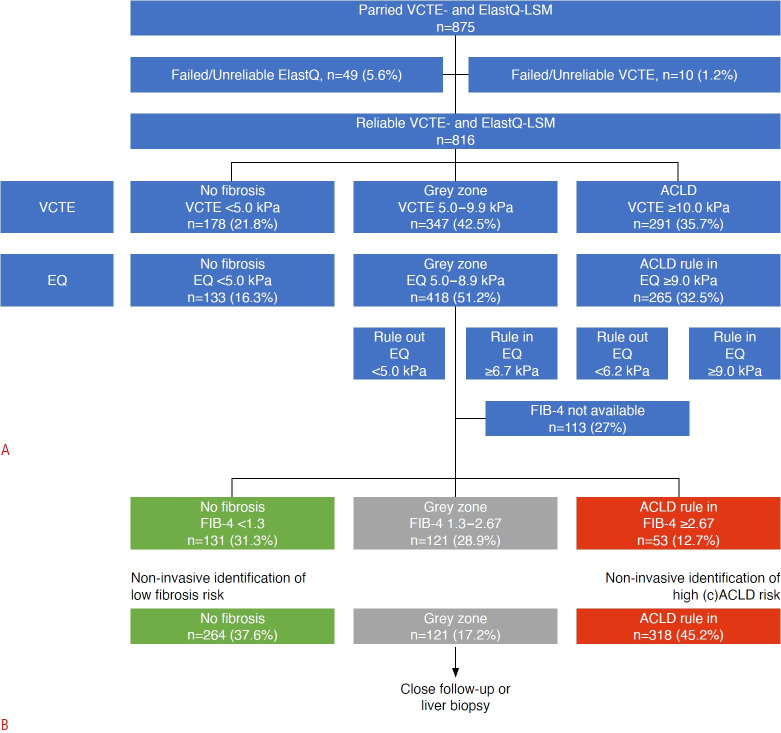
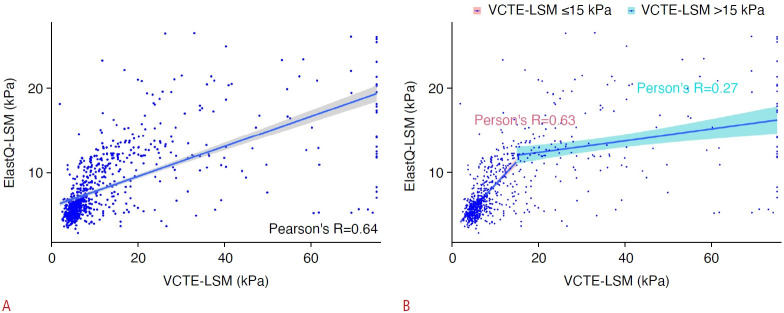
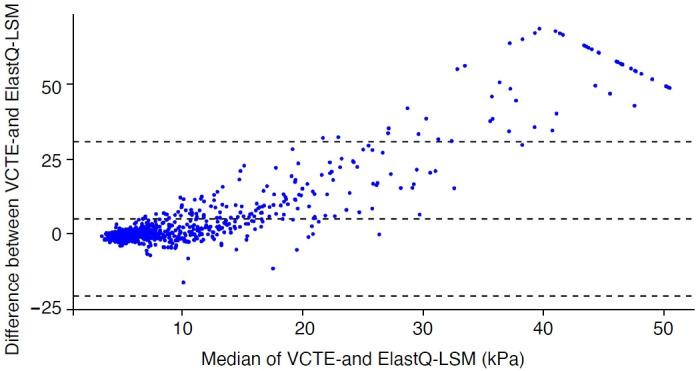
Results: The study included 875 patients at risk for liver disease, of whom 816 (376 women, 46.1%; median age, 57.0 years [interquartile range, 19.0]) had successful and reliable VCTE- and ElastQ-LSMs. The median LSM was 13.0 kPa (range, 2.0 to 75.0 kPa) for VCTE and 6.6 kPa (range, 2.9 to 26.5 kPa) for ElastQ. The correlation between VCTE-LSM and ElastQ-LSM was adequate for VCTE-LSM <15 kPa (Pearson r=0.63) but lower for VCTE-LSM ≥15.0 kPa (Pearson r=0.27). VCTE-LSM indicated no fibrosis risk (<5.0 kPa) in 178 cases (21.8%), gray zone (5.0-9.9 kPa) in 347 cases (42.5%), and advanced chronic liver disease (ACLD; ≥10.0 kPa) in 291 cases (35.7%). The diagnostic AUC for ElastQ-LSM was 0.82 for fibrosis risk and 0.90 for ACLD. The clinically relevant ElastQ cutoffs for ruling out fibrosis risk and ruling in compensated ACLD (cACLD) were <5.0 kPa and ≥9.0 kPa, respectively.
Conclusion: ElastQ 2D-SWE enables accurate, non-invasive assessments of liver fibrosis and cACLD risk. In clinical practice, ElastQ-LSM <5.0 kPa rules out fibrosis, while ElastQ-LSM ≥9.0 kPa rules in cACLD.
Keywords: Compensated advanced chronic liver disease; Non-invasive, chronic liver disease; Two-dimensional shear wave elastography; Ultrasound.
Conflict of interest statement
DB served as a speaker and/or consultant and/or advisory board member for AbbVie and Siemens, received travel support from AbbVie and Gilead, and received grant support form Siemens and Gilead. ADS, RM, LM, AR, GS: nothing declared. MM served as a speaker and/or consultant and/or advisory board member for AbbVie, Bristol-Myers Squibb, Gilead, Collective Acumen, and W. L. Gore & Associates and received travel support from AbbVie, BristolMyers Squibb, and Gilead. IS served as speaker for AbbVie, BMS, Gilead, Janssen, Echosens, and Philips; received advisory board fees from AbbVie, Merck; Siemens, Canon, and Toshiba; and received research support from Philips. GF served as a speaker for Canon Medical Systems, Fujifilm Medical Systems, Mindray Medical Systems, Philips Ultrasound, and Siemens Healthineers and as an advisory board member for Philips Ultrasound and Siemens Healthineers. TR served as a speaker and/or consultant and/or advisory board member for AbbVie, Bayer, Boehringer Ingelheim, Gilead, Intercept, MSD, Siemens, and W. L. Gore & Associates and received grants/ research support from AbbVie, Boehringer Ingelheim, Gilead, MSD, Philips, and W. L. Gore & Associates as well as travel support from Boehringer Ingelheim and Gilead.
Figures
References
-
- Asrani SK, Devarbhavi H, Eaton J, Kamath PS. Burden of liver diseases in the world. J Hepatol. 2019;70:151–171. - PubMed
-
- Stift J, Semmler G, Walzel C, Mandorfer M, Schwarzer R, Schwabl P, et al. Transjugular aspiration liver biopsy performed by hepatologists trained in HVPG measurements is safe and provides important diagnostic information. Dig Liver Dis. 2019;51:1144–1151. - PubMed
-
- Bedossa P, Carrat F. Liver biopsy: the best, not the gold standard. J Hepatol. 2009;50:1–3. - PubMed
LinkOut - more resources
Full Text Sources