A Mixed-Methods Implementation Evaluation of Virtual Reality Job Interview Training in IPS Supported Employment
- PMID: 37644829
- PMCID: PMC10902191
- DOI: 10.1176/appi.ps.20230023
A Mixed-Methods Implementation Evaluation of Virtual Reality Job Interview Training in IPS Supported Employment
Abstract
Objective: Employment rates among individuals with serious mental illness may be improved by engagement in the individual placement and support (IPS) model of supported employment. Results from a recent randomized controlled trial (RCT) indicate that virtual reality job interview training (VR-JIT) improves employment rates among individuals with serious mental illness who have been actively engaged in IPS for at least 90 days. This study reports on an initial implementation evaluation of VR-JIT during the RCT in a community mental health agency.
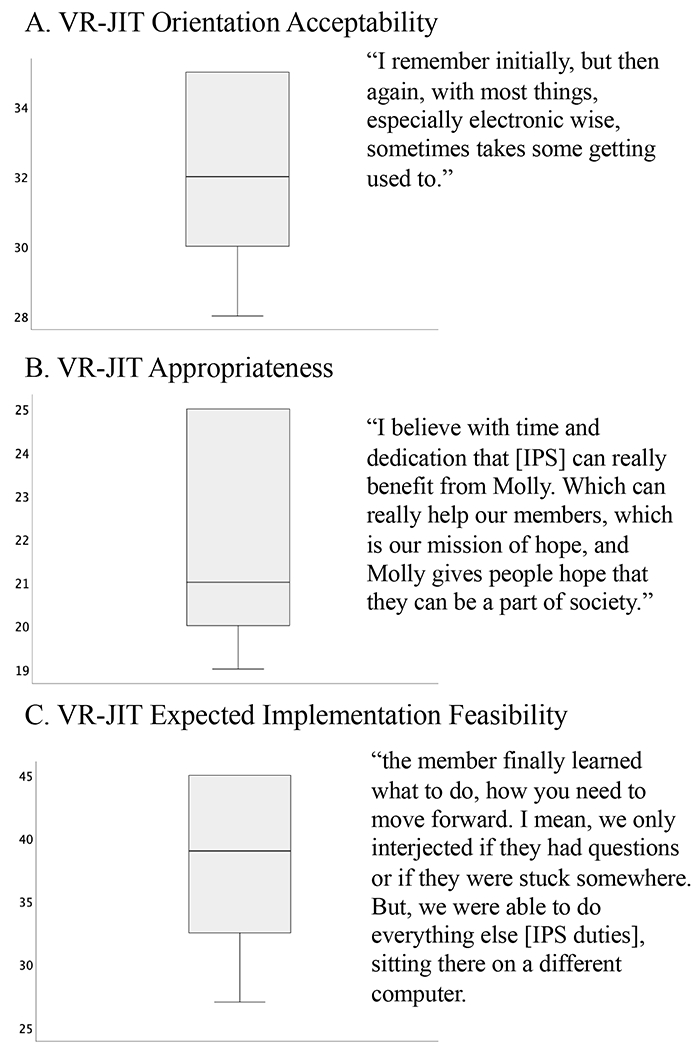
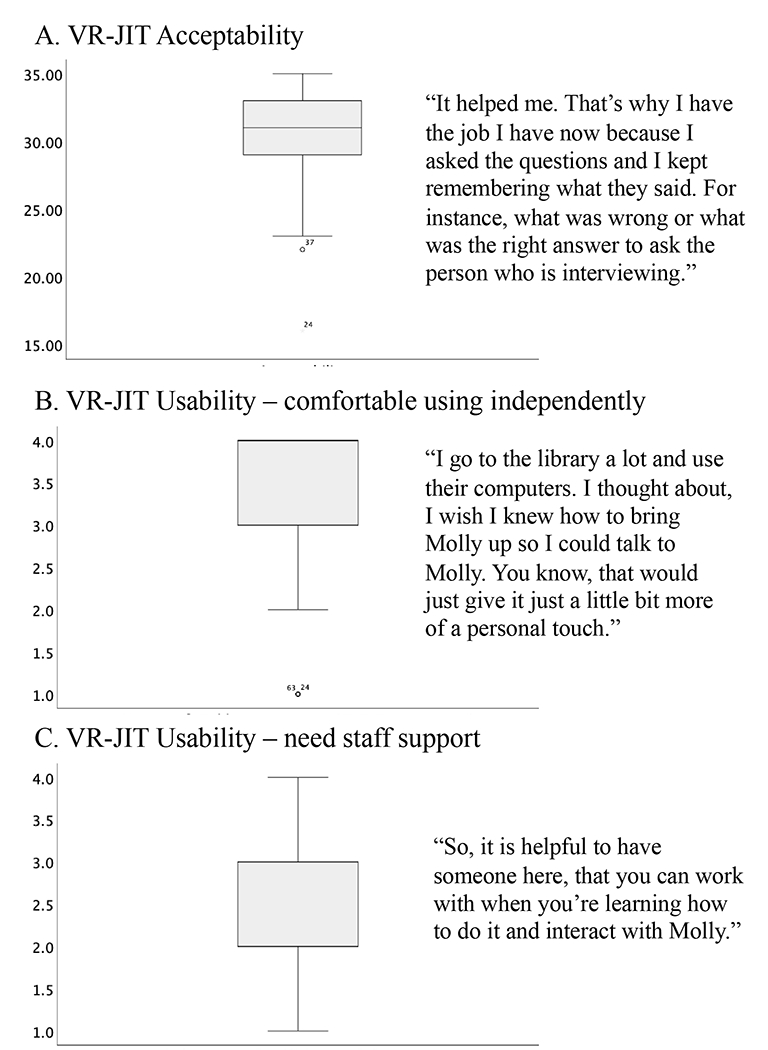
Methods: A sequential, complementary mixed-methods design included use of qualitative data to improve understanding of quantitative findings. Thirteen IPS staff trained to lead VR-JIT implementation completed VR-JIT acceptability, appropriateness, and feasibility surveys. Participants randomly assigned to IPS with VR-JIT completed acceptability (N=42) and usability (N=28) surveys after implementation. The authors also conducted five focus groups with IPS staff (N=11) and VR-JIT recipients (N=13) and semistructured interviews with IPS staff (N=9) and VR-JIT recipients (N=4), followed by an integrated analysis process.
Results: Quantitative results suggest that IPS staff found VR-JIT to be highly acceptable, appropriate for integration with IPS, and feasible for delivery. VR-JIT was highly acceptable to recipients. Qualitative results add important context to the quantitative findings, including benefits of VR-JIT for IPS staff as well as adaptations for delivering technology-based interventions to individuals with serious mental illness.
Conclusions: These qualitative and quantitative findings are consistent with each other and were influenced by VR-JIT's adaptability and perceived benefits. Tailoring VR-JIT instruction and delivery to individuals with serious mental illness may help optimize VR-JIT implementation within IPS.
Keywords: Bipolar disorder; Community mental health services; Psychiatric rehabilitation; Schizophrenia; Virtual job interview training.
Conflict of interest statement
The data reported in this manuscript were collected as part of a trial evaluating the original version of virtual reality job interview training.Dr. M. J. Smith reports receiving royalty payments from SIMmersion L.L.C. for a youth-focused version of the virtual job interview intervention and receiving speaker honoraria for invited presentations from Hartford Healthcare, Ohio State University, Rush University, Virginia Commonwealth University, Boston University, University of Utah, and The Help Group. The other authors report no financial relationships with commercial interests.
Figures
References
-
- Drake RE, Bond GR, & Becker DR (2012). IPS Supported Employment: An Evidence-Based Approach. New York: Oxford University Press.
-
- Alpine DD, & Alang SM (2021). Employment and economic outcomes of persons with mental illness and disability: The impact of the Great Recession in the United States. Psychiatr Rehabil J, 44(2), 132–141. - PubMed
-
- Healthy People 2030. Rockville, MD, United States Department of Health and Human Services, Office of Disease Prevention and Health Promotion, 2020. https://health.gov/healthypeople/objectives-and-data/social-determinants...
MeSH terms
Grants and funding
LinkOut - more resources
Full Text Sources