


Prevalence and influencing factors of fatigue among patients undergoing continuous ambulatory peritoneal dialysis: A cross-sectional study
- PMID: 37645579
- PMCID: PMC10461161
- DOI: 10.33546/bnj.2715
Prevalence and influencing factors of fatigue among patients undergoing continuous ambulatory peritoneal dialysis: A cross-sectional study
Abstract
Background: Fatigue is one of the most commonly reported symptoms among patients undergoing continuous ambulatory peritoneal dialysis (CAPD). However, only a few studies have addressed the prevalence of fatigue and its influencing factors within this population in Thailand.
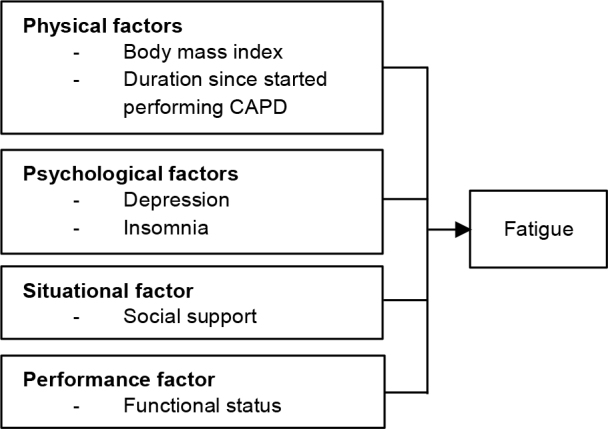
Objective: This study aimed to explore the prevalence of fatigue and its influencing factors, including duration of CAPD initiation, body mass index, insomnia, social support, functional status, and depression among patients undergoing CAPD.
Methods: This cross-sectional study involved 136 participants from the outpatient department of a general hospital in Thailand. Data were collected from January to March 2023, utilizing validated self-reported questionnaires, which included the Center for Epidemiologic Study Depression Scale, Insomnia Severity Index, Multidimensional Scale of Perceived Social Support, Functional Status Scale, and Fatigue Severity Scale. Data were analyzed using descriptive statistics, Pearson's product-moment correlation, and Stepwise multiple regressions.
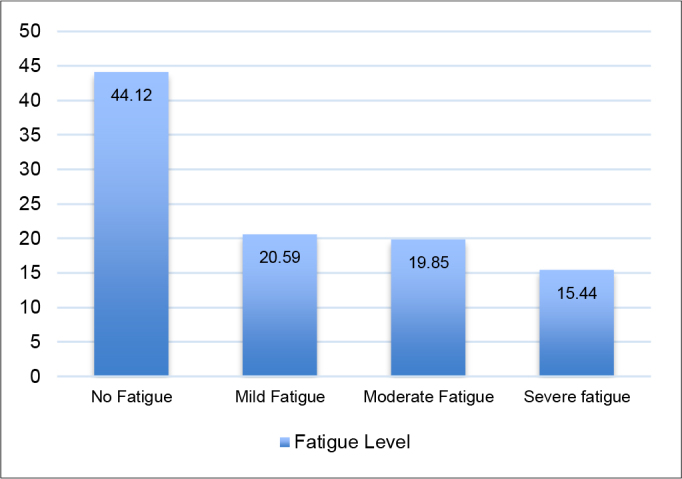
Results: The study achieved a 100% participation rate among the selected participants. The prevalence of fatigue among patients undergoing CAPD was 55.88%, including mild fatigue (20.59%), moderate fatigue (19.85%), and severe fatigue (15.44%). Bivariate analysis indicated that fatigue-related factors were insomnia, depression, body mass index, social support, and functional status. However, the multiple regression analysis revealed that only insomnia (β = 0.399, p <0.001), social support (β = -0.302, p <0.001), depression (β = 0.201, p = 0.003), and functional status (β = -0.149, p = 0.021) jointly influenced fatigue among patients undergoing CAPD, explaining 50.10 percent of the variance (R2 = 0.501, F(4, 131) = 32.871, p <0.001).
Conclusion: The findings indicated that more than half of the participants experienced fatigue. Insomnia, social support, depression, and functional status emerged as significant predictive factors of fatigue. Therefore, it is advisable for nurses and other healthcare providers to evaluate fatigue and its associated factors routinely. Nursing interventions to alleviate fatigue should prioritize improvements in sleep quality, reduction of depression, preservation of functional status, and promotion of family engagement.
Keywords: Thailand; body mass index; continuous ambulatory peritoneal dialysis; depression; fatigue; functional status; insomnia; social support.
© The Author(s) 2023.
Conflict of interest statement
The authors declared no potential conflict of interest in this study.
Figures
References
-
- Abd-Rabouh, M., Abd Elhameed, S., & Shebl, A. (2017). Relationship between fatigue and functional status of the elderly patients on Hemodialysis. Mansoura Nursing Journal, 4(2), 83-96. 10.21608/mnj.2017.149622 - DOI
-
- Avdal, E. U., Ayvaz, İ., Uran, B. N. Ö., Yildirim, J. G., Sofulu, F., & Pamuk, G. (2020). Opinions of hemodialysis and peritoneum patients regarding depression and psychological problems which they experience: A qualitative study. Journal of Infection and Public Health, 13(12), 1988-1992. 10.1016/j.jiph.2020.02.041 - DOI - PubMed
-
- Bagheri-Nesami, M., Shorofi, S. A., Nikkhah, A., Espahbodi, F., & Koolaee, F.-S. G. (2016). The effects of aromatherapy with lavender essential oil on fatigue levels in haemodialysis patients: A randomized clinical trial. Complementary Therapies in Clinical Practice, 22, 33-37. 10.1016/j.ctcp.2015.12.002 - DOI - PubMed
LinkOut - more resources
Full Text Sources