This is a preprint.
Role of the exercise professional in metabolic and bariatric surgery
- PMID: 37645986
- PMCID: PMC10462198
- DOI: 10.1101/2023.04.20.23288698
Role of the exercise professional in metabolic and bariatric surgery
Update in
-
Role of the exercise professional in metabolic and bariatric surgery.Surg Obes Relat Dis. 2024 Jan;20(1):98-108. doi: 10.1016/j.soard.2023.09.026. Epub 2023 Sep 27. Surg Obes Relat Dis. 2024. PMID: 38238107 Free PMC article. Review.
Abstract
Background: Physical activity (PA) is important for the long-term health and weight management of patients who undergo metabolic and bariatric surgery (MBS). However, the roles of exercise professionals in MBS settings have not been systematically determined.
Objectives: To investigate: (1) who are the professionals implementing PA programming in MBS clinical settings; and (2) what patient-centric tasks do they perform?
Setting: Clinical and academic exercise settings worldwide.
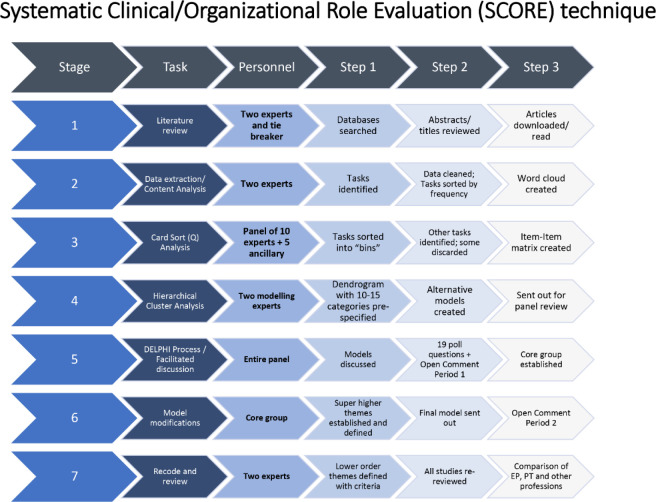
Methods: This multimethod study included a scoping review of PA programs in MBS described in the research literature. Data about job tasks were extracted and provided to 10 experts to sort into categories. Cluster analysis was utilized to find the hierarchical structure of tasks. A Delphi process was used to agree on a final model.
Results: The majority of PA professionals were exercise physiologists in the USA and physiotherapists or other types of exercise professionals elsewhere. Forty-three tasks were identified, the most reported being: supervision of exercise, fitness testing, and exercise prescription. Seven higher-order categories were determined: (1) Exercise-related health assessment, (2) Body composition and physical fitness assessment, (3) Lifestyle physical activity and sedentary behavior assessment, (4) Education, instruction, and prescription, (5) Exercise monitoring, (6) Behavioral counseling and psychosocial support, and (7) Dietary support. The following statements were rated an average of 9.0, classifying them as "imperative": 1) "Pre- and post-operative PA/exercise guidelines for MBS patients are needed", 2) "MBS programs need to include PA/exercise as part of multidisciplinary care".
Conclusions: The expert group reached a consensus on 7 major classifications of job tasks for the exercise professional. It is important for governing medical associations across the world to formally recognize experienced exercise professionals as playing pivotal roles in continuing, multidisciplinary care for MBS patients. These findings also provide evidence-based information in the effort to solidify these positions within the greater context of healthcare.
Keywords: Metabolic and bariatric surgery; exercise prescription; implementation; mixed methods; physical activity; qualitative.
Conflict of interest statement
COMPETING INTERESTS None
Figures

References
-
- Grover BT, Morell MC, Kothari SN, Borgert AJ, Kallies KJ, Baker MT. Defining Weight Loss After Bariatric Surgery: a Call for Standardization. Obesity Surgery. 2019;29(11):3493–9. - PubMed
-
- Garber CE. The Health Benefits of Exercise in Overweight and Obese Patients. Curr Sports Med Rep. 2019;18(8):287–91. - PubMed
-
- Johnson NA, Sultana RN, Brown WJ, Bauman AE, Gill T. Physical activity in the management of obesity in adults: A position statement from Exercise and Sport Science Australia. Journal of Science and Medicine in Sport. 2021;24(12):1245–54. - PubMed
-
- Herring LY, Stevinson C, Carter P, et al. The effects of supervised exercise training 12–24 months after bariatric surgery on physical function and body composition: A randomised controlled trial. Int J Obes (Lond). 2017;41(6):909–16. - PubMed
Publication types
Grants and funding
LinkOut - more resources
Full Text Sources