


Prognostic Impact of Mitral Regurgitation Before and After Transcatheter Aortic Valve Replacement in Patients With Severe Low-Flow, Low-Gradient Aortic Stenosis
- PMID: 37646211
- PMCID: PMC10547324
- DOI: 10.1161/JAHA.123.029553
Prognostic Impact of Mitral Regurgitation Before and After Transcatheter Aortic Valve Replacement in Patients With Severe Low-Flow, Low-Gradient Aortic Stenosis
Abstract
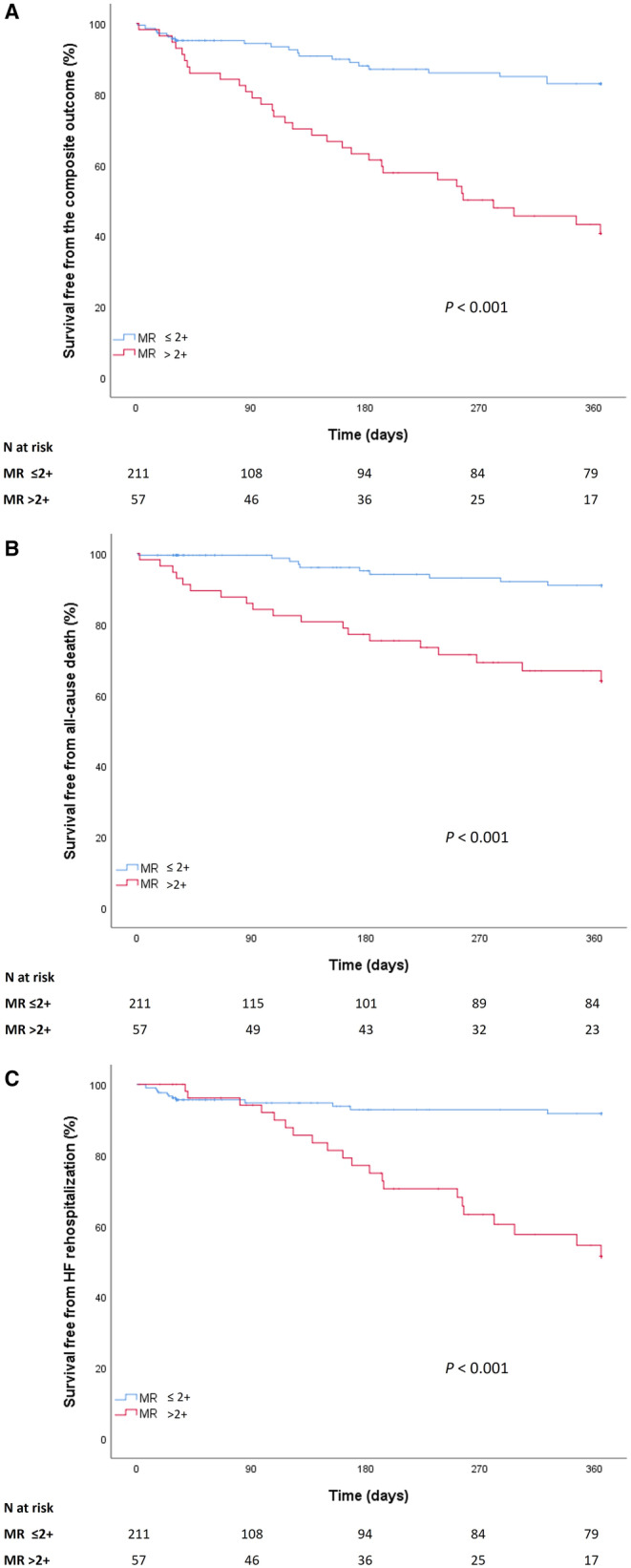
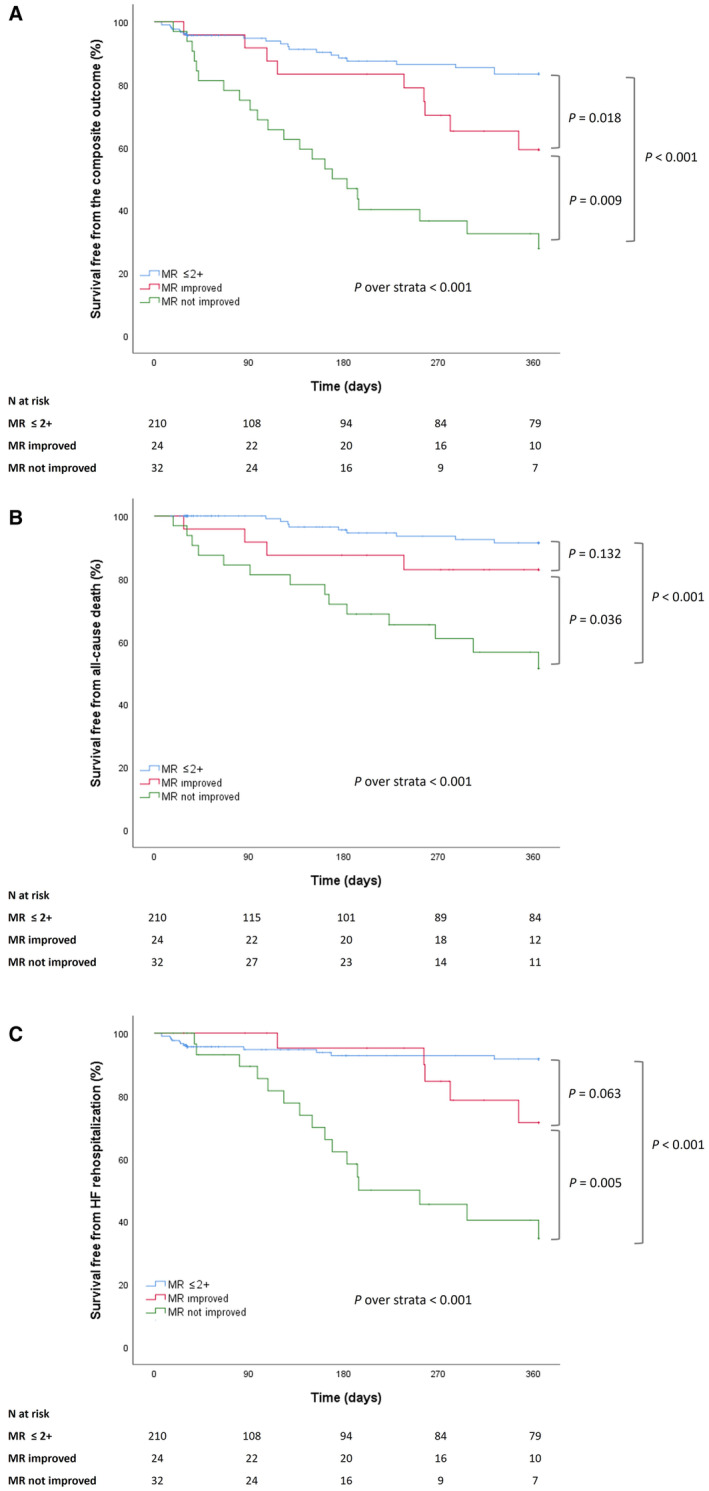
Background There is little evidence about the prognostic role of mitral regurgitation (MR) in patients with low-flow, low-gradient aortic stenosis undergoing transcatheter aortic valve replacement (TAVR). The aim of this study was to assess the prevalence and outcome implications of MR severity in patients with low-flow, low-gradient aortic stenosis undergoing TAVR, and to evaluate whether MR improvement after TAVR could influence clinical outcome. Methods and Results This study included consecutive patients with low-flow, low-gradient aortic stenosis undergoing TAVR at 2 Italian high-volume centers. The study population was categorized according to the baseline MR severity and to the presence of MR improvement at discharge. The primary outcome was the composite of all-cause death and hospitalization for worsening heart failure up to 1 year. The study included 268 patients; 57 (21%) patients showed MR >2+. Patients with MR >2+ showed a lower 1-year survival free from the primary outcome (P<0.001), all-cause death (P<0.001), and heart failure hospitalization (P<0.001) compared with patients with MR ≤2+. At multivariable analysis, baseline MR >2+ was an independent predictor of the primary outcome (P<0.001). Among patients with baseline MR >2+, MR improvement was reported in 24 (44%) cases after TAVR. The persistence of MR was associated with a significantly reduced survival free from the primary outcome, all-cause death, and heart failure hospitalization up to 1 year. Conclusions In this study, the presence of moderately severe to severe MR in patients with low-flow, low-gradient aortic stenosis undergoing TAVR portends a worse clinical outcome at 1 year. TAVR may improve MR severity in nearly half of the patients, resulting in a potential outcome benefit after discharge.
Keywords: clinical outcome; mitral insufficiency; transcatheter aortic valve implantation.
Figures
Comment in
-
Residual Mitral Regurgitation After Transcatheter Aortic Valve Replacement: An Important Target for Intervention.J Am Heart Assoc. 2023 Sep 5;12(17):e031400. doi: 10.1161/JAHA.123.031400. Epub 2023 Aug 30. J Am Heart Assoc. 2023. PMID: 37646206 Free PMC article. No abstract available.
Similar articles
-
Mitral Regurgitation in Low-Flow, Low-Gradient Aortic Stenosis Patients Undergoing TAVR: Insights From the TOPAS-TAVI Registry.JACC Cardiovasc Interv. 2020 Mar 9;13(5):567-579. doi: 10.1016/j.jcin.2019.11.042. Epub 2020 Feb 12. JACC Cardiovasc Interv. 2020. PMID: 32061600
-
Degenerative mitral regurgitation predicts worse outcomes in patients undergoing transcatheter aortic valve replacement.Catheter Cardiovasc Interv. 2018 Sep 1;92(3):574-582. doi: 10.1002/ccd.27607. Epub 2018 Mar 30. Catheter Cardiovasc Interv. 2018. PMID: 29602220
-
Impact on Outcome of Different Mechanisms, Baseline Degree and Changes of Mitral Regurgitation in Patients With Aortic Stenosis Who Underwent Transcatheter Aortic Valve Replacement.J Am Heart Assoc. 2024 Jul 16;13(14):e033125. doi: 10.1161/JAHA.123.033125. Epub 2024 Jul 9. J Am Heart Assoc. 2024. PMID: 38979804 Free PMC article.
-
Managing the patient undergoing transcatheter aortic valve replacement with ongoing mitral regurgitation.Expert Rev Cardiovasc Ther. 2021 Aug;19(8):711-723. doi: 10.1080/14779072.2021.1955347. Epub 2021 Jul 30. Expert Rev Cardiovasc Ther. 2021. PMID: 34275408 Review.
-
Does the Presence of Significant Mitral Regurgitation prior to Transcatheter Aortic Valve Implantation for Aortic Stenosis Impact Mortality? - Meta-Analysis and Systematic Review.Cardiology. 2020;145(7):428-438. doi: 10.1159/000506624. Epub 2020 May 27. Cardiology. 2020. PMID: 32460301
Cited by
-
Mitral Annular Calcification-Related Valvular Disease: A Challenging Entity.J Clin Med. 2024 Feb 3;13(3):896. doi: 10.3390/jcm13030896. J Clin Med. 2024. PMID: 38337590 Free PMC article. Review.
-
Prevalence and Prognostic Significance of Right Ventricular Dysfunction in Patients With Severe Low-Flow, Low-Gradient Aortic Stenosis Undergoing Transcatheter Aortic Valve Replacement.J Am Heart Assoc. 2024 Nov 5;13(21):e036239. doi: 10.1161/JAHA.124.036239. Epub 2024 Nov 4. J Am Heart Assoc. 2024. PMID: 39494566 Free PMC article.
-
Severe Mitral Regurgitation in Paradoxical Low-Flow, Low-Gradient Severe Aortic Stenosis.Circ Cardiovasc Imaging. 2025 May;18(5):e017598. doi: 10.1161/CIRCIMAGING.124.017598. Epub 2025 Mar 21. Circ Cardiovasc Imaging. 2025. PMID: 40116009 Free PMC article.
-
Natural History of Mitral Regurgitation After Transcatheter Aortic Valve Implantation.Ann Thorac Surg. 2025 Jul;120(1):41-49. doi: 10.1016/j.athoracsur.2024.09.008. Epub 2024 Sep 24. Ann Thorac Surg. 2025. PMID: 39322054 Free PMC article.
-
Increase in Aortic Valve Mean Gradients One Day After Transcatheter Aortic Valve Implantation: The Role of Mitral Regurgitation.Cardiol Res. 2025 Jul 28;16(4):312-320. doi: 10.14740/cr2086. eCollection 2025 Aug. Cardiol Res. 2025. PMID: 40809727 Free PMC article.
References
-
- Iung B, Delgado V, Rosenhek R, Price S, Prendergast B, Wendler O, De Bonis M, Tribouilloy C, Evangelista A, Bogachev‐Prokophiev A, et al. Contemporary presentation and management of valvular heart disease: the EURObservational Research Programme Valvular Heart Disease II Survey. Circulation. 2019;140:1156–1169. doi: 10.1161/circulationaha.119.041080 - DOI - PubMed
-
- Otto CM, Nishimura RA, Bonow RO, Carabello BA, Erwin JP III, Gentile F, Jneid H, Krieger EV, Mack M, McLeod C, et al. 2020 ACC/AHA guideline for the management of patients with valvular heart disease: a report of the American College of Cardiology/American Heart Association Joint Committee on Clinical Practice Guidelines. Circulation. 2021;143:e72–e227. doi: 10.1161/CIR.0000000000000923 - DOI - PubMed
MeSH terms
LinkOut - more resources
Full Text Sources
Medical
