


Incidence and Outcomes of Aneurysmal Subarachnoid Hemorrhage: A Multicenter Retrospective Registry-based Descriptive Trial in Kobe City
- PMID: 37648538
- PMCID: PMC10725825
- DOI: 10.2176/jns-nmc.2023-0090
Incidence and Outcomes of Aneurysmal Subarachnoid Hemorrhage: A Multicenter Retrospective Registry-based Descriptive Trial in Kobe City
Abstract
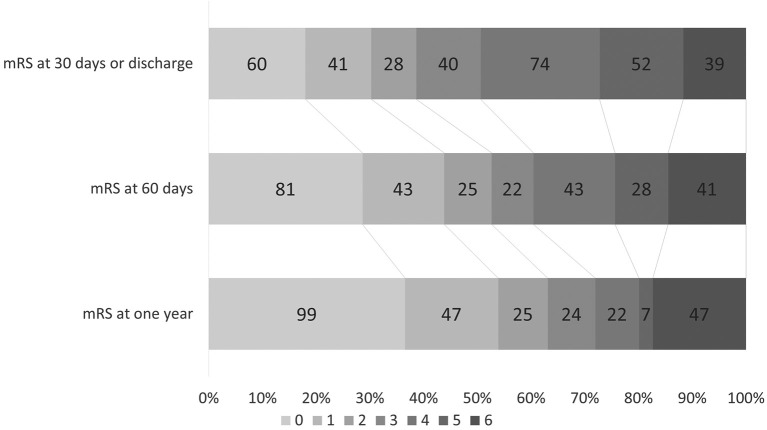
The current study aims to evaluate the incidence and results of aneurysmal subarachnoid hemorrhage (aSAH) throughout Kobe City. Based on a multicenter retrospective registry-based descriptive trial involving all 13 primary stroke centers in Kobe City, patients with aSAH treated between October 2017 and September 2019 were studied. A total of 334 patients were included, with an estimated age-adjusted incidence of 11.12 per 100,000 person-years. Curative treatment was given to 94% of patients, with endovascular treatment (51%) preferred over surgical treatment (43%). Of the patients, 12% were treated by shunt surgery for sequential hydrocephalus with a worse outcome at 30 days or discharge (14% vs. 46%, odds ratio (OR): 0.19, 95% confidence interval (CI): 0.088-0.39, p-value <0.001). As for vasospasm and delayed cerebral ischemia, most patients were given intravenous fasudil infusion (73%), with endovascular treatment for vasospasm in 24 cases (7.2%). The fasudil group had more good outcomes (42% vs. 30%, OR: 1.64, 95% CI: 0.95-2.87, p-value = 0.075) and significantly less death (3.3% vs. 35%, OR: 0.064, 95% CI: 0.024-0.15, p-value <0.001) at 30 days or discharge. Mortality rose from 12% at 30 days or discharge to 17% at 1 year, but neurological function distribution improved over time (modified Rankin Scale 0-2 was 39% at 30 days or discharge, 53% at 60 days, and 63% at 1 year). Our retrospective registered trial presented various statistics on aSAH, summarizing the current treatment status and prognosis.
Keywords: hydrocephalus; intracranial aneurysm; intracranial vasospasm; prognosis; subarachnoid hemorrhage.
Conflict of interest statement
Dr. Ohta has received lecturer's fees from Medtronic Japan, Daiichi Sankyo, Johnson & Johnson, Terumo, Stryker Japan, Tokai Medical, Otsuka, Takeda, Eisai, Kaneka, Bristol-Myers Squibb, AstraZeneca, Japan Lifeline, Kowa, Nipro, Century Medical, and Idorsia outside of the submitted work.
Dr. Imamura has received lecturer's fees from Medtronic Japan, Daiichi Sankyo, Johnson & Johnson, Terumo, Stryker Japan, and Asahi Intecc outside of the submitted work.
Dr. Sakai has received a research grant from Biomedical Solutions, Medtronic, Terumo, and TG Medical; lecturer's fees from Asahi-Intec, Biomedical Solutions, Kaneka, Medtronic, Idorsia, and Terumo; and membership on the advisory boards for Johnson & Johnson, Medtronic, and Terumo outside the submitted work.
The other authors do not declare any conflicts of interest.
All authors have registered online self-reported COI Disclosure Statement Forms through the website for JNS members.
Figures
References
-
- Connolly ES Jr, Rabinstein AA, Carhuapoma JR, et al. : Guidelines for the management of aneurysmal subarachnoid hemorrhage: a guideline for healthcare professionals from the American Heart Association/American Stroke Association. Stroke 43: 1711-1737, 2012 - PubMed
-
- Tenny S, Boktor SW: Incidence. In: StatPearls. Treasure Island (FL): StatPearls Publishing; 2023 Jan. https://www.ncbi.nlm.nih.gov/books/NBK430746/ (Accessed Apr 14 2022)
