


Exploring health insurance and knowledge of the ovulatory cycle: evidence from Demographic and Health Surveys of 29 countries in Sub-Saharan Africa
- PMID: 37649040
- PMCID: PMC10466883
- DOI: 10.1186/s12978-023-01675-z
Exploring health insurance and knowledge of the ovulatory cycle: evidence from Demographic and Health Surveys of 29 countries in Sub-Saharan Africa
Abstract
Background: Unplanned pregnancy continues to be a major public health concern in Sub-Saharan Africa (SSA). Understanding the ovulatory cycle can help women avoid unplanned pregnancy. Though a wide range of factors for ovulatory cycle knowledge in SSA countries has not been well assessed, the influence of health insurance on ovulatory cycle knowledge is largely unknown. As a result, we set out to investigate the relationship between health insurance enrollment and knowledge of the ovulatory cycle among women of childbearing age. This study aims to investigate the relationship between health insurance enrollment and knowledge of the ovulatory cycle among women of childbearing age in sub-Saharan Africa (SSA).
Methods: Demographic and Health Surveys (DHSs) data from 29 SSA countries were analyzed. The association between health insurance and ovulatory cycle knowledge was investigated using bivariate and multivariate multilevel logistic regression models among 372,692 women of reproductive age (15-49). The findings were presented as adjusted odds ratios (AOR) with 95% confidence intervals (CI). A p-value of 0.05 was considered statistically significant.
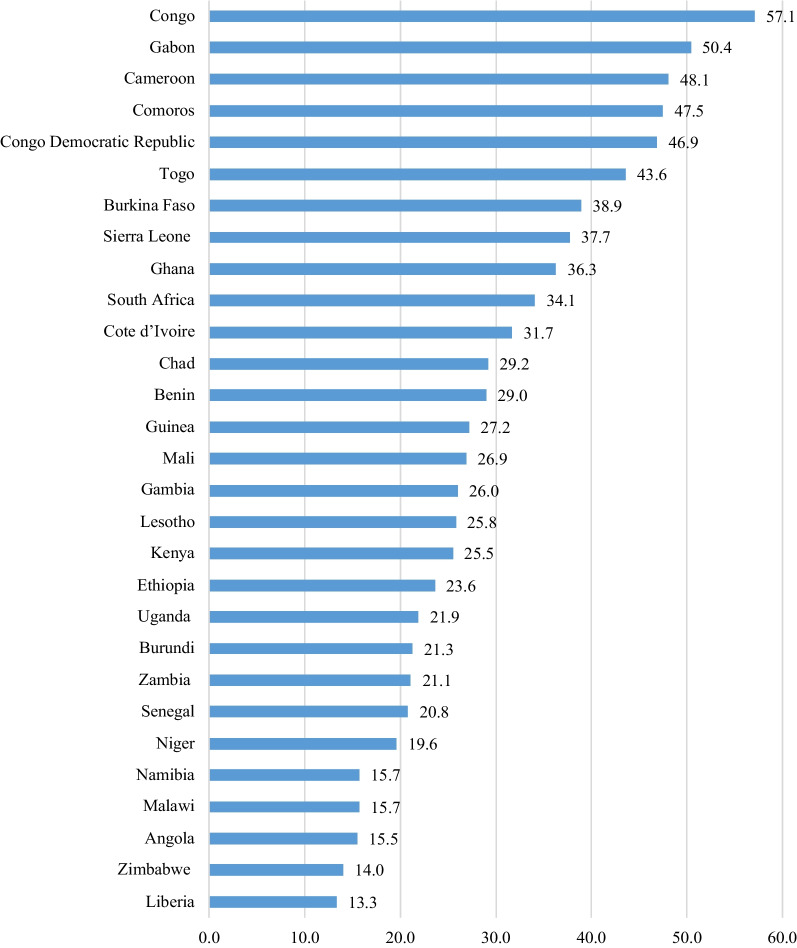
Results: The pooled result shows that the prevalence of knowledge of ovulatory cycle in the studied 29 SSA countries was 25.5% (95% CI; 24.4%-26.6%). Findings suggest higher odds of ovulatory cycle knowledge among women covered by health insurance (AOR = 1.27, 95% CI; 1.02-1.57), with higher education (higher-AOR = 2.83, 95% CI; 1.95-4.09), from the richest wealth quintile (richest-AOR = 1.39, 95% CI; 1.04-1.87), and from female headed households (AOR = 1.16, 95% CI; 1.01-1.33) compared to women who had no formal education, were from the poorest wealth quintile and belonged to male headed households, respectively. We found lower odds of ovulatory cycle knowledge among women who had 2-4 parity history (AOR = 0.80, 95% CI; 0.65-0.99) compared to those with history of one parity.
Conclusions: The findings indicate that the knowledge of the ovulatory cycle is lacking in SSA. Improving health insurance enrollment should be considered to increase ovulatory cycle knowledge as an approach to reduce the region's unplanned pregnancy rate. Strategies for improving opportunities that contribute to women's empowerment and autonomy as well as sexual and reproductive health approaches targeting women who are in poorest quintiles, not formally educated, belonging to male headed households, and having high parity should be considered.
Keywords: DHS; Global health; Health insurance; Ovulatory cycle knowledge; Sub-Sahara Africa; Women’s health.
© 2023. BioMed Central Ltd., part of Springer Nature.
Conflict of interest statement
Dr. Sanni Yaya is an Editor-in-Chief of Reproductive Health and was not involved in the peer-review or handling of the manuscript. The authors have no other competing interests to disclose.
Figures
References
-
- Hampton K, Mazza D. Fertility-awareness knowledge, attitudes and practices of women attending general practice. Aust Fam Physician. 2015;44(11):840–845. - PubMed
-
- Babbar K, Dev P. Modelling the impact of Ovulatory Cycle Knowledge on the number of children and age of women at first birth.
-
- Holesh JE, Bass AN, Lord M. Physiology, Ovulation. In: StatPearls [Internet]. Treasure Island (FL): StatPearls Publishing; 2022 [cited 2023 Mar 13]. Available from: http://www.ncbi.nlm.nih.gov/books/NBK441996/.
-
- American Pregnancy Association (ASA). American Pregnancy Association. 2022 [cited 2023 Mar 13]. What is Ovulation? Available from: https://americanpregnancy.org/getting-pregnant/infertility/understanding....
MeSH terms
LinkOut - more resources
Full Text Sources
Medical
Research Materials
