


Clinical significance of genetic profiling based on different anatomic sites in patients with mucosal melanoma who received or did not receive immune checkpoint inhibitors
- PMID: 37649078
- PMCID: PMC10469937
- DOI: 10.1186/s12935-023-03032-3
Clinical significance of genetic profiling based on different anatomic sites in patients with mucosal melanoma who received or did not receive immune checkpoint inhibitors
Abstract
Background: To date, data on the efficacy of targeted therapies for mucosal melanoma (MM) are limited. In this study, we analyzed genetic alterations according to the primary site of origin, which could provide clues for targeted therapy for MM.
Methods: We conducted a retrospective cohort study of 112 patients with MM. Targeted sequencing was performed to analyze genetic aberrations. Kaplan-Meier analysis was conducted with the log-rank test to compare the significance among subgroups.
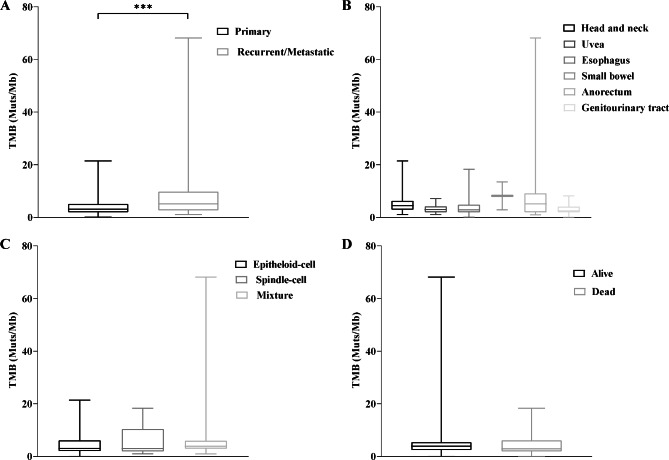
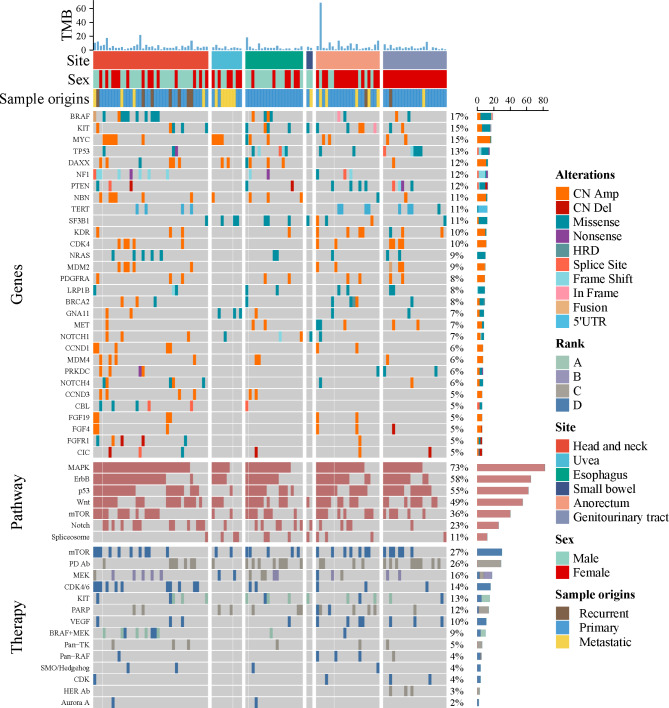
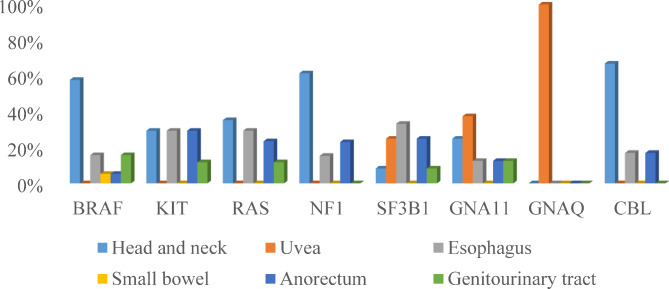
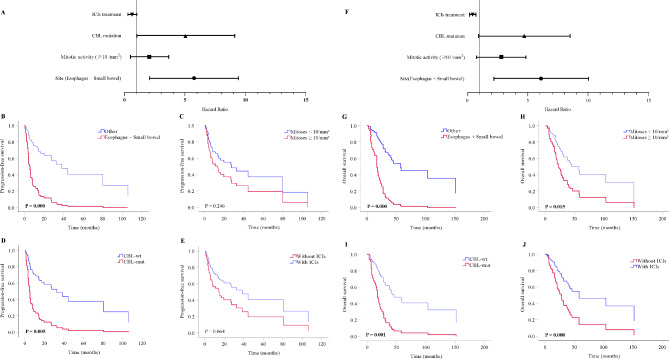
Results: In total, 112 patients with MM were included according to the anatomic sites: 38 (33.9%) in the head and neck, 22 (19.6%) in the genitourinary tract, 21 (18.8%) in the anorectum, 19 (17.0%) in the esophagus, 10 (8.9%) in the uvea, and 2 (1.8%) in the small bowel. The most significantly mutated genes included BRAF (17%), KIT (15%), RAS (15%), TP53 (13%), NF1 (12%), SF3B1 (11%), GNA11 (7%), GNAQ (5%), and FBXW7 (4%). A large number of chromosomal structural variants was found. The anatomic sites of esophagus and small bowel were independent risk factors for progression-free survival (PFS, hazard ratio [HR] 4.78, 95% confidence interval [CI] 2.42-9.45, P < 0.0001) and overall survival (OS, HR 5.26, 95% CI 2.51-11.03, P < 0.0001). Casitas B-lineage lymphoma (CBL) mutants showed significantly poorer PFS and OS. In contrast, MM patients who received immune checkpoint inhibitors (ICIs) had a significantly more favorable OS (HR 0.39, 95% CI 0.20-0.75, P = 0.008).
Conclusions: Our findings reveal the genetic features of patients with MM, mainly across six anatomic sites, offering a potential avenue for targeted therapies.
Keywords: Clinical significance; Genetic alterations; Mucosal melanoma; Primary site; Prognosis.
© 2023. BioMed Central Ltd., part of Springer Nature.
Conflict of interest statement
The authors declare that they have no known competing financial interests or personal relationships that may have influenced the work reported in this study.
Figures
References
-
- Lerner BA, Stewart LA, Horowitz DP, Carvajal RD. Mucosal melanoma: New Insights and Therapeutic Options for a unique and aggressive disease. Oncol (Williston Park) 2017;31(11):e23–e32. - PubMed
Grants and funding
LinkOut - more resources
Full Text Sources
Research Materials
Miscellaneous
