. 2023 Jul 3:36:e00323.
doi: 10.1016/j.plabm.2023.e00323. eCollection 2023 Aug.

Immune biomarkers associated with COVID-19 disease severity in an urban, hospitalized population

Affiliations

Immune biomarkers associated with COVID-19 disease severity in an urban, hospitalized population

Allison B Chambliss et al. Pract Lab Med. .

Abstract

Objectives: We sought to identify immune biomarkers associated with severe Coronavirus disease 2019 (COVID-19) in patients admitted to a large urban hospital during the early phase of the SARS-CoV-2 pandemic.

Design: The study population consisted of SARS-CoV-2 positive subjects admitted for COVID-19 (n = 58) or controls (n = 14) at the Los Angeles County University of Southern California Medical Center between April 2020 through December 2020. Immunologic markers including chemokine/cytokines (IL-6, IL-8, IL-10, IP-10, MCP-1, TNF-α) and serologic markers against SARS-CoV-2 antigens (including spike subunits S1 and S2, receptor binding domain, and nucleocapsid) were assessed in serum collected on the day of admission using bead-based multiplex immunoassay panels.

Results: We observed that body mass index (BMI) and SARS-CoV-2 antibodies were significantly elevated in patients with the highest COVID-19 disease severity. IP-10 was significantly elevated in COVID-19 patients and was associated with increased SARS-CoV-2 antibodies. Interactions among all available variables on COVID-19 disease severity were explored using a linear support vector machine model which supported the importance of BMI and SARS-CoV-2 antibodies.

Conclusions: Our results confirm the known adverse association of BMI on COVID-19 severity and suggest that IP-10 and SARS-CoV-2 antibodies could be useful to identify patients most likely to experience the most severe forms of the disease.

Keywords: Antibodies; COVID-19; Chemokines; Cytokines; Immunology; SARS-CoV-2.


Conflict of interest statement

None.

Figures

Fig. 1
Fig. 1
Comparison of Cytokine and SarsCoV-2 Antibodies by COVID-19 Severity Status Boxplots denote median (black horizontal line) and first and third quartiles (boxes) and the highest and lowest values within 1.5 * inter-quartile range (whiskers). Mean is denoted by red dot. Subjects of different COVID-19 severity status show different (A) concentrations (pg/mL) of cytokines and (B) normalized mean fluorescence intensity (MFI) of SARS-CoV-2 antibodies. P-values were computed using Wilcoxon tests. (For interpretation of the references to colour in this figure legend, the reader is referred to the Web version of this article.)
Fig. 2
Fig. 2
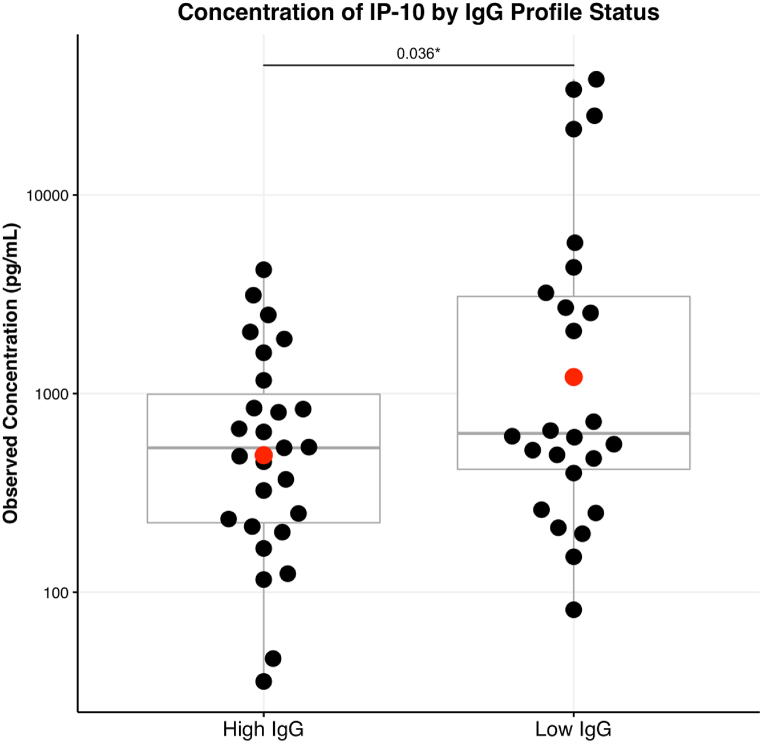
Comparison of IP-10 and anti-SARS-CoV-2 antibody levels. Boxplots denote median and first and third quartiles (boxes) and the highest and lowest values within 1.5 * inter-quartile range (whiskers). Mean is denoted in red. P-value was computed using the Welch two sample t-test. (For interpretation of the references to colour in this figure legend, the reader is referred to the Web version of this article.)
Fig. 3
Fig. 3
Age- and gender adjusted COVID-19 severity odds ratios (solid square) and 95% confidence interval (horizontal bars) for clinical laboratory, cytokines, and immunoglobulins measurements.
Fig. 4
Fig. 4
A. Features coefficients extracted from the trained SVM COVID-19 severity prediction model. Features with higher absolute coefficient magnitudes are more likely to be significant predictors of severity. B. Receiver operator characteristic curves (ROC) of the SVM model evaluated on training data (blue), the SVM model evaluated on testing data (red), and a theoretical baseline model that predicts purely randomly (black). (For interpretation of the references to colour in this figure legend, the reader is referred to the Web version of this article.)

References

    1. Zhou F., et al. Clinical course and risk factors for mortality of adult inpatients with COVID-19 in Wuhan, China: a retrospective cohort study. Lancet. 2020;395(10229):1054–1062. - PMC - PubMed
    1. Xu J., et al. Systematic comparison of two animal-to-human transmitted human coronaviruses: SARS-CoV-2 and SARS-CoV. Viruses. 2020;12(2) - PMC - PubMed
    1. Siordia J.A. Epidemiology and clinical features of COVID-19: a review of current literature. J. Clin. Virol. 2020;127 - PMC - PubMed
    1. Coperchini F., et al. The cytokine storm in COVID-19: an overview of the involvement of the chemokine/chemokine-receptor system. Cytokine Growth Factor Rev. 2020;53:25–32. - PMC - PubMed
    1. Wang X., et al. The role of IL-6 in coronavirus, especially in COVID-19. Front. Pharmacol. 2022;13 - PMC - PubMed