. 2023 Aug 9:21:3999-4008.
doi: 10.1016/j.csbj.2023.08.001. eCollection 2023.

Nucleolar Essential Protein 1 (Nep1): Elucidation of enzymatic catalysis mechanism by molecular dynamics simulation and quantum mechanics study

Affiliations

Nucleolar Essential Protein 1 (Nep1): Elucidation of enzymatic catalysis mechanism by molecular dynamics simulation and quantum mechanics study

Mateusz Jedrzejewski et al. Comput Struct Biotechnol J. .

Abstract

The Nep1 protein is essential for the formation of eukaryotic and archaeal small ribosomal subunits, and it catalyzes the site-directed SAM-dependent methylation of pseudouridine (Ψ) during pre-rRNA processing. It possesses a non-trivial topology, namely, a 31 knot in the active site. Here, we address the issue of seemingly unfeasible deprotonation of Ψ in Nep1 active site by a distant aspartate residue (D101 in S. cerevisiae), using a combination of bioinformatics, computational, and experimental methods. We identified a conserved hydroxyl-containing amino acid (S233 in S. cerevisiae, T198 in A. fulgidus) that may act as a proton-transfer mediator. Molecular dynamics simulations, based on the crystal structure of S. cerevisiae, and on a complex generated by molecular docking in A. fulgidus, confirmed that this amino acid can shuttle protons, however, a water molecule in the active site may also serve this role. Quantum-chemical calculations based on density functional theory and the cluster approach showed that the water-mediated pathway is the most favorable for catalysis. Experimental kinetic and mutational studies reinforce the requirement for the aspartate D101, but not S233. These findings provide insight into the catalytic mechanisms underlying proton transfer over extended distances and comprehensively elucidate the mode of action of Nep1.

Keywords: Enzymatic catalysis; Methylation; Nep1; Proton transfer; RNA processing; Trefoil knot.


Conflict of interest statement

The authors declare no conflict of interests.

Figures

None
Graphical abstract
Fig. 1
Fig. 1
Crystal structure of S. cerevisiae Nep1 (gray) in complex with 18S rRNA (red); PDB code: 3oin. The 31 knot is colored blue. The inset shows the details of the active site with the key residues indicated (in the crystal SAM was replaced by inhibitor, S-adenosylhomocysteine (SAH), and Ψ1191 was replaced by U). The C5 of U, corresponding to the N1 of Ψ (the position of methylation) is indicated with an arrow.
Fig. 2
Fig. 2
Overview of the proposed mechanism for the N1–methylation of pseudouridine catalyzed by Nep1.
Fig. 3
Fig. 3
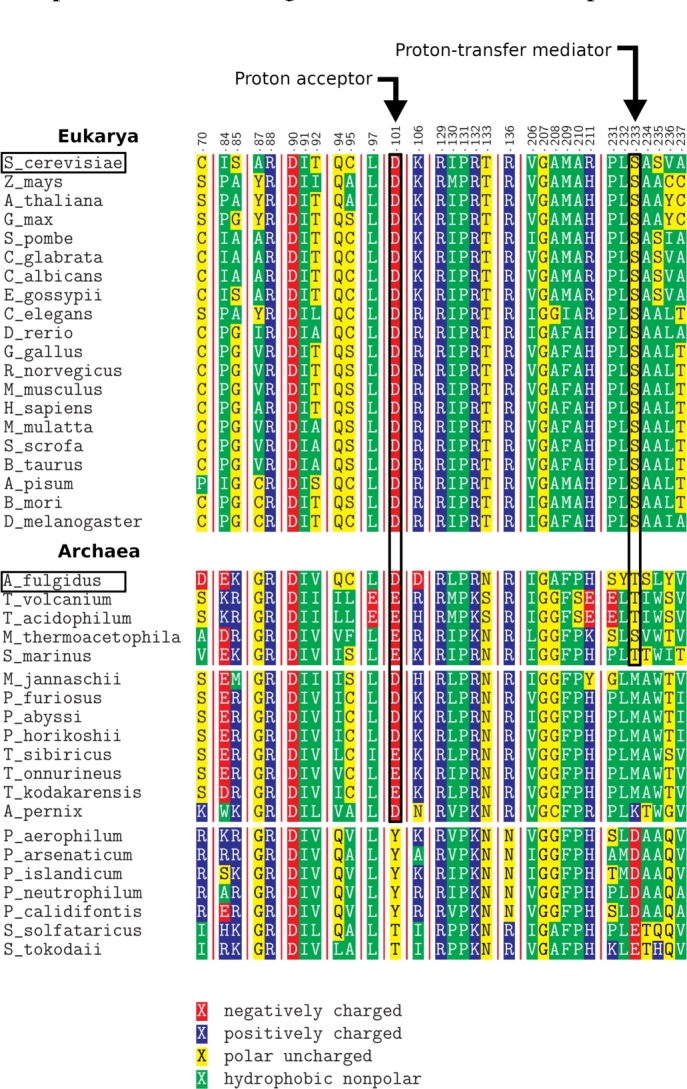
Fragment of the alignment of Nep1 proteins from Eukarya and Archaea. The numbering is based on Nep1 from S. cerevisiae. Arrows point to the residues we propose as catalytically important (the proton acceptor and the proton–transfer mediator). The sequences in Archaea are grouped based on the identity of amino acids in these two positions. Black boxes indicate S. cerevisiae and A. fulgidus, whose Nep1 proteins were further investigated with MD and QM.
Fig. 4
Fig. 4
The snapshots of each active site from the MD simulations. In A and B, the N1 of Ψ and the proton acceptor are bridged by the OH group of the putative proton–transfer mediator residue (S233* and T198* for ScNep1 and AfNep1, respectively). In C and D, these moieties are bridged by a water molecule instead, indicating a water–mediated proton transfer as an alternative mechanistic pathway.
Fig. 5
Fig. 5
Overview of the evaluated mechanisms of the methylation of Ψ by Nep1, consisting of two chemical steps: the proton transfer (TS1) from N1 to aspartate (D101/D74), mediated by either (A) the hydroxyl–containing amino acids (S233*/T198*) or (B) the molecule of water, and the methyl transfer (TS2) from SAM to N1.
Fig. 6
Fig. 6
Energy profiles for the methylation of Ψ in the active site of Nep1 proceeding via different evaluated pathways.
Fig. 7
Fig. 7
Optimized structures of the transition states for the proton–transfer step (TS1) during the different evaluated pathways.

References

    1. Cantoni G.L. Biological methylation: selected aspects. Annu Rev Biochem. 1975;44(1):435–451. - PubMed
    1. Perlinska A.P., Stasiulewicz A., Nawrocka E.K., Kazimierczuk K., Setny P., Sulkowska J.I. Restriction of s-adenosylmethionine conformational freedom by knotted protein binding sites. PLoS Comput Biol. 2020;16(5) - PMC - PubMed
    1. Schubert H.L., Blumenthal R.M., Cheng X. Many paths to methyltransfer: a chronicle of convergence. Trends Biochem Sci. 2003;28(6):329–335. - PMC - PubMed
    1. Anantharaman V., Koonin E.V., Aravind L. Spout: a class of methyltransferases that includes spou and trmd rna methylase superfamilies, and novel superfamilies of predicted prokaryotic rna methylases. J Mol Microbiol Biotechnol. 2002;4(1):71–76. - PubMed
    1. Krishnamohan A., Jackman J.E. A family divided: distinct structural and mechanistic features of the spou-trmd (spout) methyltransferase superfamily. Biochemistry. 2018;58(5):336–345. - PMC - PubMed