


Extended balloon labour induction: A single arm proof of concept trial
- PMID: 37649714
- PMCID: PMC10462842
- DOI: 10.1016/j.eurox.2023.100226
Extended balloon labour induction: A single arm proof of concept trial
Abstract
Background: Mechanical labour induction with a transcervical balloon is as effective as pharmacological methods, with fewer adverse effects. Its use has been limited to labour induction with an unfavourable cervix able to retain the balloon. We have developed an innovative approach using 2-3 balloons side-by-side to extend the benefits of mechanical labour induction/augmentation with a favourable cervix without having to resort to amniotomy or uterotonics.
Objectives: To assess the effectiveness of side-by-side balloons for extended labour induction/augmentation.
Methods: We conducted a single arm proof of concept trial at Princess Marina Hospital (PMH) in Gaborone, Botswana. Participants were assessed as unsuitable for single balloon labour induction based on a modified Bishop cervical score of 7 or more. Three Foley catheters taped symmetrically side by side were passed through the cervix and inflated with 60mls each. Traction was applied with a weight of 250mls water suspended over the bed-end. The use of uterotonics, time from induction to birth, mode of birth, Apgar scores and adverse maternal and neonatal outcomes were recorded. Participants' satisfaction with the method of labour induction was assessed using a descriptive scale.
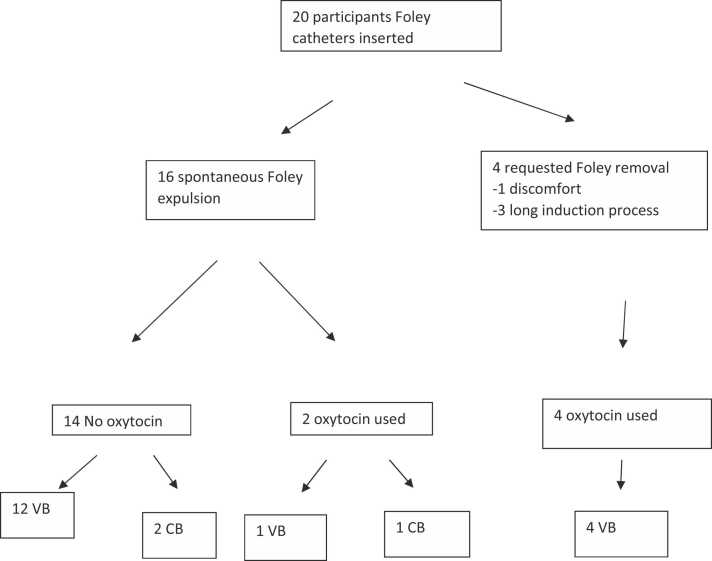
Results: We enrolled 20 participants of whom two were nulliparous. Indications for labour induction were mainly late term (70%) and hypertensive disorders of pregnancy (25%). The mean cervical score was 7.2. Overall, 17 (85%) of the participants achieved a vaginal birth, of whom 5 required oxytocin for labour augmentation. Four of these had requested removal of the balloons, one due to discomfort and three felt the process was taking too long. Three participants underwent caesarean birth. The mean time from initiation of labour induction to vaginal birth was 16 h (standard deviation (SD) 8.4) and 20 h for caesarean birth (SD 10.5). There were no 5-minute Apgar scores below 7 nor neonatal admissions. One baby required brief resuscitation. There were no adverse maternal outcomes.
Conclusion: This proof-of-concept study suggests that use of side-by-side balloons in participants with favourable cervix is effective in achieving vaginal birth in most participants without uterotonics or amniotomy. There were no adverse outcomes, though the study was too small to exclude the possibility of rare adverse outcomes. This offers a novel option for labour induction/augmentation, particularly where uterotonics or amniotomy are best avoided such as prior caesarean birth, vertical infection transmission risk and in settings with limited capacity for fetal surveillance. The results clearly justify larger randomized trials to evaluate this novel approach with greater precision. On the basis of the current study we are developing a purpose-designed balloon for extended balloon labour induction.
Keywords: Favourable cervix; Foley catheter balloon; Labour augmentation; Labour induction.
© 2023 The Authors.
Conflict of interest statement
None.
Figures
References
-
- Drife J.O. The history of labour induction: how did we get here? Best Pr Res Clin Obstet Gynaecol. 2021;77:3–14. - PubMed
-
- Souza J.P., Gülmezoglu A.M., Vogel J., Carroli G., Lumbiganon P., Qureshi Z., et al. Moving beyond essential interventions for reduction of maternal mortality (the WHO Multicountry Survey on Maternal and Newborn Health): a cross-sectional study. Lancet. 2013;381(9879):1747–1755. May 18. - PubMed
-
- Hofmeyr G.J. Balloon labour induction and the price of elegance. BJOG. 2020;127(13):1655. - PubMed
-
- Embrey M.P., Mollison B.G. The unfavourable cervix and induction of labour using a cervical balloon. J Obstet Gynaecol Br Common. 1967;74(1):44–48. - PubMed
LinkOut - more resources
Full Text Sources
