


Psychological and Physiological Responses Across Six Weeks of HIIT and MICT in Previously Inactive, Young Adults
- PMID: 37650003
- PMCID: PMC10464759
- DOI: 10.70252/FQAV8949
Psychological and Physiological Responses Across Six Weeks of HIIT and MICT in Previously Inactive, Young Adults
Abstract
High-intensity interval training (HIIT) is suggested as a public health strategy to increase engagement in, and adherence to, physical activity. However, debate exists regarding the efficacy in inactive individuals.
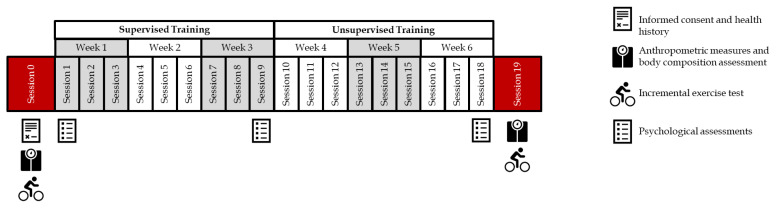
Purpose: To determine the physiological and psychological responses to three weeks of supervised and three weeks of unsupervised HIIT or moderate-intensity continuous training (MICT) in previously inactive adults.
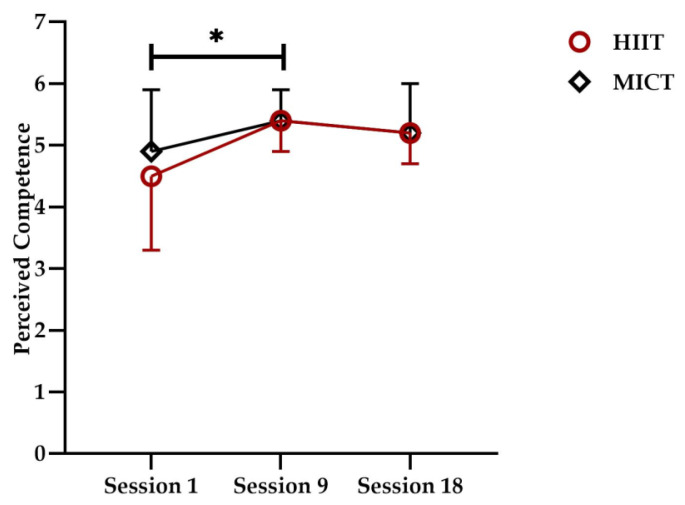
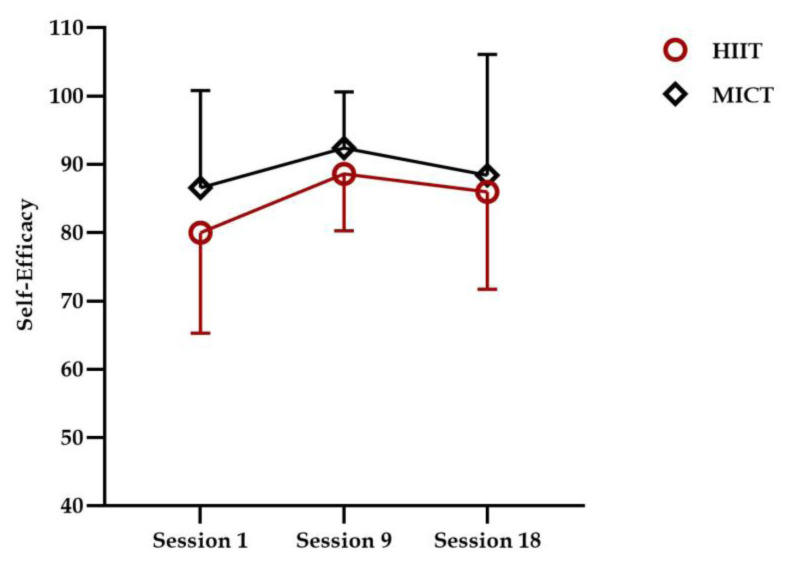
Methods: Young adults (n = 20; 21.4 ± 2.2 years; 13 females) were randomized to six weeks of HIIT or MICT. Pre- and post-testing included anthropometric measures, an incremental exercise test, and body composition. Psychological outcomes (i.e., perceived competence, self-efficacy, and enjoyment) were assessed at the end of the first, ninth, and eighteenth training sessions. Differences in physiological outcomes were analyzed using repeated measures factorial ANCOVAs. Differences in psychological outcomes were analyzed using repeated measures factorial ANOVAs.
Results: Maximal oxygen consumption (Δ 2.8 ml·kg-1·min-1; p = .03) and peak power output (Δ 20.2 W; p = .01) improved over time with no group differences (p > .05). No changes occurred in body composition or self-efficacy (p ≥ .27). Perceived competence increased with supervised training (p = .01) with no further increases during unsupervised training. There was no difference in enjoyment across supervised training (p = .07), but enjoyment decreased during unsupervised training (p = .003).
Conclusions: Cardiorespiratory fitness improved comparably for HIIT and MICT but with a shorter time commitment for HIIT. Perceived competence increased across supervised training suggesting it may be important to provide support at the beginning of an exercise intervention.
Keywords: Exercise enjoyment; VO2max; intermittent exercise; perceptual responses.
Figures
References
-
- Armstrong S, Wong CA, Perrin E, Page S, Sibley L, Skinner A. Association of physical activity with income, race/ethnicity, and sex among adolescents and young adults in the United States: Findings from the National Health and Nutrition Examination Survey, 2007–2016. JAMA Pediatr. 2018;172(8):732–40. - PMC - PubMed
-
- Bandura A. Self-efficacy: Toward a unifying theory of behavioral change. Psychol Rev. 1977;84(2):191–215. - PubMed
-
- Bartlett JD, Close GL, MacLaren DPM, Gregson W, Drust B, Morton JP. High-intensity interval running is perceived to be more enjoyable than moderate-intensity continuous exercise: Implications for exercise adherence. J Sports Sci. 2011;29(6):547–53. - PubMed
-
- Bauman AE, Sallis JF, Dzewaltowski DA, Owen N. Toward a better understanding of the influences on physical activity. Am J Prev Med. 2002;23(2):5–14. - PubMed
LinkOut - more resources
Full Text Sources
Miscellaneous