. 2023 Sep 26;42(9):113047.
doi: 10.1016/j.celrep.2023.113047. Epub 2023 Aug 30.

Molecular, metabolic, and functional CD4 T cell paralysis in the lymph node impedes tumor control

Affiliations

Molecular, metabolic, and functional CD4 T cell paralysis in the lymph node impedes tumor control

Mengdi Guo et al. Cell Rep. .

Abstract

CD4 T cells are central effectors of anti-cancer immunity and immunotherapy, yet the regulation of CD4 tumor-specific T (TTS) cells is unclear. We demonstrate that CD4 TTS cells are quickly primed and begin to divide following tumor initiation. However, unlike CD8 TTS cells or exhaustion programming, CD4 TTS cell proliferation is rapidly frozen in place by a functional interplay of regulatory T cells and CTLA4. Together these mechanisms paralyze CD4 TTS cell differentiation, redirecting metabolic circuits, and reducing their accumulation in the tumor. The paralyzed state is actively maintained throughout cancer progression and CD4 TTS cells rapidly resume proliferation and functional differentiation when the suppressive constraints are alleviated. Overcoming their paralysis established long-term tumor control, demonstrating the importance of rapidly crippling CD4 TTS cells for tumor progression and their potential restoration as therapeutic targets.

Keywords: CD4 T cell; CP: Immunology; CTLA4; T regulatory cell; cancer; dysfunction; exhaustion; immunotherapy; metabolism; transcriptomic signature; tumor immunology.


Conflict of interest statement

Declaration of interests The authors declare no competing interests.

Figures

Figure 1.
Figure 1.. Sub-optimal help and rapidly blunted proliferation of CD4 TTS cells
(A) Tumor sizes of PyMT and MC38 tumor cells in WT and CD4 knockout (KO) mice at the indicated time points. (B) Mice received naive CD4 SMARTA TTS cells followed by implantation of PyMG tumors. On the same day of tumor implantation, mice received unlabeled or GP61–80 peptide-labeled β2m−/− bmDC. Bar graph shows the tumor size at the indicated day. (C–E) TAGIT proliferation dye-labeled naive SMARTA cells were transferred into WT mice followed by PyMG injection. (C) Histograms show TAGIT dilution on the indicated day. The bar graph represents the total number of CD4 SMARTA TTS cells in the dLN at the indicated day after PyMG administration. (D) Expression (flow plot) and the percentage of Ki67+ out of total CD4 SMARTA TTS cells (gated on SMARTA cells) in the dLN. (E) Representative percentage (flow plots) and number (bar graph) of CD4 SMARTA TTS cells in the tumor at each time point. Data represent three independent experiments with at least five mice per group. Error bars indicate standard deviation (SD). For comparison of tumor growth kinetics, significance is determined by two-way ANOVA; for other comparisons, significance is determined by Mann-Whitney U test. *p < 0.05.
Figure 2.
Figure 2.. Incomplete differentiation and selective function of CD4 TTS cells
(A) Representative expression of the indicated protein CD4 SMARTA TTS cells (in the dLN) on the indicated day. Virus-specific CD4 SMARTA T cells from chronic LCMV infection are shown for comparison. (B) Geometric mean fluorescence intensity (GMFI) of ICOS and CXCR5 by Bcl6+ tumor-specific or virus-specific CD4 SMARTA Tfh cells (bar graphs). Histograms show representative ICOS and CXCR5 expression by dLN tumor-specific SMARTA cells, and by virus-specific CD4 Th1 and Tfh cells. (C) Expression and quantification of TNF-α- and IL-2-producing CD4 SMARTA T cells in dLN after ex vivo LCMV-GP61–80 peptide stimulation. (D) (Left) FoxP3 versus TAGIT expression by CD4 SMARTA TTS cells on day 30 in the dLN. The bar graph is gated on CD4 SMARTA TTS cells and shows the percentage of FoxP3+ cells in the dLN. (Right) Plots show the cycling (Ki67+) FoxP3+ CD4 SMARTA TTS cells in the PyMG tumor. The bar graphs show the percentage of FoxP3+ SMARTA TTS cells in the tumor. (E) (Top) UMAP embeddings of CyTOF data of CD4 SMARTA TTS cells in the dLN at days 8, 15, and 30 after PyMG initiation. Cells are colored by Phenograph clustering. Data are concatenated from five to seven mice per group. (Bottom) UMAP plot shows the clusters that are increased (red) or decreased (blue) in abundance from day 8 to 30. The bar graph indicates the log2 fold change of each cluster and the associated significance (calculated using diffcyt, *adjusted p value < 0.05). Heatmap depicts the normalized Z scores of the arcsinh-transformed median signal intensity (MSI) of the indicated protein in each cluster. (F) Expression of the indicated proteins by CD4 SMARTA TTS cells in the dLN. Virus-specific CD4 SMARTA T cells from chronic LCMV infection are shown for comparison. (G) UMAPs show the arcsinh-transformed single-cell expression of the indicated proteins by CD4 SMARTA TTS cells in the dLN at each time point. For flow cytometry, data represent three independent experiments with at least five mice per group. Error bars indicate SD. Significance is determined by Mann-Whitney U test. *p < 0.05. CyTOF data are representative of two experiments with at least three mice per group.
Figure 3.
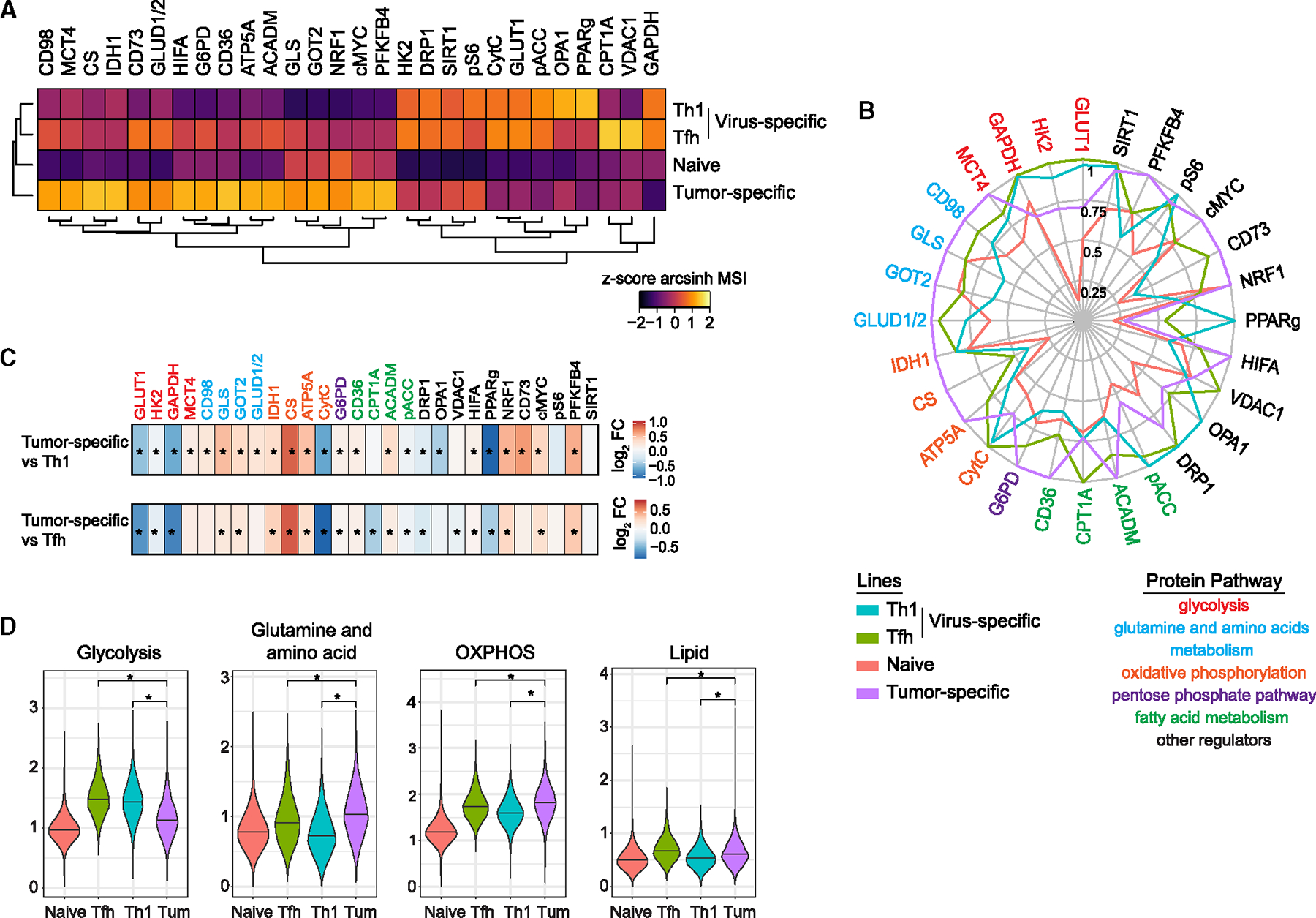
Figure 3.. CyTOF analyses of CD4 TTS cell metabolic pathways.
CD4 SMARTA T cells were transferred into WT mice followed by PyMG tumor injection or acute LCMV-Armstrong infection. On day 8, SMARTA cells from tumor dLN or spleen of LCMV-infected mice were isolated. SMARTA cells from uninfected mice were used as naive control. (A) Heatmap depicts the normalized Z scores of the arcsinh-transformed MSI of the indicated protein for each cluster. (B) Radar plot depicts the relative arcsinh-transformed MSI of the indicated proteins by each group, scaling as the percentage of the highest expression. (C) Heatmaps show the differential state comparisons (calculated by diffcyt) between tumor-specific CD4 SMARTA T cells and LCMV-specific CD4 Th1 (top) or Tfh (bottom) SMARTA T cells. Coloration shows log2 fold change. *adjusted p value < 0.05. (D) Violin plots show the single-cell scoring of each metabolic pathway calculated as described in STAR Methods. Statistics were performed Wilcox test only comparing CD4 TTS cells with Th1 and Tfh. *p < 0.05. Data are representative of two experiments with at least three mice per group.
Figure 4.
Figure 4.. Transcriptional programming of CD4 T cell paralysis in dLN by scRNA-seq
(A) Seurat clustering (resolution 0.5) of CD4 TTS cells. The bar graph depicts the proportion of each cluster. (B) Top 20 differentially expressed genes (DEGs) of each cluster. (C)Monocle trajectory analysis overlaid on UMAP colored by Seurat clusters.

(D) Single-cell heatmap depicts gene set variation analysis pathway analysis within each Seurat cluster. (E) Radar plot shows normalized enrichment scores of GSEA comparing CD4 SMARTA TTS cells from c4 (see Figure S4E) with defined Th cell lineage signatures. Numbers in parentheses are the FDR. A value of 0.00 = FDR < 10−3. (F) IPA pathway enrichment scoring of CD4 SMARTA TTS cells in c4 (see Figure S4E). All included pathways are significant with p < 0.05. Pathways colored in red were specifically mentioned in the text. (G) Venn diagrams show the overlap and difference in DEGs of paralyzed tumor CD4 TTS cells, effector and exhausted virus-specific CD4 (left) and CD8 T cells (right). Each group was individually compared with naive T cells first prior to the comparisons shown. The numbers indicate the number of genes.
Figure 5.
Figure 5.. CTLA4 and Tregs reciprocally induce paralysis of CD4 TTS cells.
(A and B) On days 0, 2, and 5 (A) or days 21, 23, and 26 (B) after PyMG administration, mice were treated with 300 μg CTLA4 blocking or isotype control antibodies. Histogram shows proliferation of SMARTA cells on (A) day 8 or (B) day 29 in the dLN. Bar graphs show the frequency and number of SMARTA cells that completely diluted TAGIT. (C–H) FoxP3-DTR mice received TAGIT-labeled naive SMARTA cells followed by PyMG injection and either PBS or diphtheria toxin (DT) treatment.

(C) Histograms show the proliferation of CD4 SMARTA TTS cells in the dLN on the indicated day. The bar graph shows the percentage of CD4 SMARTA TTS cells that have completely diluted TAGIT. (D) Flow plots and bar graph depict the frequency of SMARTA cells of CD4 T cells in the tumor at day 30. (E) FoxP3-DTR mice were treated with PBS or DT on days 21 and 23 after PyMG injection. Histograms show the proliferation of CD4 SMARTA TTS cells in the dLN on day 29 (8 days after treatment). (F) UMAP plots indicating PhenoGraph clusters of CD4 SMARTA TTS cells in dLN 8 days after PyMG initiation (concatenated from four to five mice in each group). Bar graph shows the frequency of each cluster, with each circle representing the percent of SMARTA TTS cells in that cluster from an individual mouse. *adjusted p value < 0.05, calculated by diffcyt. Heatmap depicts the normalized Z scores of the arcsinh-transformed MSI of the indicated protein for each cluster. (G) UMAPs show the single-cell arcsinh-transformed expression of the indicated protein by CD4 SMARTA TTS cells. (H) Expression of the indicated protein on SMARTA iTreg (c5, 7, and 8) and Tregs (FoxP3+ Helios+ of non-SMARTA CD4 T cells in dLN, from PBS control-treated mice). Bar graphs show the frequency (left) and GMSI (geometric mean of arcsinh-transformed MSI calculated by FlowJo) (right) of the indicated protein in the Tregs or SMARTA iTregs. Data represent two to three independent experiments with at least four mice per group. Error bars indicate SD. Significance other than CyTOF analyses is determined by Mann-Whitney U test. *p < 0.05.
Figure 6.
Figure 6.. CTLA4 drives tumor-specific iTreg differentiation in Treg-depleted mice and dual Treg depletion and CTLA4 blockade enable effector differentiation and metabolic re-organization
(A) On day 5 after PyMG administration, mice received isotype control, anti-CD3 alone, anti-CD28 alone, or dual anti-CD3 and anti-CD28 antibodies. Cell proliferation of CD4 SMARTA TTS cells in dLN was analyzed on day 8. (B and C) FoxP3-DTR mice were treated on days 0 and 2 with DT, and on days 0, 2, and 5 with CTLA4-blocking or isotype antibodies.

(B) Expression of FoxP3 and Bcl6 by SMARTA cells. Bar graphs show the frequency (left) and number (right) of FoxP3+ SMARTA cells. (C) Cytokine production by CD4 SMARTA TTS cells after ex vivo restimulation. (D–H) FoxP3-DTR mice were treated on days 0 and 2 with PBS or DT; and/or on days 0, 2, and 5 with CTLA4-blocking or isotype antibodies. Analysis was performed on dLN SMARTA TTS cells on day 8 after PyMG administration. (D) UMAP plots show Seurat clustering (resolution 0.3) of CD4 SMARTA TTS cells s in each condition. Bar graph depicts the proportion of each cluster. The numbers in the stacked bar graphs indicate the cluster. (E) Monocle trajectory analysis overlaid onto the Seurat clustered UMAP (all conditions combined). (F–H) IPA pathways enrichment scoring of the indicated clusters. All pathways are significant with a p value < 0.05. For (A)–(C), the data represent three independent experiments with at least five mice per group. Error bars indicate SD. Significance is determined by Mann-Whitney U test. *p < 0.05.

Update of

References

    1. Waldman AD, Fritz JM, and Lenardo MJ (2020). A guide to cancer immunotherapy: from T cell basic science to clinical practice. Nat. Rev. Immunol. 20, 651–668. - PMC - PubMed
    1. Pauken KE, and Wherry EJ (2015). Overcoming T cell exhaustion in infection and cancer. Trends Immunol. 36, 265–276. - PMC - PubMed
    1. Hunder NN, Wallen H, Cao J, Hendricks DW, Reilly JZ, Rodmyre R, Jungbluth A, Gnjatic S, Thompson JA, and Yee C (2008). Treatment of metastatic melanoma with autologous CD4+ T cells against NY-ESO-1. N. Engl. J. Med. 358, 2698–2703. - PMC - PubMed
    1. Tran E, Turcotte S, Gros A, Robbins PF, Lu YC, Dudley ME, Wunderlich JR, Somerville RP, Hogan K, Hinrichs CS, et al. (2014). Cancer immunotherapy based on mutation-specific CD4+ T cells in a patient with epithelial cancer. Science 344, 641–645. - PMC - PubMed
    1. Ahrends T, Spanjaard A, Pilzecker B, Ba˛ ba1a N, Bovens A, Xiao Y, Jacobs H, and Borst J (2017). CD4+ T Cell Help Confers a Cytotoxic T Cell Effector Program Including Coinhibitory Receptor Downregulation and Increased Tissue Invasiveness. Immunity 47, 848–861.e5. - PubMed

Publication types