


ChatGPT- versus human-generated answers to frequently asked questions about diabetes: A Turing test-inspired survey among employees of a Danish diabetes center
- PMID: 37651381
- PMCID: PMC10470899
- DOI: 10.1371/journal.pone.0290773
ChatGPT- versus human-generated answers to frequently asked questions about diabetes: A Turing test-inspired survey among employees of a Danish diabetes center
Abstract
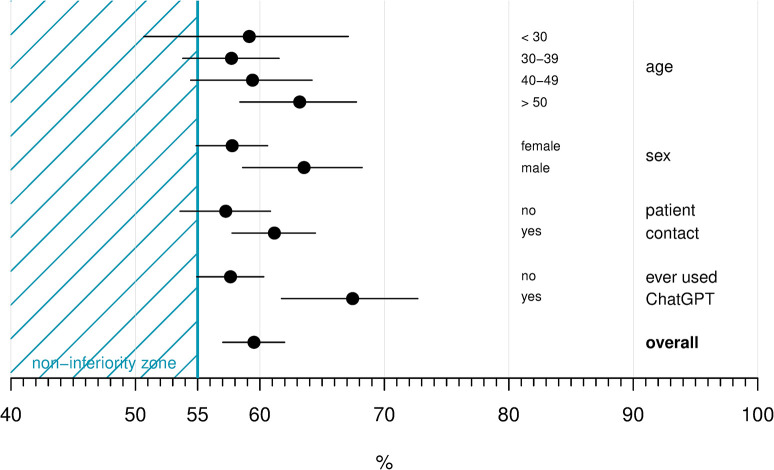
Large language models have received enormous attention recently with some studies demonstrating their potential clinical value, despite not being trained specifically for this domain. We aimed to investigate whether ChatGPT, a language model optimized for dialogue, can answer frequently asked questions about diabetes. We conducted a closed e-survey among employees of a large Danish diabetes center. The study design was inspired by the Turing test and non-inferiority trials. Our survey included ten questions with two answers each. One of these was written by a human expert, while the other was generated by ChatGPT. Participants had the task to identify the ChatGPT-generated answer. Data was analyzed at the question-level using logistic regression with robust variance estimation with clustering at participant level. In secondary analyses, we investigated the effect of participant characteristics on the outcome. A 55% non-inferiority margin was pre-defined based on precision simulations and had been published as part of the study protocol before data collection began. Among 311 invited individuals, 183 participated in the survey (59% response rate). 64% had heard of ChatGPT before, and 19% had tried it. Overall, participants could identify ChatGPT-generated answers 59.5% (95% CI: 57.0, 62.0) of the time, which was outside of the non-inferiority zone. Among participant characteristics, previous ChatGPT use had the strongest association with the outcome (odds ratio: 1.52 (1.16, 2.00), p = 0.003). Previous users answered 67.4% (61.7, 72.7) of the questions correctly, versus non-users' 57.6% (54.9, 60.3). Participants could distinguish between ChatGPT-generated and human-written answers somewhat better than flipping a fair coin, which was against our initial hypothesis. Rigorously planned studies are needed to elucidate the risks and benefits of integrating such technologies in routine clinical practice.
Copyright: © 2023 Hulman et al. This is an open access article distributed under the terms of the Creative Commons Attribution License, which permits unrestricted use, distribution, and reproduction in any medium, provided the original author and source are credited.
Conflict of interest statement
The authors have declared that no competing interests exist.
Figures
References
-
- OpenAI. ChatGPT: Optimizing language models for dialogue. 2022. https://openai.com/blog/chatgpt/ (Accessed on Feb 10, 2023).
-
- Hu K. ChatGPT sets record for fastest-growing user base—analyst note. 2023. https://www.reuters.com/technology/chatgpt-sets-record-fastest-growing-u... (Accessed on Feb 10, 2023).
Publication types
MeSH terms
LinkOut - more resources
Full Text Sources
Medical
