. 2023 Oct 13;44(10):105006.
doi: 10.1088/1361-6579/acf5c7.

HIRA: Heart Rate Interval based Rapid Alert score to characterize autonomic dysfunction among patients with sepsis-related acute respiratory failure (ARF)

Affiliations

HIRA: Heart Rate Interval based Rapid Alert score to characterize autonomic dysfunction among patients with sepsis-related acute respiratory failure (ARF)

Preethi Krishnan et al. Physiol Meas. .

Abstract

Objective. To examine whether heart rate interval based rapid alert (HIRA) score derived from a combination model of heart rate variability (HRV) and modified early warning score (MEWS) is a surrogate for the detection of acute respiratory failure (ARF) in critically ill sepsis patients.Approach. Retrospective HRV analysis of sepsis patients admitted to Emory healthcare intensive care unit (ICU) was performed between sepsis-related ARF and sepsis controls without ARF. HRV measures such as time domain, frequency domain, and nonlinear measures were analyzed up to 24 h after patient admission, 1 h before the onset of ARF, and a random event time in the sepsis controls. Statistical significance was computed by the Wilcoxon Rank Sum test. Machine learning algorithms such as eXtreme Gradient Boosting and logistic regression were developed to validate the HIRA score model. The performance of HIRA and early warning score models were evaluated using the area under the receiver operating characteristic (AUROC).Main Results. A total of 89 (ICU) patients with sepsis were included in this retrospective cohort study, of whom 31 (34%) developed sepsis-related ARF and 58 (65%) were sepsis controls without ARF. Time-domain HRV for Electrocardiogram (ECG) Beat-to-Beat RR intervals strongly distinguished ARF patients from controls. HRV measures for nonlinear and frequency domains were significantly altered (p< 0.05) among ARF compared to controls. The HIRA score AUC: 0.93; 95% confidence interval (CI): 0.88-0.98) showed a higher predictive ability to detect ARF when compared to MEWS (AUC: 0.71; 95% CI: 0.50-0.90).Significance. HRV was significantly impaired across patients who developed ARF when compared to controls. The HIRA score uses non-invasively derived HRV and may be used to inform diagnostic and therapeutic decisions regarding the severity of sepsis and earlier identification of the need for mechanical ventilation.

Keywords: acute respiratory failure; heart rate variability; machine learning; sepsis.


Figures

Figure 1.
Figure 1.
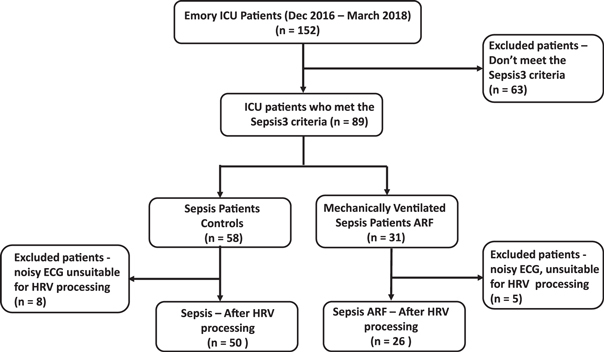
The study population includes all-cause sepsis (controls) and sepsis-related acute respiratory failure (ARF) patients who underwent invasive mechanical ventilation.
Figure 2.
Figure 2.
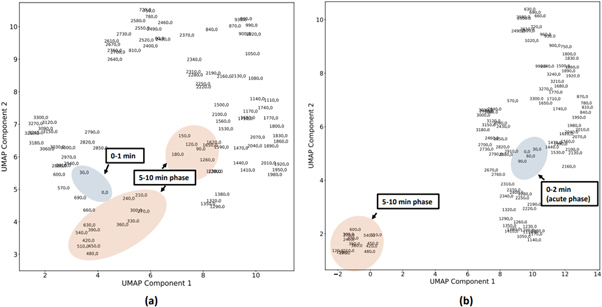
The uniform manifold approximation projection (UMAP) plot shows distinct clustering for controls and the sepsis-related ARF cohort. (A) The controls cohort UMAP plot shows that the temporal regions are organized at random. (B) Sepsis-related ARF cohort UMAP suggests greater dynamics among the HRV features. The clusters within the ARF cohort reveal a grouping of periods between 0 and 2 min before ARF onset (blue highlight region), and a second cluster containing data about an earlier period containing 5–10 min temporal periods.
Figure 3.
Figure 3.
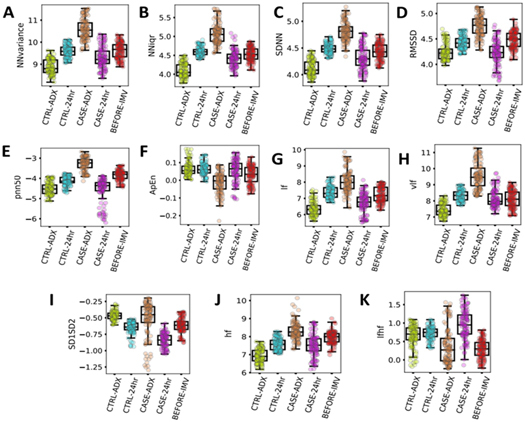
The box-plot panel shows a selected set of time-domain HRV measures that were statistically significant among acute respiratory failure patients in comparison with sepsis patients. The controls cohort includes HRV data 1 h at intensive care unit (ICU) following admission (CTRL-ADX) and 24 h after ICU admission (CTRL-24 h). The ARF cohort includes HRV data for 1 h following ICU admission (CASE-ADX), 24 h after ICU admission (CASE-24 h) and 1 h before invasive mechanical ventilation (BEFORE-IMV). The time-domain HRV measures shown in the figure are as follows: (A) Beat-to-Beat (NN) interval variance (NNvariance). (B) NN interquartile range (NNIqr). (C) NN Standard Deviation (SDNN). (D) Root mean square of successive differences of the NN intervals (RMSSD). (E) Count of NN intervals > 50 milliseconds divided by the total number of all NN intervals (pnn50). (F) Approximate Entropy (ApEn). The frequency domain and nonlinear HRV measures shown in the figure are as follows: (G) low frequency (LF). (H) very low frequency (VLF). (I) SD1/SD2 ratio nonlinear measure (SD1SD2) (J) high frequency (HF). (k) Ratio LF/HF (LFHF).
Figure 4.
Figure 4.
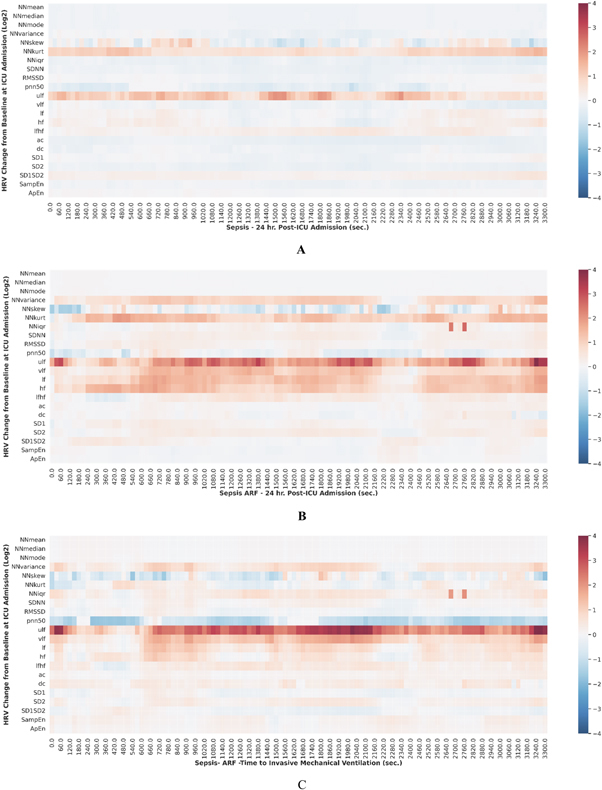
(A) The figure depicts a heatmap of heart rate variability (HRV) statistical measures over time among sepsis patients without ARF at 24 h post ICU admission. NN mean median, mode, and variance were found to be under-expressed. NN kurtosis (kurt) and ultra low frequency (ULF) were over-expressed compared to the baseline at ICU admission. (B) The figure depicts a heatmap of HRV statistical measures over time among sepsis patients with ARF at 24 h post ICU admission. NN variance and frequency measures were over-expressed relative to baseline at ICU admission. (C) The figure depicts a heatmap of HRV statistical measures over time among ARF temporal response in the one hour before the onset of invasive mechanical ventilation (IMV). Frequency measures, NN skew, kurt, and variance show significantly decreased expression.
Figure 5.
Figure 5.
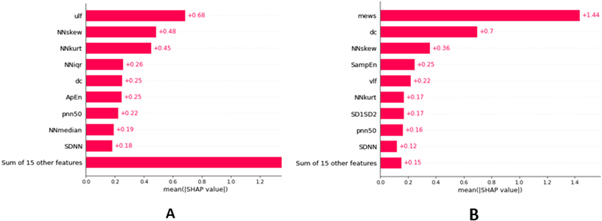
Mean SHAP plot of the top ranked features for ARF prediction (A) HIRA_ADX (24 h post admission) (B) HIRA (1 h before intubation). Abbreviations: ULF, Power in the ultra-low frequency range; NNskew, Skewness of the NN interval; NNkurt, Kurtosis of the NN interval; NNiqr, Interquartile Range of NN intervals; ApEn, Approximate Entropy (a.u.); pnn50, Count of NN intervals > 50 milliseconds divided by the total number of all NN intervals (%); DC, Deceleration capacity (ms); NNmedian, Median of the NN interval (ms); SDNN, Standard deviation of all NN intervals (ms): MEWS, Modified Early Warning Score; SampEn, VLF, Power in the low frequency range; SD1SD2, SD1/SD2 ratio (SD1, SD2 measures of the Poincaré plot), SDNN, Standard deviation of all NN intervals (ms).
Figure 6.
Figure 6.
Shows the area under the receiver operating characteristic curve (AUC) curves of the modified early warning score (MEWS) threshold (MEWS_thresh_3, MEWS_thresh_4, MEWS_thresh_5), heart rate interval-based rapid alert (HIRA), heart rate variability (HRV), and MEWS+Lactate ( a combination model of MEWS and lactate). The HIRA XG boost model has yielded the greatest AUC compared to MEWS, MEWS+Lactate, and HRV models.

References

    1. Arbo J E, et al. Heart rate variability measures for prediction of severity of illness and poor outcome in ED patients with sepsis. Am. J. Emerg. Med. 2020;38:2607–13. doi: 10.1016/j.ajem.2020.01.012. - DOI - PMC - PubMed
    1. Azoulay E, Mokart D, Kouatchet A, Demoule A, Lemiale V. Acute respiratory failure in immunocompromised adults. Lancet Respir. Med. 2019;7:173–86. doi: 10.1016/S2213-2600(18)30345-X. - DOI - PMC - PubMed
    1. Chawla N V, Bowyer K W, Hall L O, Kegelmeyer W P. SMOTE: synthetic minority over-sampling technique. jair. 2002;16:321–57. doi: 10.1613/jair.953. - DOI
    1. Chen W-L, Kuo C-D. Characteristics of heart rate variability can predict impending septic shock in emergency department patients with sepsis. Acad. Emerg. Med. 2007;14:392–7. doi: 10.1197/j.aem.2006.12.015. - DOI - PubMed
    1. de Castilho F M, Ribeiro A L P, Nobre V, Barros G, de Sousa M. Heart rate variability as predictor of mortality in sepsis: a systematic review. PLoS One. 2018;13:e0203487. doi: 10.1371/journal.pone.0203487. - DOI - PMC - PubMed

Publication types