Review
. 2023 Aug;8(8):e012169.
doi: 10.1136/bmjgh-2023-012169.

Does ignoring transmission dynamics lead to underestimation of the impact of interventions against mosquito-borne disease?

Affiliations
Review

Does ignoring transmission dynamics lead to underestimation of the impact of interventions against mosquito-borne disease?

Sean Cavany et al. BMJ Glob Health. 2023 Aug.

Abstract

New vector-control technologies to fight mosquito-borne diseases are urgently needed, the adoption of which depends on efficacy estimates from large-scale cluster-randomised trials (CRTs). The release of Wolbachia-infected mosquitoes is one promising strategy to curb dengue virus (DENV) transmission, and a recent CRT reported impressive reductions in dengue incidence following the release of these mosquitoes. Such trials can be affected by multiple sources of bias, however. We used mathematical models of DENV transmission during a CRT of Wolbachia-infected mosquitoes to explore three such biases: human movement, mosquito movement and coupled transmission dynamics between trial arms. We show that failure to account for each of these biases would lead to underestimated efficacy, and that the majority of this underestimation is due to a heretofore unrecognised bias caused by transmission coupling. Taken together, our findings suggest that Wolbachia-infected mosquitoes could be even more promising than the recent CRT suggested. By emphasising the importance of accounting for transmission coupling between arms, which requires a mathematical model, we highlight the key role that models can play in interpreting and extrapolating the results from trials of vector control interventions.

Keywords: Arboviruses; Cluster randomized trial; Dengue; Epidemiology; Prevention strategies.


Conflict of interest statement

Competing interests: None declared.

Figures
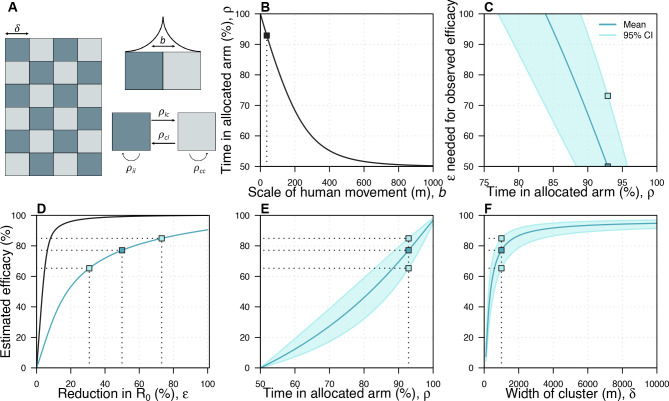
Figure 1
Figure 1
The spatial scales of transmission and trial design. (A) Idealised trial design. We used a checkerboard pattern to approximate the design of the AWED trial of Wolbachia-infected mosquitoes to control dengue. ρij represents the amount of time an individual who lives in arm i spends in arm j, where i and j can represent either control (c) or treatment (t). b describes the scale of human movement. The Laplace distribution shown in the top right is illustrative, and does not represent the distribution used in the model, which was much narrower. (B) The relationship between the scale of human movement and the amount of time individuals spend in clusters of the same type as their home cluster. (C) The relationship between the reduction in R0 (ε) required to reproduce the observed efficacy in the AWED trial and the time people spend in their allocated arm. In this panel and panels (E, F), the dark blue line corresponds to the observed mean estimated in the AWED trial whereas the light blue line and shaded region correspond to the 95% CIs. (D) The relationship between ε and the estimated efficacy when b=36.9 m. The black line shows the theoretical relationship between a reduction in R0 and observed efficacy, assuming no mosquito movement and no human movement between arms. The blue line shows this relationship if we include these two factors as well as the effect of transmission coupling. The dark and light blue squares indicate the mean and the 95% CI, respectively, of the observed efficacy in the AWED trial and the corresponding reduction in R0. (E) The relationship between the amount of time people spend in their allocated arm and the estimated efficacy. (F) The relationship between the size of the clusters and the estimated efficacy. The dashed line indicates the estimated efficacy at the baseline cluster size (1000 m). In all panels, parameters are at their baseline given in online supplemental table S1 unless otherwise stated. AWED, Applying Wolbachia to Eliminate Dengue.
Figure 2
Figure 2
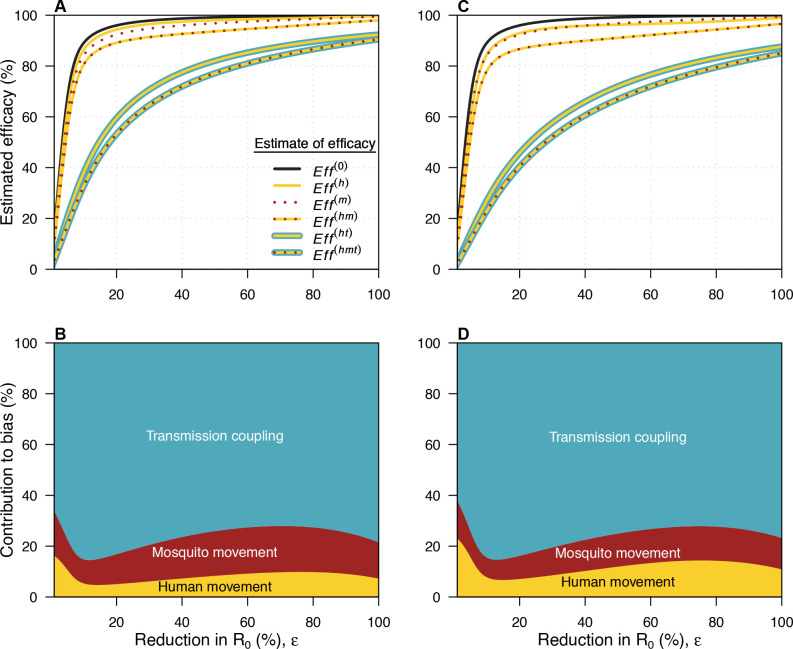
Sources of bias in efficacy estimates. In all panels, yellow refers to mosquito movement, red to human movement and blue to transmission coupling. (A, B) use the baseline value of b=36.9 m, while (C, D) use a larger value of b=58.4 m. (A) The relationship between the reduction in R0 (ε) and the estimated efficacy for the six possible models. The black line here is the relationship for a model with no human movement or mosquito movement. Where a line has more than one colour, it represents the model which includes each of the types of bias represented by those colours. The difference between this line and each of the coloured lines represents the bias introduced by not accounting for the features present in the model described by that coloured line. (B) The contribution of each source of bias to the total bias. Eff(0) refers to the estimated efficacy from a model with none of the biases, Eff(h) to the estimated efficacy from a model with human movement only, Eff(m) to the estimated efficacy from a model with mosquito movement only, Eff(hm) to the estimated efficacy from a model with human and mosquito movement, Eff(ht) to the estimated efficacy from a model with human movement and transmission coupling, and Eff(hmt) to the estimated efficacy from a model with all three biases. (C, D) As in (A, B) but with b=58.4 m.

References

    1. Bhatt S, Gething PW, Brady OJ, et al. . The global distribution and burden of Dengue. Nature 2013;496:504–7. 10.1038/nature12060 - DOI - PMC - PubMed
    1. Bowman LR, Donegan S, McCall PJ. Is Dengue vector control deficient in effectiveness or evidence?: systematic review and meta-analysis. PLoS Negl Trop Dis 2016;10:e0004551. 10.1371/journal.pntd.0004551 - DOI - PMC - PubMed
    1. Morrison AC, Zielinski-Gutierrez E, Scott TW, et al. . Defining challenges and proposing solutions for control of the virus vector Aedes Aegypti. PLoS Med 2008;5:e68. 10.1371/journal.pmed.0050068 - DOI - PMC - PubMed
    1. Ferguson NM, Kien DTH, Clapham H, et al. . Modeling the impact on virus transmission of Wolbachia-mediated blocking of Dengue virus infection of Aedes Aegypti. Sci Transl Med 2015;7:279ra37. 10.1126/scitranslmed.3010370 - DOI - PMC - PubMed
    1. Anders KL, Indriani C, Ahmad RA, et al. . The AWED trial (applying wolbachia to eliminate dengue) to assess the efficacy of wolbachia-infected mosquito deployments to reduce dengue incidence in yogyakarta, indonesia: study protocol for a cluster randomised controlled trial [Internet]. Trials 2018;19:302. 10.1186/s13063-018-2670-z Available: 10.1186/s13063-018-2670-z - DOI - DOI - PMC - PubMed

Publication types