Review
. 2023 Sep;55(9):1955-1973.
doi: 10.1038/s12276-023-01071-4. Epub 2023 Sep 1.

Lipid remodeling of adipose tissue in metabolic health and disease

Affiliations
Review

Lipid remodeling of adipose tissue in metabolic health and disease

Yoon Keun Cho et al. Exp Mol Med. 2023 Sep.

Abstract

Adipose tissue is a dynamic and metabolically active organ that plays a crucial role in energy homeostasis and endocrine function. Recent advancements in lipidomics techniques have enabled the study of the complex lipid composition of adipose tissue and its role in metabolic disorders such as obesity, diabetes, and cardiovascular disease. In addition, adipose tissue lipidomics has emerged as a powerful tool for understanding the molecular mechanisms underlying these disorders and identifying bioactive lipid mediators and potential therapeutic targets. This review aims to summarize recent lipidomics studies that investigated the dynamic remodeling of adipose tissue lipids in response to specific physiological changes, pharmacological interventions, and pathological conditions. We discuss the molecular mechanisms of lipid remodeling in adipose tissue and explore the recent identification of bioactive lipid mediators generated in adipose tissue that regulate adipocytes and systemic metabolism. We propose that manipulating lipid-mediator metabolism could serve as a therapeutic approach for preventing or treating obesity-related metabolic diseases.


Conflict of interest statement

The authors declare no competing interests.

Figures
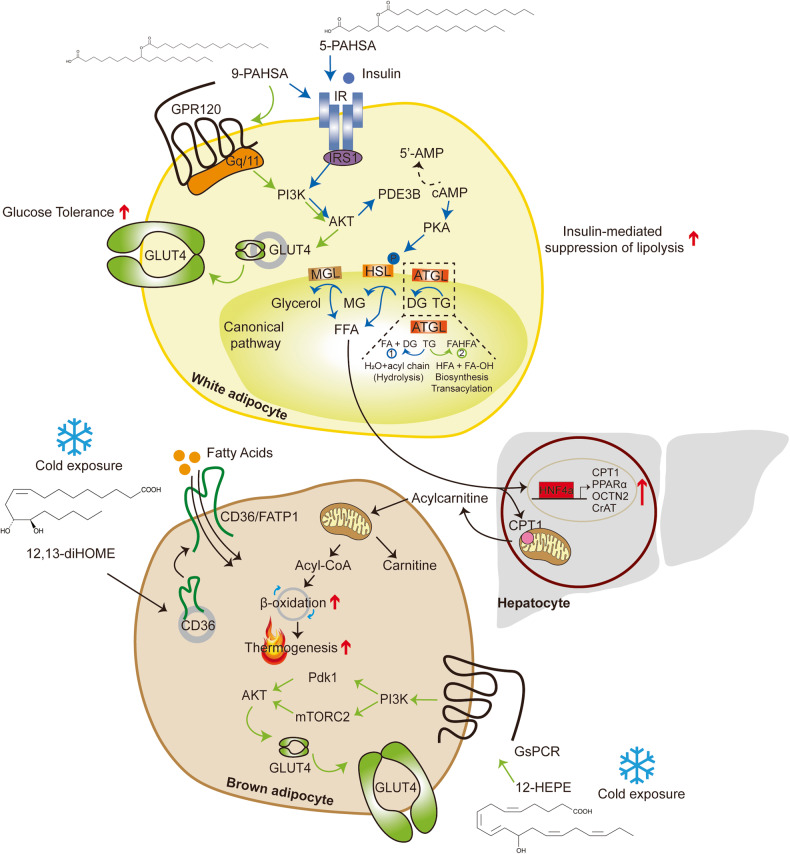
Fig. 1
Fig. 1. Bioactive lipid-mediated regulation of insulin downstream signaling and lipid metabolism in adipocytes: mechanistic overview.
The schematic depicts the mechanisms of bioactive lipids identified by the lipidomics approach in adipocyte metabolism. The ester bond formation of FAHFAs is catalyzed by ATGL, and 9-PAHSA enhances insulin-stimulated glucose transport by enhancing GLUT4 translocation via the GPR120/PI3K/AKT axis. 5- and 9-PAHSA promote insulin-mediated suppression of lipolysis in white adipocytes. 12,13-DiHOME induces FA transporter (CD36) translocation, elevating FA uptake and producing substrates for thermogenesis. 12-HETE stimulates the GsPCR/PI3K/mTORC2/AKT pathway, enhancing GLUT4 translocation and contributing to improved insulin sensitivity. Circulating FAs activate HNF4α, promoting the gene expression of CPT1, PPARα, OCTN2, and CrAT, and they mediate hepatic production of acylcarnitine, which then serves as fuel for β-oxidation.
Fig. 2
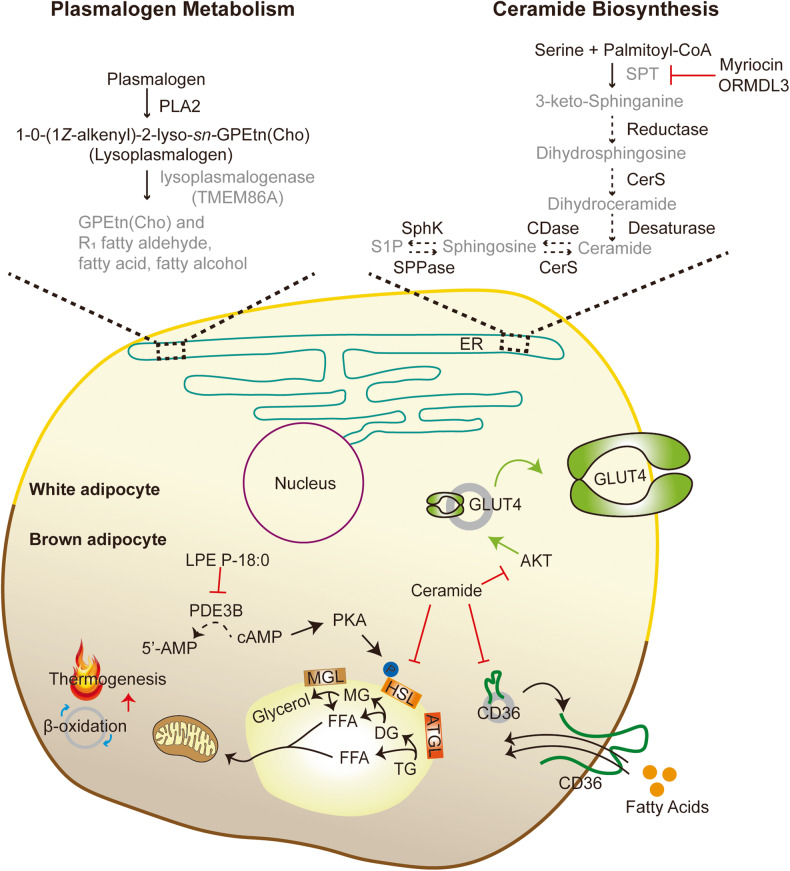
Fig. 2. Effects of genetic deletion of lipid biosynthetic and metabolic enzymes on adipocyte metabolism.
Enzymes and pathways involved in plasmalogen metabolism: TMEM86A has lysoplasmalogenase activity in adipocytes. Inhibiting the activity of TMEM86A leads to an increase in lysoplasmalogen and plasmalogen. LPE P-18:0, a lysoplasmalogen species, suppresses PDE3B activity, elevating intracellular cAMP levels. Increased levels of intracellular cAMP activate the PKA signaling pathway and induce lipolysis by phosphorylating HSL accompanied by enhanced thermogenesis. Enzymes and pathways involved in ceramide biosynthesis: Genetic abrogation of Sptlc2 and Ormdl3 regulates ceramide biosynthesis. Ceramides alleviate GLUT4 translocation via inhibition of AKT signaling, attenuate CD36 translocation, and suppress the activity of HSL, leading to impaired glucose tolerance, fatty acid uptake, and thermogenesis.

References

    1. Sakers A, De Siqueira MK, Seale P, Villanueva CJ. Adipose-tissue plasticity in health and disease. Cell. 2022;185:419–446. doi: 10.1016/j.cell.2021.12.016. - DOI - PMC - PubMed
    1. Lange M, et al. AdipoAtlas: a reference lipidome for human white adipose tissue. Cell Rep. Med. 2021;2:100407. doi: 10.1016/j.xcrm.2021.100407. - DOI - PMC - PubMed
    1. Von Bank H, Kirsh C, Simcox J. Aging adipose: depot location dictates age-associated expansion and dysfunction. Ageing Res. Rev. 2021;67:101259. doi: 10.1016/j.arr.2021.101259. - DOI - PMC - PubMed
    1. Benjamin W, Gellhorn A, Wagner M, Kundel H. Effect of aging on lipid composition and metabolism in the adipose tissues of the rat. Am. J. Physiol.-Leg. Content. 1961;201:540–546. doi: 10.1152/ajplegacy.1961.201.3.540. - DOI
    1. Gohlke S, et al. Identification of functional lipid metabolism biomarkers of brown adipose tissue aging. Mol. Metab. 2019;24:1–17. doi: 10.1016/j.molmet.2019.03.011. - DOI - PMC - PubMed

Publication types