


Risk factor mining and prediction of urine protein progression in chronic kidney disease: a machine learning- based study
- PMID: 37653403
- PMCID: PMC10472702
- DOI: 10.1186/s12911-023-02269-2
Risk factor mining and prediction of urine protein progression in chronic kidney disease: a machine learning- based study
Abstract
Background: Chronic kidney disease (CKD) is a global public health concern. Therefore, to provide timely intervention for non-hospitalized high-risk patients and rationally allocate limited clinical resources is important to mine the key factors when designing a CKD prediction model.
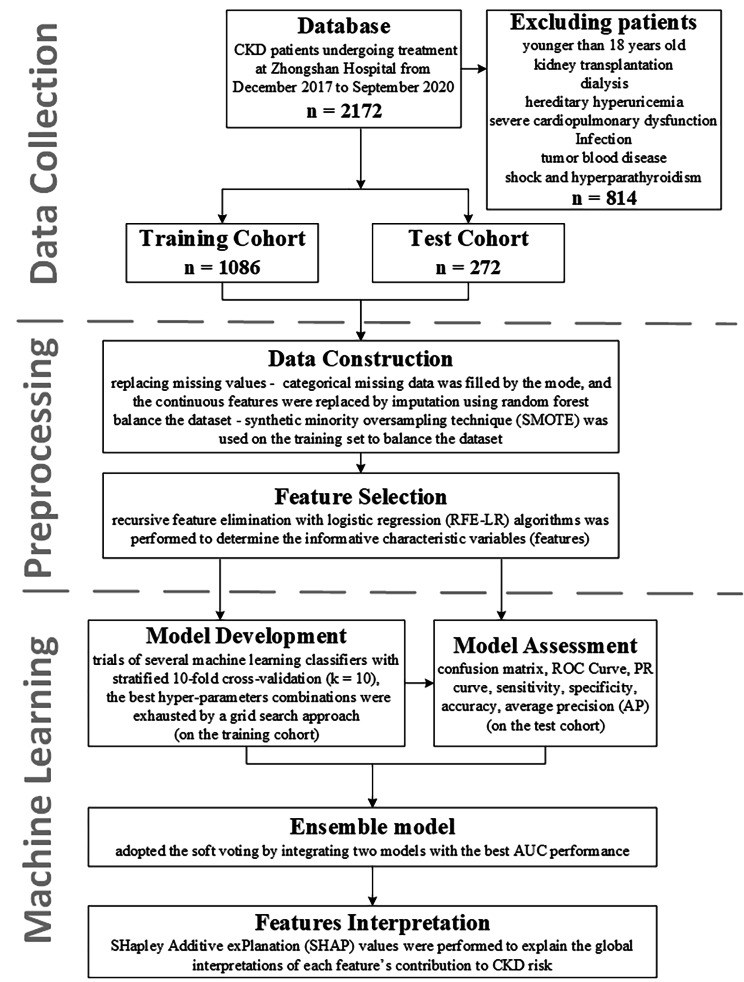
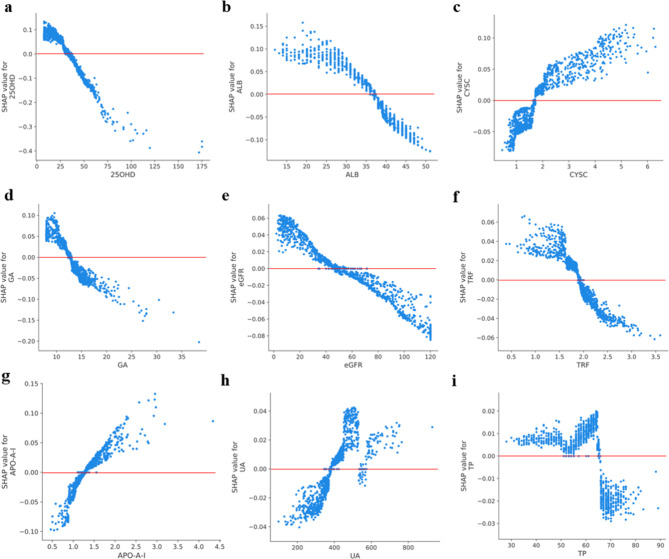
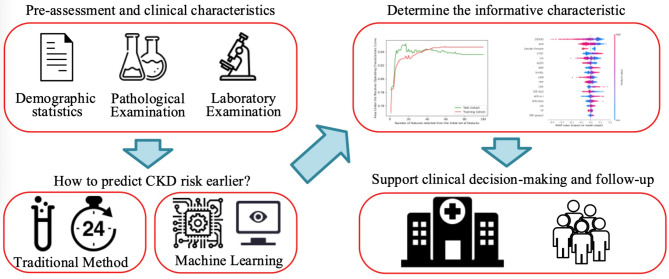
Methods: This study included data from 1,358 patients with CKD pathologically confirmed during the period from December 2017 to September 2020 at Zhongshan Hospital. A CKD prediction interpretation framework based on machine learning was proposed. From among 100 variables, 17 were selected for the model construction through a recursive feature elimination with logistic regression feature screening. Several machine learning classifiers, including extreme gradient boosting, gaussian-based naive bayes, a neural network, ridge regression, and linear model logistic regression (LR), were trained, and an ensemble model was developed to predict 24-hour urine protein. The detailed relationship between the risk of CKD progression and these predictors was determined using a global interpretation. A patient-specific analysis was conducted using a local interpretation.
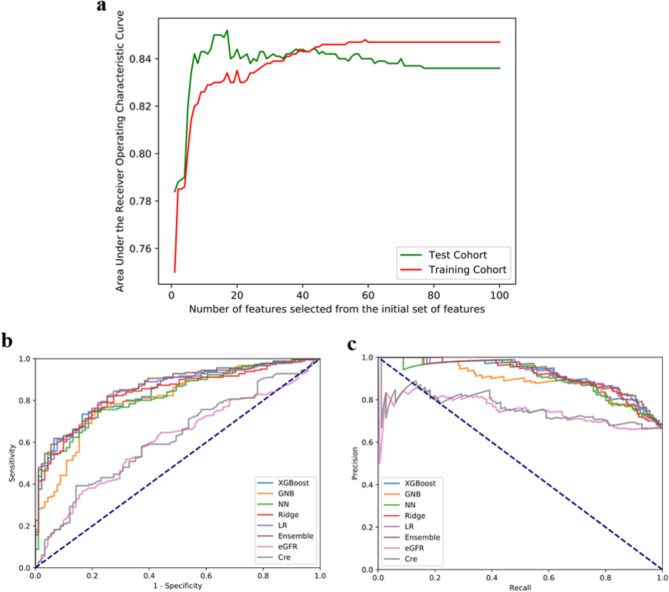
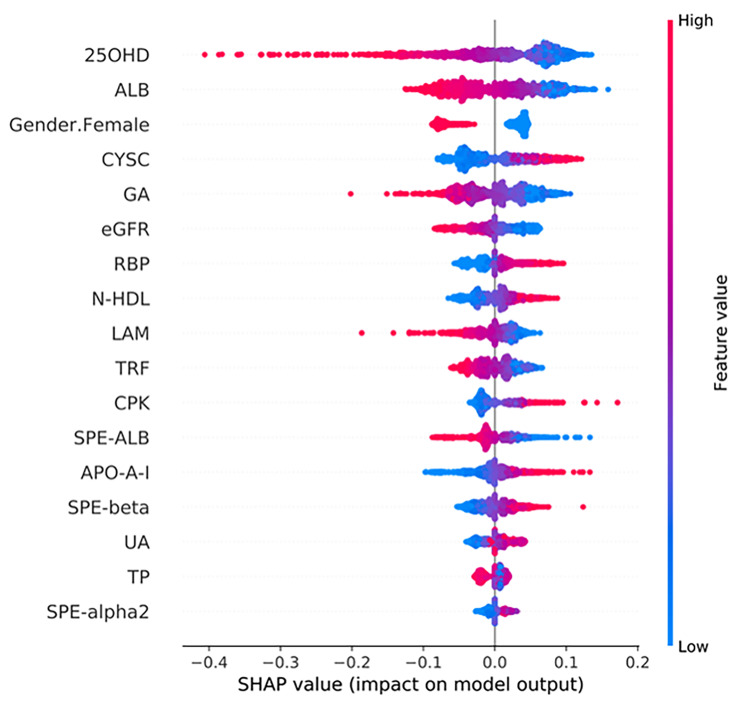
Results: The results showed that LR achieved the best performance, with an area under the curve (AUC) of 0.850 in a single machine learning model. The ensemble model constructed using the voting integration method further improved the AUC to 0.856. The major predictors of moderate-to-severe severity included lower levels of 25-OH-vitamin, albumin, transferrin in males, and higher levels of cystatin C.
Conclusions: Compared with the clinical single kidney function evaluation indicators (eGFR, Scr), the machine learning model proposed in this study improved the prediction accuracy of CKD progression by 17.6% and 24.6%, respectively, and the AUC was improved by 0.250 and 0.236, respectively. Our framework can achieve a good predictive interpretation and provide effective clinical decision support.
Keywords: Chronic kidney disease; Clinical decision support; Machine learning; Model interpretation.
© 2023. BioMed Central Ltd., part of Springer Nature.
Conflict of interest statement
The authors declare no competing interests.
Figures
References
-
- Robinson BM, Akizawa T, Jager KJ, Kerr PG, Saran R, Pisoni RL. Factors affecting outcomes in patients reaching end-stage kidney disease worldwide: differences in access to renal replacement therapy, modality use, and haemodialysis practices. Lancet. 2016;388(10041):294–306. doi: 10.1016/S0140-6736(16)30448-2. - DOI - PMC - PubMed
Publication types
MeSH terms
LinkOut - more resources
Full Text Sources
Medical
Research Materials
Miscellaneous
