


Crush syndrome: a review for prehospital providers and emergency clinicians
- PMID: 37653520
- PMCID: PMC10472640
- DOI: 10.1186/s12967-023-04416-9
Crush syndrome: a review for prehospital providers and emergency clinicians
Abstract
Introduction: Disasters and accidents have occurred with increasing frequency in recent years. Primary disasters have the potential to result in mass casualty events involving crush syndrome (CS) and other serious injuries. Prehospital providers and emergency clinicians stand on the front lines of these patients' evaluation and treatment. However, the bulk of our current knowledge, derived from historical data, has remained unchanged for over ten years. In addition, no evidence-based treatment has been established to date.
Objective: This narrative review aims to provide a focused overview of, and update on, CS for both prehospital providers and emergency clinicians.
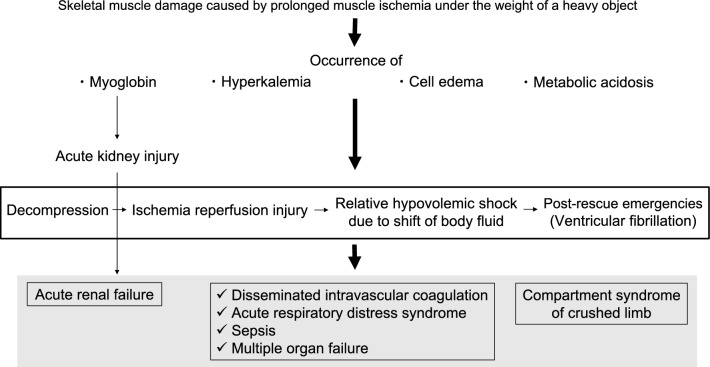
Discussion: CS is a severe systemic manifestation of trauma and ischemia involving soft tissue, principally skeletal muscle, due to prolonged crushing of tissues. Among earthquake survivors, the reported incidence of CS is 2-15%, and mortality is reported to be up to 48%. Patients with CS can develop cardiac failure, kidney dysfunction, shock, systemic inflammation, and sepsis. In addition, late presentations include life-threatening systemic effects such as hypovolemic shock, hyperkalemia, metabolic acidosis, and disseminated intravascular coagulation. Immediately beginning treatment is the single most important factor in reducing the mortality of disaster-situation CS. In order to reduce complications from CS, early, aggressive resuscitation is recommended in prehospital settings, ideally even before extrication. However, in large-scale natural disasters, it is difficult to diagnose CS, and to reach and start treatments such as continuous administration of massive amounts of fluid, diuresis, and hemodialysis, on time. This may lead to delayed diagnosis of, and high on-site mortality from, CS. To overcome these challenges, new diagnostic and therapeutic modalities in the CS animal model have recently been advanced.
Conclusions: Patient outcomes can be optimized by ensuring that prehospital providers and emergency clinicians maintain a comprehensive understanding of CS. The field is poised to undergo significant advances in coming years, given recent developments in what is considered possible both technologically and surgically; this only serves to further emphasize the importance of the field, and the need for ongoing research.
Keywords: Crush injury; Crush syndrome; Disaster; Ischemia reperfusion; Outcome; Treatment.
© 2023. BioMed Central Ltd., part of Springer Nature.
Conflict of interest statement
The authors declare that they have no competing interests.
.
Figures
References
-
- Long B, Liang SY, Gottlieb M. Crush injury and syndrome: a review for emergency clinicians. Am J Emerg Med. 2023;69:180–187. - PubMed
-
- Genthon A, Wilcox SR. Crush syndrome: a case report and review of the literature. J Emerg Med. 2014;46(2):313–319. - PubMed
-
- Strauss MB. The effect of hyperbaric oxygen in crush injuries and skeletal muscle-compartment syndromes. Undersea Hyperb Med. 2012;39(4):847–855. - PubMed
Publication types
MeSH terms
LinkOut - more resources
Full Text Sources
Medical
