


Efficacy and safety of human gut-derived multi-strain probiotics in patients with irritable bowel syndrome: A prospective open-label observation study
- PMID: 37653742
- PMCID: PMC10470732
- DOI: 10.1097/MD.0000000000034899
Efficacy and safety of human gut-derived multi-strain probiotics in patients with irritable bowel syndrome: A prospective open-label observation study
Abstract
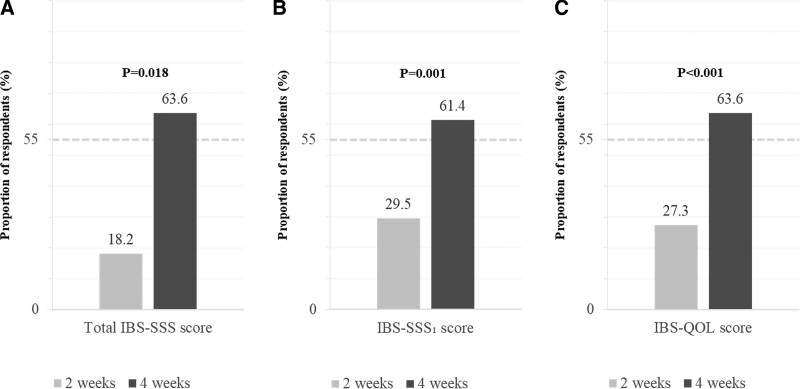
This study aimed to investigate the efficacy and safety of human gut-derived multi-strain probiotics in patients with irritable bowel syndrome (IBS). This was an open-label, prospective, observational study. Patients with IBS were administered human gut-derived multi-strain probiotics for 4 weeks. The primary and secondary outcomes were based on the overall responder rate of the total IBS severity scoring system (IBS-SSS) score (>50-point decrease) and the IBS quality of life (IBS-QOL) score and IBS-SSS1 subscore (>10-point decrease in both scores), respectively. The estimated response rate is 55%. Of 44 patients, the total IBS-SSS score responder rate was 18.2% and 63.6% of patients at 2 and 4 weeks, respectively (P = .018). Compared with baseline, a significant improvement in the IBS-QOL score was observed in 27.3% and 63.6% of patients at 2 and 4 weeks, respectively (P = .001). Overall improvement rates in the IBS-SSS1 subscore were observed in 29.5% and 61.4% of patients at 2 and 4 weeks, respectively (P < .001). Primary and secondary outcomes were higher at 4 weeks (total IBS-SSS score, 63.6%; IBS-QOL score, 63.6%; IBS-SSS1 subscore, 61.4%) than the estimated responder rate (55%). Human gut-derived multi-strain probiotics have the potential to become an effective and safe treatment option for IBS patients.
Copyright © 2023 the Author(s). Published by Wolters Kluwer Health, Inc.
Conflict of interest statement
The authors have no conflicts of interest to disclose.
Figures
References
-
- Palsson OS, Whitehead W, Törnblom H, et al. Prevalence of Rome IV functional bowel disorders among adults in the United States, Canada, and the United Kingdom. Gastroenterology. 2020;158:1262–1273.e3. - PubMed
-
- Lacy BE, Mearin F, Chang L, et al. Bowel disorders. Gastroenterology. 2016;150:1393–1407.e5. - PubMed
-
- Black CJ, Ford AC. Global burden of irritable bowel syndrome: trends, predictions and risk factors. Nat Rev Gastroenterol Hepatol. 2020;17:473–86. - PubMed
-
- Oka P, Parr H, Barberio B, et al. Global prevalence of irritable bowel syndrome according to Rome III or IV criteria: a systematic review and meta-analysis. Lancet Gastroenterol Hepatol. 2020;5:908–17. - PubMed
-
- Chang L. Epidemiology and quality of life in functional gastrointestinal disorders. Aliment Pharmacol Ther. 2004;20:31–9. - PubMed
Publication types
MeSH terms
LinkOut - more resources
Full Text Sources
