


Using machine learning to detect sarcopenia from electronic health records
- PMID: 37654711
- PMCID: PMC10467215
- DOI: 10.1177/20552076231197098
Using machine learning to detect sarcopenia from electronic health records
Abstract
Introduction: Sarcopenia (low muscle mass and strength) causes dysmobility and loss of independence. Sarcopenia is often not directly coded or described in electronic health records (EHR). The objective was to improve sarcopenia detection using structured data from EHR.
Methods: Adults undergoing musculoskeletal testing (December 2017-March 2020) were classified as meeting sarcopenia thresholds for 0 (controls), ≥1 (Sarcopenia-1), or ≥2 (Sarcopenia-2) tests. Electronic health record diagnoses, medications, and laboratory testing were extracted from the Indiana Network for Patient Care. Five machine learning models were applied to EHR data for predicting sarcopenia.
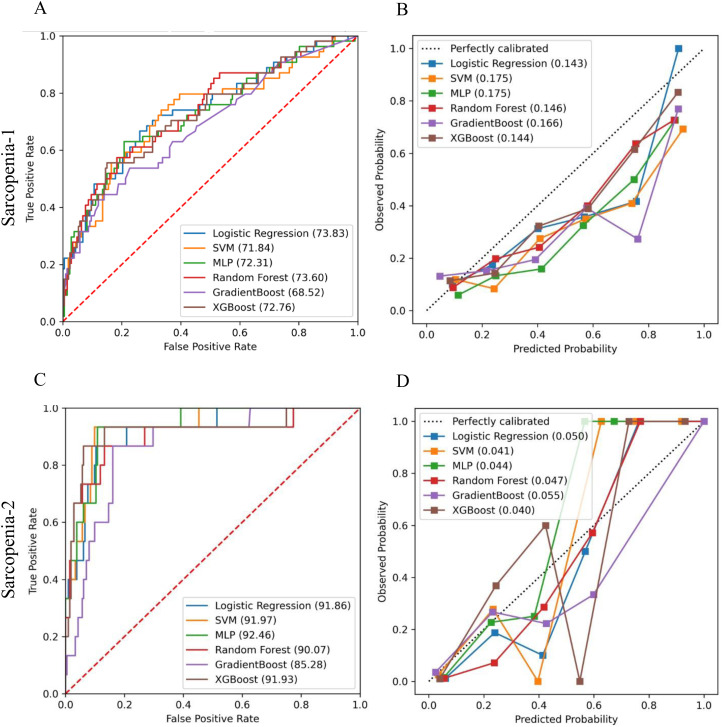
Results: Of 1304 participants, 1055 were controls, 249 met Sarcopenia-1 and 76 met Sarcopenia-2. Sarcopenic participants were older, with higher fat mass, Charlson Comorbidity Index, and more chronic diseases. All models performed better for Sarcopenia-2 than Sarcopenia-1. The top performing models for Sarcopenia-1 were Logistic Regression [area under the curve (AUC) 71.59 (95% confidence interval [CI], 71.51-71.66)] and Multi-Layer Perceptron [AUC 71.48 (95%CI, 71.00-71.97)]. The top performing models for Sarcopenia-2 were Logistic Regression [AUC 91.44 (95%CI, 91.28-91.60)] and Support Vector Machine [AUC 90.81 (95%CI, 88.41-93.20)]. For the best Logistic Regression Model, important sarcopenia predictors included diabetes mellitus, digestive system complaints, signs and symptoms involving the nervous, musculoskeletal and respiratory systems, metabolic disorders, and kidney or urinary tract disorders. Opioids, corticosteroids, and antihyperlipidemic drugs were also more common among sarcopenic participants.
Conclusions: Applying machine learning models, sarcopenia can be predicted from structured data in EHR, which may be developed through future studies to facilitate large-scale early detection and intervention in clinical populations.
Keywords: Sarcopenia; health informatics; machine learning; musculoskeletal.
© The Author(s) 2023.
Figures
References
-
- Sandberg C, Johansson K, Christersson C, et al. Sarcopenia is common in adults with complex congenital heart disease. Int J Cardiol 2019; 296: 57–62. - PubMed
-
- Silva TLD, Mulder AP. Sarcopenia and poor muscle quality associated with severe obesity in young adults and middle-aged adults. Clin Nutr ESPEN 2021; 45: 299–305. - PubMed
-
- Rolland Y, Abellan van Kan G, Gillette-Guyonnet Set al. et al. Cachexia versus sarcopenia. Curr Opin Clin Nutr Metab Care 2011; 14: 15–21. - PubMed
Grants and funding
LinkOut - more resources
Full Text Sources
Miscellaneous
