


Prospective Multicenter Randomized Controlled Trial of Surgical Versus Nonsurgical Treatment for Acute Rockwood Type 3 Acromioclavicular Injury
- PMID: 37655239
- PMCID: PMC10467399
- DOI: 10.1177/23259671231190411
Prospective Multicenter Randomized Controlled Trial of Surgical Versus Nonsurgical Treatment for Acute Rockwood Type 3 Acromioclavicular Injury
Abstract
Background: Evidence for the superiority of surgical versus nonsurgical treatment of Rockwood type 3 acromioclavicular joint (ACJ) dislocation is still lacking.
Hypothesis: It was hypothesized that surgical treatment will outperform nonsurgical treatment.
Study design: Randomized controlled trial; Level of evidence, 1.
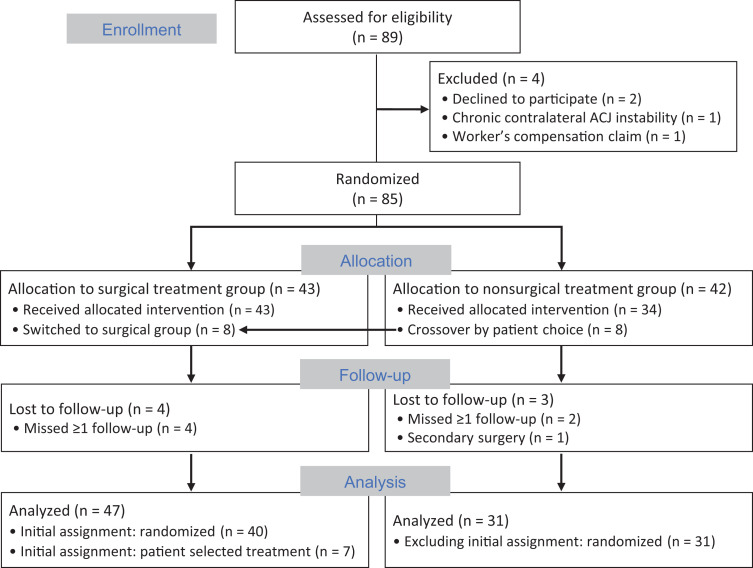
Methods: A prospective randomized trial involving 4 study centers was performed from January 1, 2011, to March 31, 2016. A total of 85 patients with acute Rockwood type 3 ACJ dislocations were allocated randomly to receive either nonsurgical or surgical treatment. A total of 70 patients were treated as allocated, and 8 patients made an early crossover from nonsurgical to surgical treatment, leaving 47 patients treated surgically and 31 patients nonsurgically. All patients were followed up longitudinally, including clinical evaluation using the Constant score and standardized radiographic evaluation, with final follow-up after 2 years.
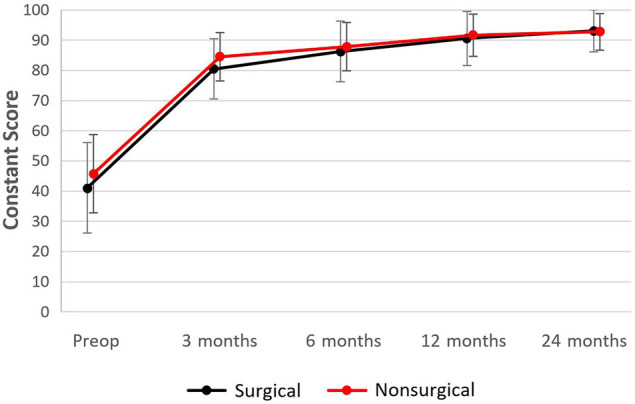
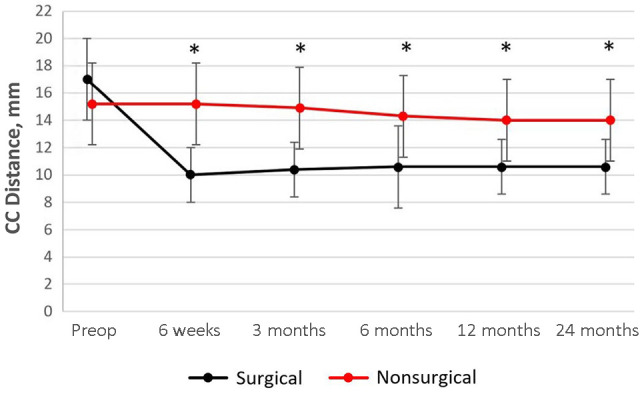
Results: At no follow-up time point was there a significant difference in Constant score between the surgically and nonsurgically treated patients. Radiographic analysis showed not only an inferior coracoclavicular distance at all follow-up points for surgical treatment but also a higher incidence of posttraumatic osteoarthritis and heterotopic ossifications, without any negative clinical correlation. With regard to complications, 1 patient (3%) in the nonsurgical group underwent secondary surgical ACJ stabilization. The revision rate after surgical treatment was 17% (P < .001). Neither primary horizontal instability nor younger age were associated with inferior clinical outcomes after nonsurgical treatment.
Conclusion: Surgical treatment of ACJ Rockwood type 3 injuries did not lead to superior functional outcomes. Neither younger age nor horizontal instability were associated with inferior outcomes after nonsurgical treatment. Surgical treatment led to a slower recovery and to higher complication and revision rates.
Registration: ISRCTN registry (study ID: ISRCTN92265154).
Keywords: Rockwood type 3; acromioclavicular dislocation; functional outcome; skillful neglect; surgery.
© The Author(s) 2023.
Conflict of interest statement
The authors have declared that there are no conflicts of interest in the authorship and publication of this contribution. AOSSM checks author disclosures against the Open Payments Database (OPD). AOSSM has not conducted an independent investigation on the OPD and disclaims any liability or responsibility relating thereto.
Figures
References
-
- Abdelrahman AA, Ibrahim A, Abdelghaffar K, Ghandour TM, Eldib D. Open versus modified arthroscopic treatment of acute acromioclavicular dislocation using a single tight rope: randomized comparative study of clinical outcome and cost-effectiveness. J Shoulder Elbow Surg. 2019;28(11):2090–2097. - PubMed
-
- Alexander OM. Dislocation of the acromioclavicular joint. Radiography. 1949;15(179):260, illust. - PubMed
-
- Balke M, Schneider MM, Shafizadeh S, Bäthis H, Bouillon B, Banerjee M. Current state of treatment of acute acromioclavicular joint injuries in Germany: is there a difference between specialists and non-specialists? A survey of German trauma and orthopaedic departments. Knee Surg Sports Traumatol Arthrosc. 2015;23(5):1447–1452. - PubMed
-
- Barth J, Duparc F, Andrieu K, et al. Is coracoclavicular stabilisation alone sufficient for the endoscopic treatment of severe acromioclavicular joint dislocation (Rockwood types III, IV, and V)? Orthop Traumatol Surg Res. 2015;101(8 suppl):S297–S303. - PubMed
-
- Beitzel K, Cote MP, Apostolakos J, et al. Current concepts in the treatment of acromioclavicular joint dislocations. Arthroscopy. 2013;29(2):387–397. - PubMed
LinkOut - more resources
Full Text Sources
