


Comparison of Arthroscopic Single-row and Double-row Repair for Rotator Cuff Injuries With Different Tear Sizes: A Systematic Review and Meta-analysis
- PMID: 37655249
- PMCID: PMC10467404
- DOI: 10.1177/23259671231180854
Comparison of Arthroscopic Single-row and Double-row Repair for Rotator Cuff Injuries With Different Tear Sizes: A Systematic Review and Meta-analysis
Abstract
Background: There is no clinical gold standard for the indications for single-row (SR) versus double-row (DR) repair according to small, large, or massive rotator cuff tear size.
Purpose: To conduct a meta-analysis to compare the clinical outcomes and retear rates after arthroscopic SR and DR repair for rotator cuff injuries with different tear sizes.
Study design: Systematic review; Level of evidence, 3.
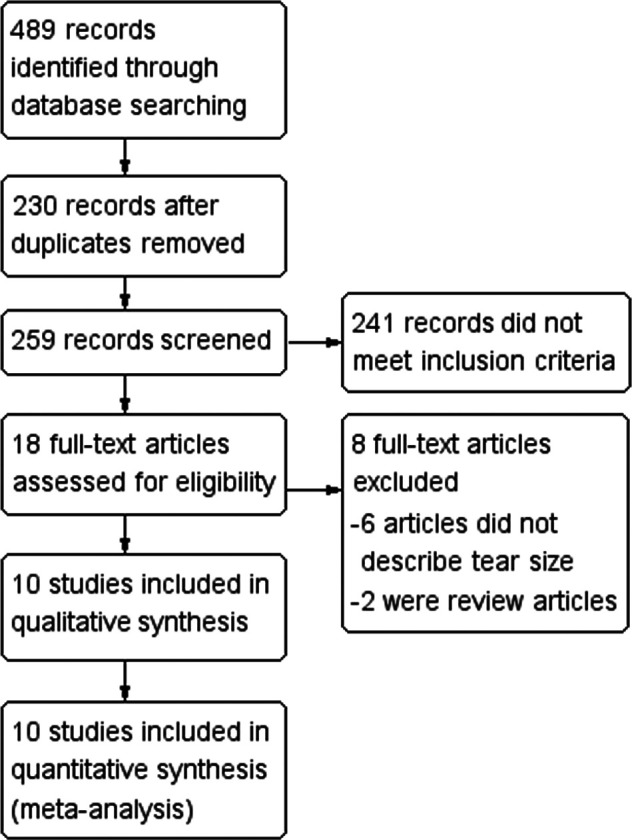
Methods: On the basis of PRISMA (Preferred Reporting Items for Systematic Reviews and Meta-Analyses) criteria, the PubMed, Embase, Cochrane Library databases, Web of Science, China National Knowledge Infrastructure, and China BioMedical Literature database were searched for relevant studies published before November 1, 2021, using the following search terms: "Rotator Cuff Injuries," "Rotator Cuff Tears," "Arthroscopy," "Arthroscopic Surgery," "single-row," and "double-row"; a total of 489 articles were retrieved. Quality evaluation was conducted for all the studies that met the inclusion criteria. This study evaluated the Constant-Murley score, American Shoulder and Elbow Surgeons (ASES) score, University of California, Los Angeles (UCLA) score, and range of motion (ROM) as well as retear rate. A fixed-effects or random-effects model was adopted to calculate the results and assess risk.
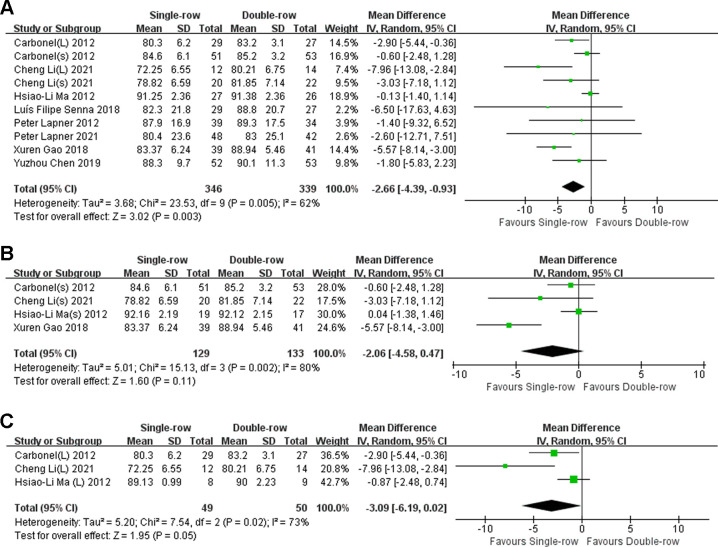
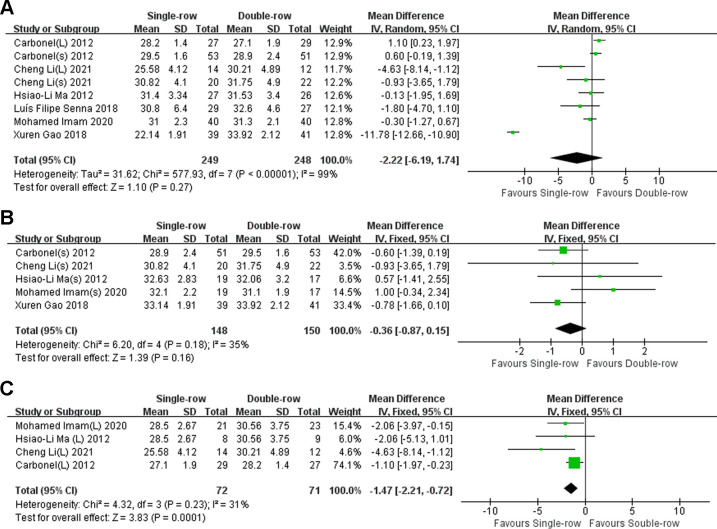
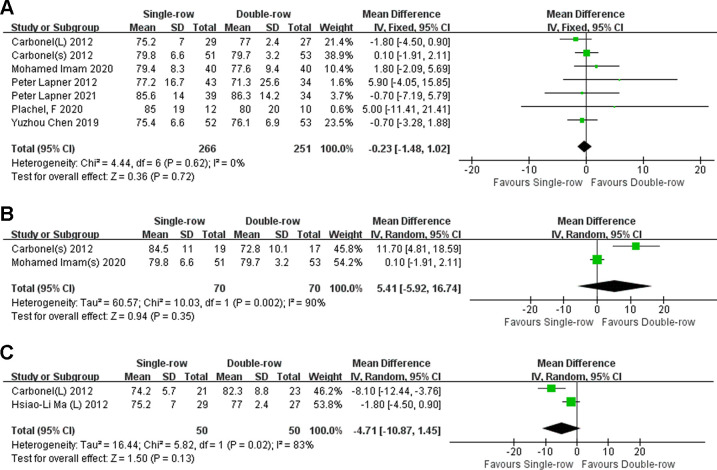
Results: A total of 10 clinical studies were included, with 404 cases of DR and 387 cases of SR. Regarding overall results, DR had better forward elevation ROM (mean difference [MD] = -4.03° [95% CI, -6.00° to -2.06°]; P < .0001; I 2 = 46%) and a lower retear rate (MD = 2.39 [95% CI, 1.40 to 4.08]; P = .001; I 2 = 0%) compared with SR repair. With regard to small tears (<3 cm), there was no noticeable difference on any of the 3 outcome scores between SR and DR. For large rotator cuff tears (≥3 cm), DR repair showed significantly better ASES scores (MD = -3.09 [95% CI, -6.19 to 0.02]; P = .05; I 2 = 73%) and UCLA scores (MD = -1.47 [95% CI, -2.21 to -0.72]; P = .0001; I 2 = 31%) compared with SR repair.
Conclusion: Our meta-analysis revealed that DR had better UCLA scores, ASES scores, and ROM in forward elevation and lower retear rates. In rotator cuff tears <3 cm, there were no statistical differences in clinical outcome between SR and DR.
Keywords: arthroscopic rotator cuff repair; clinical outcomes; double-row; fixation; rotator cuff injuries; single-row.
© The Author(s) 2023.
Conflict of interest statement
The authors have declared that there are no conflicts of interest in the authorship and publication of this contribution. AOSSM checks author disclosures against the Open Payments Database (OPD). AOSSM has not conducted an independent investigation on the OPD and disclaims any liability or responsibility relating thereto.
Figures



References
-
- Aleem AW, Syed UA, Wascher J, et al. Functional outcomes after bilateral arthroscopic rotator cuff repair. J Shoulder Elbow Surg. 2016;25(10):1668–1673. - PubMed
-
- Anderson K, Boothby M, Aschenbrener D, van Holsbeeck M. Outcome and structural integrity after arthroscopic rotator cuff repair using 2 rows of fixation: minimum 2-year follow-up. Am J Sports Med. 2006;34(12):1899–1905. - PubMed
-
- Avanzi P, Giudici LD, Capone A, et al. Prospective randomized controlled trial for patch augmentation in rotator cuff repair: 24-month outcomes. J Shoulder Elbow Surg. 2019;28(10):1918–1927. - PubMed
-
- Chen M, Xu W, Dong Q, Huang Q, Xie Z, Mao Y. Outcomes of single-row versus double-row arthroscopic rotator cuff repair: a systematic review and meta-analysis of current evidence. Arthroscopy. 2013;29(8):1437–1449. - PubMed
Publication types
LinkOut - more resources
Full Text Sources
Research Materials
Miscellaneous
