


Randomized Trial of Exercise and Nutrition on Chemotherapy Completion and Pathologic Complete Response in Women With Breast Cancer: The Lifestyle, Exercise, and Nutrition Early After Diagnosis Study
- PMID: 37656930
- PMCID: PMC10691793
- DOI: 10.1200/JCO.23.00871
Randomized Trial of Exercise and Nutrition on Chemotherapy Completion and Pathologic Complete Response in Women With Breast Cancer: The Lifestyle, Exercise, and Nutrition Early After Diagnosis Study
Abstract
Purpose: Successful completion of chemotherapy is critical to improve breast cancer outcomes. Relative dose intensity (RDI), defined as the ratio of chemotherapy delivered to prescribed, is a measure of chemotherapy completion and is associated with cancer mortality. The effect of exercise and eating a healthy diet on RDI is unknown. We conducted a randomized trial of an exercise and nutrition intervention on RDI and pathologic complete response (pCR) in women diagnosed with breast cancer initiating chemotherapy.
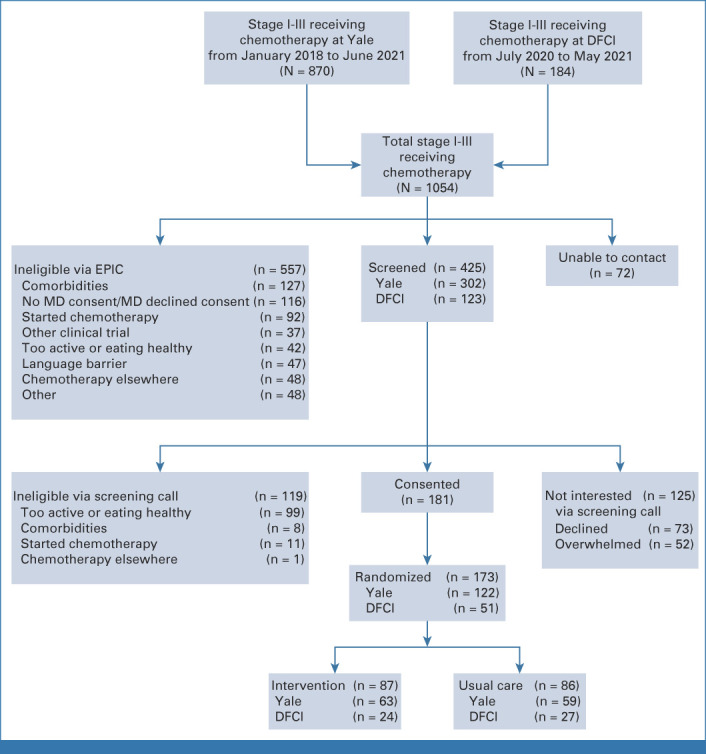
Methods: One hundred seventy-three women with stage I-III breast cancer were randomly assigned to usual care (UC; n = 86) or a home-based exercise and nutrition intervention with counseling sessions delivered by oncology-certified registered dietitians (n = 87). Chemotherapy dose adjustments and delays and pCR were abstracted from electronic medical records. T-tests and chi-square tests were used to examine the effect of the intervention versus UC on RDI and pCR.
Results: Participants randomly assigned to intervention had greater improvements in exercise and diet quality compared with UC (P < .05). RDI was 92.9% ± 12.1% and 93.6% ± 11.1% for intervention and UC, respectively (P = .69); the proportion of patients in the intervention versus UC who achieved ≥85% RDI was 81% and 85%, respectively (P = .44). The proportion of patients who had at least one dose reduction and/or delay was 38% intervention and 36% UC (P = .80). Among 72 women who received neoadjuvant chemotherapy, women randomly assigned to intervention were more likely to have a pCR than those randomly assigned to UC (53% v 28%; P = .037).
Conclusion: Although a diet and exercise intervention did not affect RDI, the intervention was associated with a higher pCR in patients with hormone receptor-positive/human epidermal growth factor receptor 2-negative and triple-negative breast cancer undergoing neoadjuvant chemotherapy.
Trial registration: ClinicalTrials.gov NCT03314688.
Conflict of interest statement
The following represents disclosure information provided by authors of this manuscript. All relationships are considered compensated unless otherwise noted. Relationships are self-held unless noted. I = Immediate Family Member, Inst = My Institution. Relationships may not relate to the subject matter of this manuscript. For more information about ASCO's conflict of interest policy, please refer to
Open Payments is a public database containing information reported by companies about payments made to US-licensed physicians (
No other potential conflicts of interest were reported.
Figures
References
-
- Siegel RL, Miller KD, Jemal A: Cancer statistics, 2020. CA Cancer J Clin 70:7e30, 2020 - PubMed
-
- Longo DL, Duffey PL, DeVita VT, et al. : The calculation of actual or received dose intensity: A comparison of published methods. J Clin Oncol 9:2042-2051, 1991 - PubMed
-
- Bonadonna G, Valagussa P, Moliterni A, et al. : Adjuvant cyclophosphamide, methotrexate, and fluorouracil in node-positive breast cancer: The results of 20 years of follow-up. N Engl J Med 332:901-906, 1995 - PubMed
-
- Weycker D, Barron R, Edelsberg J, et al. : Incidence of reduced chemotherapy relative dose intensity among women with early stage breast cancer in US clinical practice. Breast Cancer Res Treat 133:301-310, 2012 - PubMed
-
- Neilson HK, Farris MS, Stone CR, et al. : Moderate-vigorous recreational physical activity and breast cancer risk, stratified by menopause status: A systematic review and meta-analysis. Menopause 24:322-344, 2017 - PubMed
Publication types
MeSH terms
Associated data
Grants and funding
LinkOut - more resources
Full Text Sources
Medical
Research Materials
