


Active surveillance versus treatment in low-risk DCIS: Women's preferences in the LORD-trial
- PMID: 37657228
- PMCID: PMC10632767
- DOI: 10.1016/j.ejca.2023.113276
Active surveillance versus treatment in low-risk DCIS: Women's preferences in the LORD-trial
Abstract
Background: Ductal carcinoma in situ (DCIS) can progress to invasive breast cancer (IBC), but most DCIS lesions remain indolent. However, guidelines recommend surgery, often supplemented by radiotherapy. This implies overtreatment of indolent DCIS. The non-randomised patient preference LORD-trial tests whether active surveillance (AS) for low-risk DCIS is safe, by giving women with low-risk DCIS a choice between AS and conventional treatment (CT). Here, we aim to describe how participants are distributed among both trial arms, identify their motives for their preference, and assess factors associated with their choice.
Methods: Data were extracted from baseline questionnaires. Descriptive statistics were used to assess the distribution and characteristics of participants; thematic analyses to extract self-reported reasons for the choice of trial arm, and multivariable logistic regression analyses to investigate associations between patient characteristics and chosen trial arm.
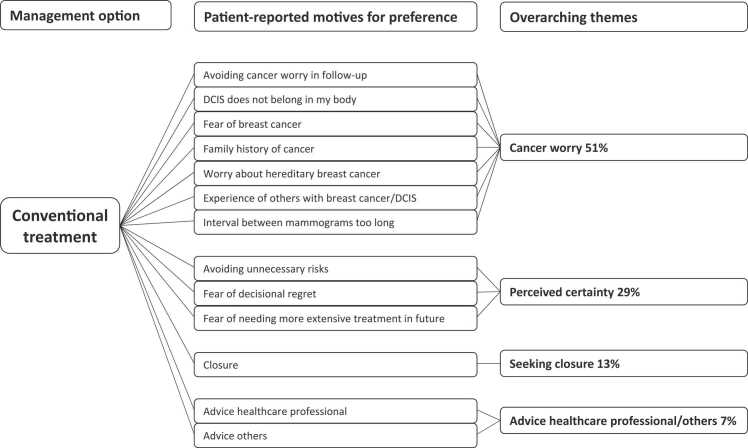
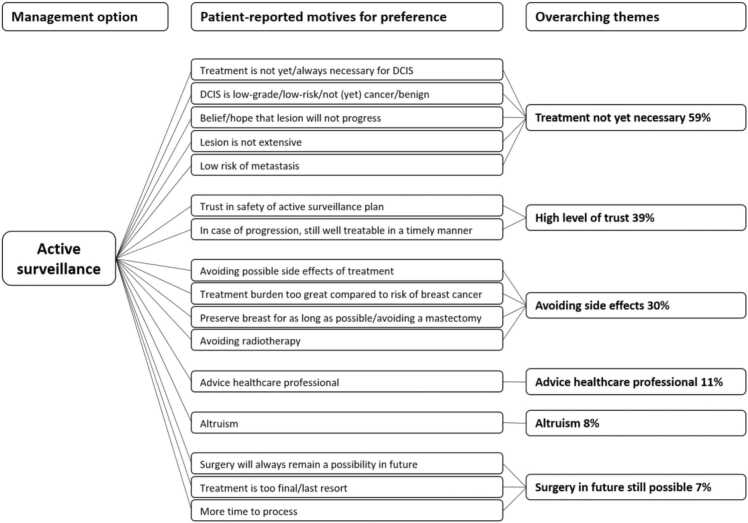
Results: Of 377 women included, 76% chose AS and 24% CT. Most frequently cited reasons for AS were "treatment is not (yet) necessary" (59%) and trust in the AS-plan (39%). Reasons for CT were cancer worry (51%) and perceived certainty (29%). Women opting for AS more often had lower educational levels (OR 0.45; 95% confidence interval [CI], 0.22-0.93) and more often reported experiencing shared decision making (OR 2.71; 95% CI, 1.37-5.37) than women choosing CT.
Conclusion: The LORD-trial is the first to offer women with low-risk DCIS a choice between CT and AS. Most women opted for AS and reported high levels of trust in the safety of AS. Their preferences highlight the necessity to establish the safety of AS for low-risk DCIS.
Keywords: DCIS; Patient preference; Shared decision making.
Copyright © 2023 The Authors. Published by Elsevier Ltd.. All rights reserved.
Conflict of interest statement
Declaration of Competing Interest The authors declare that they have no known competing financial interests or personal relationships that could have appeared to influence the work reported in this paper.
Figures
References
-
- Shapiro S., Coleman E.A., Broeders M., et al. Breast cancer screening programmes in 22 countries: current policies, administration and guidelines. International Breast Cancer Screening Network (IBSN) and the European Network of Pilot Projects for Breast Cancer Screening. Int J Epidemiol. 1998;27(5):735–742. doi: 10.1093/ije/27.5.735. - DOI - PubMed
-
- van Luijt P.A., Fracheboud J., Heijnsdijk E.A., den Heeten G.J., de Koning H.J., National Evaluation Team for Breast Cancer Screening in Netherlands Study G Nation-wide data on screening performance during the transition to digital mammography: observations in 6 million screens. Eur J Cancer. 2013;49(16):3517–3525. doi: 10.1016/j.ejca.2013.06.020. - DOI - PubMed
-
- Vinnicombe S., Pinto Pereira S.M., McCormack V.A., Shiel S., Perry N., Dos Santos Silva I.M. Full-field digital versus screen-film mammography: comparison within the UK breast screening program and systematic review of published data. Radiology. 2009;251(2):347–358. doi: 10.1148/radiol.2512081235. - DOI - PubMed
Publication types
MeSH terms
LinkOut - more resources
Full Text Sources
Medical
Research Materials
