Association of Motor Function With Cognitive Trajectories and Structural Brain Differences: A Community-Based Cohort Study
- PMID: 37657942
- PMCID: PMC10624482
- DOI: 10.1212/WNL.0000000000207745
Association of Motor Function With Cognitive Trajectories and Structural Brain Differences: A Community-Based Cohort Study
Erratum in
-
Corrections to Received Date Information.Neurology. 2024 Jul 9;103(1):e209596. doi: 10.1212/WNL.0000000000209596. Epub 2024 Jun 3. Neurology. 2024. PMID: 38830175 Free PMC article. No abstract available.
Abstract
Background and objectives: The association of motor function with cognitive health remains controversial, and the mechanisms underlying this relationship are unclear. We aimed to examine the association between motor function and long-term cognitive trajectories and further explore the underlying mechanisms using brain MRI.
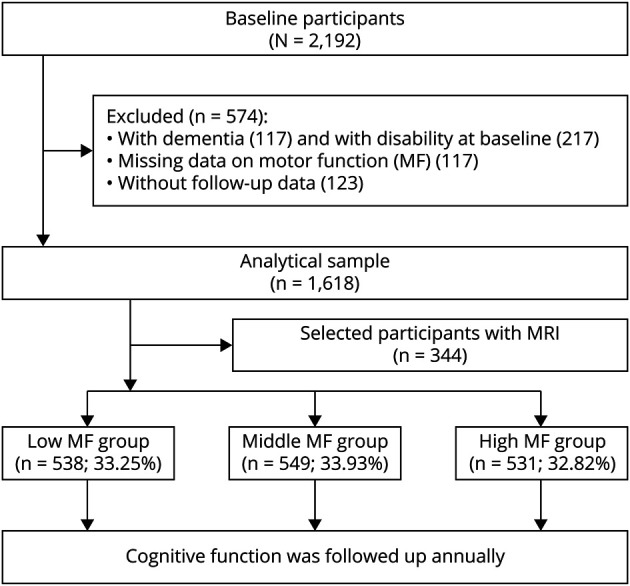
Methods: In the Rush Memory and Aging Project, a prospective cohort study, a total of 2,192 volunteers were recruited from the communities in northeastern Illinois and followed up for up to 22 years (from 1997 to 2020). Individuals with dementia, disability, missing data on motor function at baseline, and missing follow-up data on cognitive function were excluded. At baseline, global motor function was evaluated using the averaged z scores of 10 motor tests covering dexterity, gait, and hand strength; the composite score was tertiled as low, moderate, or high. Global and domain-specific cognitive functions-including episodic memory, semantic memory, working memory, visuospatial ability, and perceptual speed-were measured annually through 19 cognitive tests. A subsample (n = 401) underwent brain MRI scans and regional brain volumes were measured. Data were analyzed using linear mixed-effects models and linear regression.
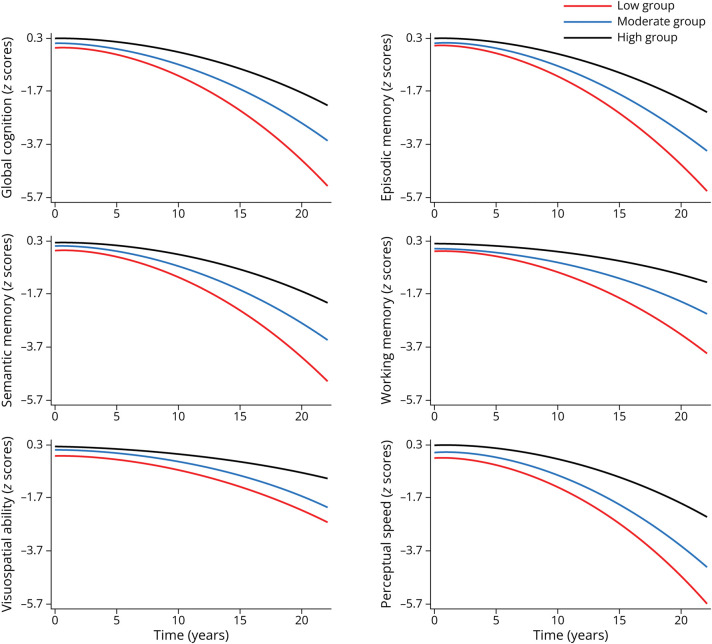
Results: Among the 1,618 participants (mean age 79.45 ± 7.32 years) included in this study, baseline global motor function score ranged from 0.36 to 1.82 (mean 1.03 ± 0.22). Over the follow-up (median 6.03 years, interquartile range 3.00-10.01 years), low global motor function and its subcomponents were related to significantly faster declines in global cognitive function (β = -0.005, 95% CI -0.006 to -0.005) and each of the 5 cognitive domains. Of the 344 participants with available MRI data, low motor function was also associated with smaller total brain (β = -25.848, 95% CI -44.902 to -6.795), total white matter (β = -18.252, 95% CI -33.277 to -3.226), and cortical white matter (β = -17.503, 95% CI -32.215 to -2.792) volumes, but a larger volume of white matter hyperintensities (β = 0.257, 95% CI 0.118-0.397).
Discussion: Low motor function is associated with an accelerated decline in global and domain-specific cognitive functions. Both neurodegenerative and cerebrovascular pathologies might contribute to this association.
Copyright © 2023 The Author(s). Published by Wolters Kluwer Health, Inc. on behalf of the American Academy of Neurology.
Conflict of interest statement
Z. Wang, J. Wang, J. Guo, A. Dove, K. Arfanakis, and X. Qi report no disclosures relevant to the manuscript. D.A. Bennett received grants from the NIH (R01AG17917). W. Xu received grants from the Swedish Research Council (No. 2021-01647), the Swedish Council for Health Working Life and Welfare (2021-01826), Lindhés Advokatbyrå AB (2021-0134), and Stiftelsen För Gamla Tjänarinnor (2021–2022). Go to
Figures
References
MeSH terms
LinkOut - more resources
Full Text Sources
Medical