


A scoping review of risk factors for urinary incontinence in older men
- PMID: 37660036
- PMCID: PMC10474661
- DOI: 10.1186/s12877-023-04249-7
A scoping review of risk factors for urinary incontinence in older men
Abstract
Background: Most epidemiological studies have not systematically identified or categorized risk factors for urinary incontinence (UI) in older men, despite a higher prevalence than in younger men. Considering the burden of UI, an understanding of risk factors can inform cost-effective prevention/treatment programs. This scoping review aimed to identify and categorise risk factors for UI in older men, identify gaps in the evidence, and opportunities for future research.
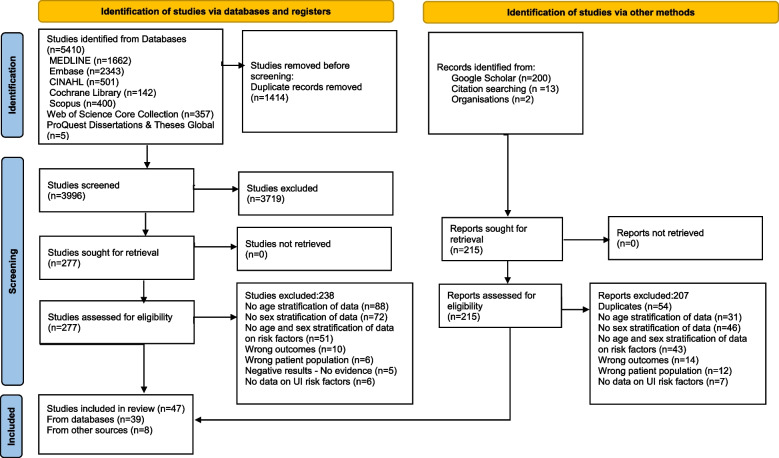
Methods: The Joanna Briggs Institute (JBI) method for scoping reviews guided the conduct and reporting of this review alongside the Preferred Reporting Items for Systematic Reviews and Meta-analyses extension for scoping reviews checklist. JBI's Population, Concept, and Context approach framed the inclusion criteria (all evidence sources on UI risk factors that included older men [65 +]). We employed JBI's three-step search strategy, which included a limited initial search in Ovid MEDLINE, a detailed comprehensive database search, and a search of reference lists of included studies, Google Scholar and grey literature. There were no restrictions on language, study type, or publication date. Two independent reviewers screened, selected, and extracted eligible studies. Data were analyzed using descriptive statistics and qualitative content analysis.
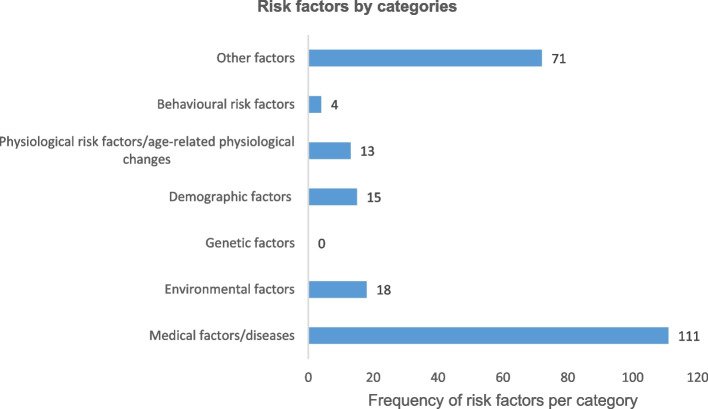
Results: Forty-seven articles that met the inclusion criteria identified 98 risk factors across six categories. Behavioural risk factors, reported by only two studies, were the least investigated of all the categories, whereas medical factors/diseases were the most investigated. No genetic factors were documented. The top five risk factors were increasing age/advanced age (n = 12), Benign Prostatic Hyperplasia (n = 11), Diabetes Mellitus (n = 11), Detrusor overactivity (n = 10), limitation in physical function/ADL disability (n = 10), increased Body Mass Index (BMI)/overweight/obesity (n = 8), Dementia (n = 8), and Parkinson's disease (n = 7).
Conclusion: There is a dearth of evidence to describe the role behavioural risk factors have in UI in older men. These factors may play a role in health promotion and disease prevention in this area.
Registration: A protocol detailing the methods was developed and published, and is registered in the Open Science Framework [Feb 07 2023; https://osf.io/xsrge/ ].
Keywords: Aging; Geriatrics; Older men; Risk factors; Scoping review; Urinary incontinence.
© 2023. BioMed Central Ltd., part of Springer Nature.
Conflict of interest statement
The authors declare no competing interests.
Figures


References
-
- D’Ancona C, Haylen B, Oelke M, Abranches-Monteiro L, Arnold E, Goldman H, et al. The International Continence Society (ICS) report on the terminology for adult male lower urinary tract and pelvic floor symptoms and dysfunction. Neurourol Urodyn. 2019;38(2):433–477. - PubMed
-
- Yates A. Addressing the gender gap in urinary continence care. Br J Community Nurs. 2021;26(5):228–234. - PubMed
-
- The Canadian Continence Foundation. The impact of incontinence in Canada. A briefing document for policy makers. 2014. Available from: https://www.canadiancontinence.ca/pdfs/en-impact-of-incontinence-in-cana....
Publication types
MeSH terms
LinkOut - more resources
Full Text Sources
Medical
Miscellaneous
