


Caffeine and kidney function at two years in former extremely low gestational age neonates
- PMID: 37660176
- PMCID: PMC11293578
- DOI: 10.1038/s41390-023-02792-y
Caffeine and kidney function at two years in former extremely low gestational age neonates
Abstract
Background: Extremely low gestational age neonates (ELGANs) are at risk for chronic kidney disease. The long-term kidney effects of neonatal caffeine are unknown. We hypothesize that prolonged caffeine exposure will improve kidney function at 22-26 months.
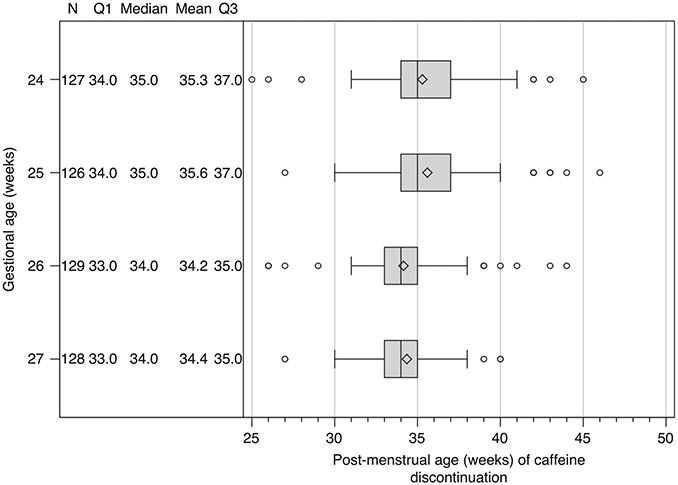
Methods: Secondary analysis of the Preterm Erythropoietin Neuroprotection Trial of neonates <28 weeks' gestation. Participants included if any kidney outcomes were collected at 22-26 months corrected age. Exposure was post-menstrual age of caffeine discontinuation.
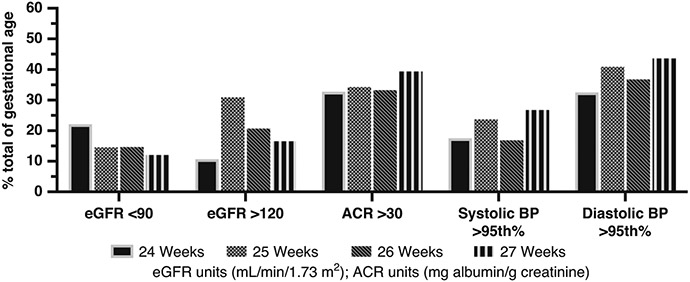
Primary outcomes: 'reduced eGFR' <90 ml/min/1.73 m2, 'albuminuria' (>30 mg albumin/g creatinine), or 'elevated blood pressure' (BP) >95th %tile. A general estimating equation logistic regression model stratified by bronchopulmonary dysplasia (BPD) status was used.
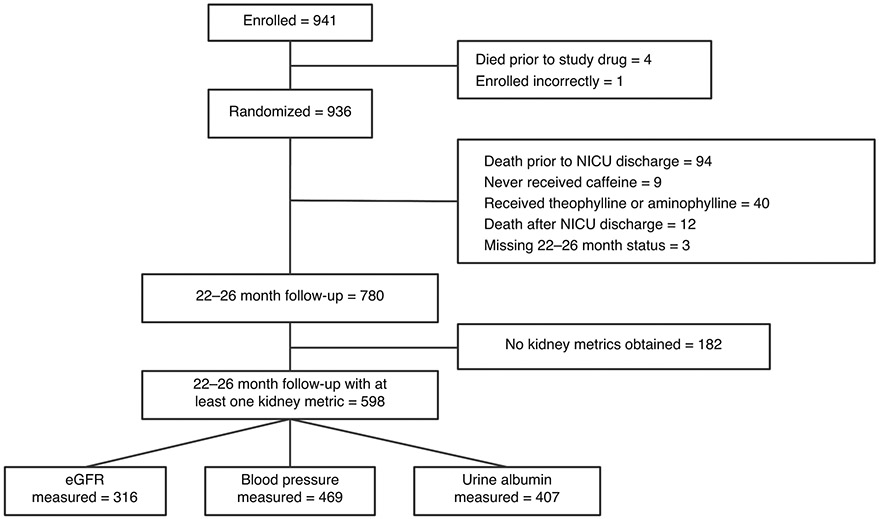
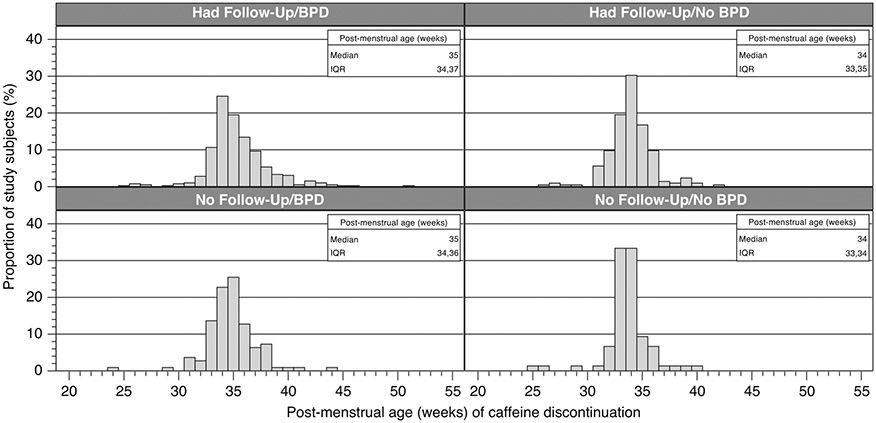
Results: 598 participants had at least one kidney metric at follow up. Within the whole cohort, postmenstrual age of caffeine discontinuation was not associated with any abnormal measures of kidney function at 2 years. In the stratified analysis, for each additional week of caffeine, the no BPD group had a 21% decreased adjusted odds of eGFR <90 ml/min/1.73m2 (aOR 0.78; CI 0.62-0.99) and the BPD group had a 15% increased adjusted odds of elevated BP (aOR 1.15; CI: 1.05-1.25).
Conclusions: Longer caffeine exposure during the neonatal period is associated with differential kidney outcomes at 22-26 months dependent on BPD status.
Impact: In participants born <28 weeks' gestation, discontinuation of caffeine at a later post menstrual age was not associated with abnormal kidney outcomes at 22-26 months corrected age. When assessed at 2 years of age, later discontinuation of caffeine in children born <28 weeks' gestation was associated with a greater risk of reduced eGFR in those without a history of BPD and an increased odds of hypertension in those with a history of BPD. More work is necessary to understand the long-term impact of caffeine on the developing kidney.
© 2023. The Author(s), under exclusive licence to the International Pediatric Research Foundation, Inc.
Conflict of interest statement
COMPETING INTERESTS
All authors declare no real or perceived conflicts of interest that could affect the study design, collection, analysis, and interpretation of data, writing of the report, or the decision to submit for publication. For full disclosure, we provide here an additional list of other author’s commitments and funding sources that are not directly related to this study: M.W.H. receives research funding unrelated to this project from the NIH, Wisconsin Partnership Program, and Meriter Foundation. D.J.A. is a consultant for Baxter, Nuwellis, Medtronic Bioporto, and Seastar. His institution receives grant funding for education and research that is not related to this project from NIH, Baxter, Nuwellis, Medtronic, Bioporto, and Seastar. He has patents pending on inventions to improve the kidney care of neonates. He is the Founder and Chief Scientific Officer for Zorro-Flow. J.R.C. is a consultant for Medtronics and investor in Zorro-Flow. She receives funding for research not related to this project from the NIH. She is Vice-President of the Neonatal Kidney Collaborative. R.Guillet is a consultant for NEMA Research. She receives funding for research not related to this project from NIH. C.S. is a consultant for AM Pharma which is unrelated to the content in this manuscript. Meredith Schuh receives research funding unrelated to this project from NIH and Otsuka
Figures
References
-
- Mammen C. et al. Long-term risk of CKD in children surviving episodes of acute kidney injury in the intensive care unit: a prospective cohort study. Am. J. Kidney Dis 59, 523–530 (2012). - PubMed
MeSH terms
Substances
Grants and funding
LinkOut - more resources
Full Text Sources
Medical
Research Materials
Miscellaneous
