


The relationship between quadriceps femoris thickness measured by US and femoral cartilage thickness in knee osteoarthritis, its effect on radiographic stage and clinical parameters: comparison with healthy young population
- PMID: 37663162
- PMCID: PMC10472037
- DOI: 10.22540/JFSF-08-155
The relationship between quadriceps femoris thickness measured by US and femoral cartilage thickness in knee osteoarthritis, its effect on radiographic stage and clinical parameters: comparison with healthy young population
Abstract
Objective: In this study, we aimed to investigate the relationship between quadriceps muscle thickness and femoral cartilage thickness measured by ultrasonography (US) in knee osteoarthritis (OA), to correlate this relationship with radiographic stage and clinical parameters, and to compare these values with those in healthy young adults.
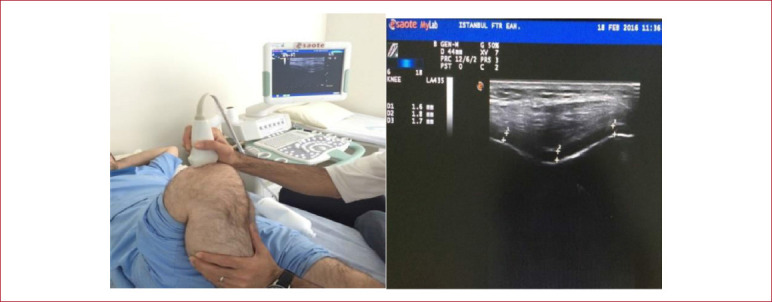
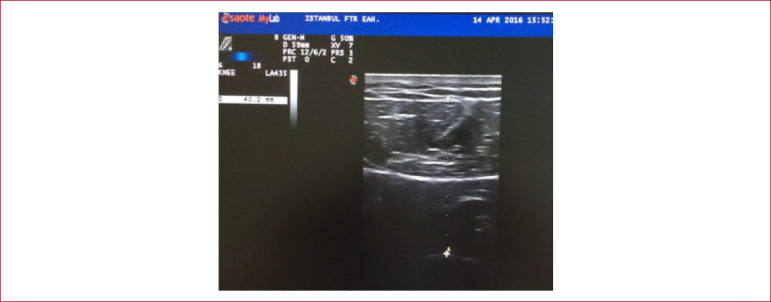
Methods: A total of 71 patients with knee osteoarthritis and 31 healthy young adults were included in the study. Patients with knee osteoarthritis (Group 1) and healthy young adults (Group 2) were divided into two groups. Muscle thickness measurements of the quadriceps femoris muscle (M. vastus intermedius + M. rectus femoris) were performed by US.
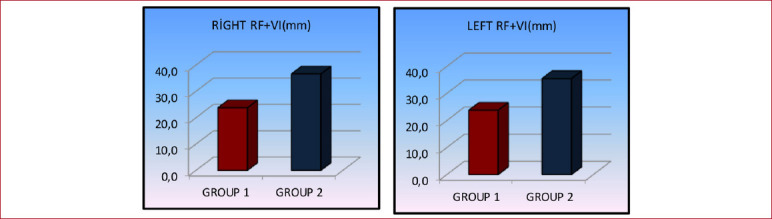
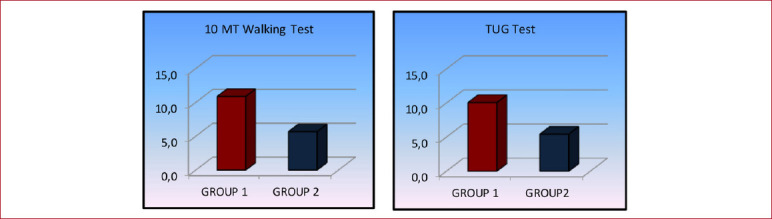
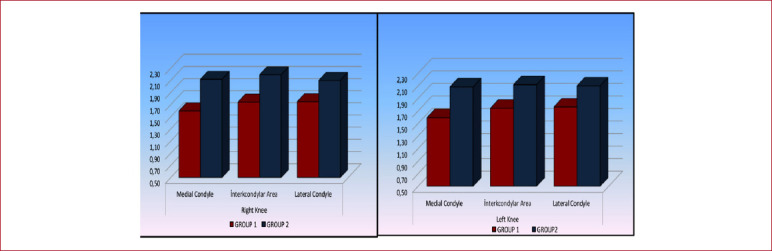
Results: Bilateral quadriceps muscle thickness and bilateral femoral cartilage thickness values were significantly lower in Group 1 than in Group 2. The 10-metre walk test score and Time Up and Go (TUG) test score were significantly higher in Group 1 than in Group 2. A strong positive correlation was found between bilateral quadriceps (RF+VI) muscle thickness and bilateral femoral cartilage thickness (medial, intercondylar, lateral) in Group 1.
Conclusions: This study showed a strong positive correlation between quadriceps thickness and femoral cartilage thickness. According to these results, we conclude that US may have a place in the diagnosis of knee osteoarthritis.
Keywords: Cartilge thickness; Knee osteoarthritis; Quadriceps muscule thickness; US.
Copyright: © 2023 Hylonome Publications.
Figures
References
-
- Brandt KD, Dieppe P, Radin EL. Etiopathogenesis of osteoarthritis. Rheum Dis Clin N Am. 2008;34(3):531–559. - PubMed
-
- Sharma L, Pai YC. Impaired proprioception and osteoarthritis. Curr Opin Rheumatol. 1997;9(3):253–258. - PubMed
-
- Liikavainio T, Lyytinen T, Tyrväinen E, et al. Physical function and prop-erties of quadriceps femoris muscle in men with knee osteoarthritis. Arch Phys Med Rehabil. 2008;89(11):2185–2194. - PubMed
-
- Chi-Fishman G, Hicks JE, Cintas HM, et al. Ultrasound imaging distin-guishes between normal and weak muscle. Arch Phys Med Rehabil. 2004;85(6):980–986. - PubMed
-
- Freilich RJ, Kirsner RL, Byrne E. Isometric strength and thickness re-lationships in human quadriceps muscle. Neuromuscul Disord. 1995;5(5):415–422. - PubMed
LinkOut - more resources
Full Text Sources