


Evaluating the Frequency and Characteristics of Unexpected Ovarian Malignancy in Postmenopausal Women Who Have Undergone Laparoscopic Surgery for Adnexal Masses - A Review of Five Years
- PMID: 37664369
- PMCID: PMC10474307
- DOI: 10.7759/cureus.42872
Evaluating the Frequency and Characteristics of Unexpected Ovarian Malignancy in Postmenopausal Women Who Have Undergone Laparoscopic Surgery for Adnexal Masses - A Review of Five Years
Abstract
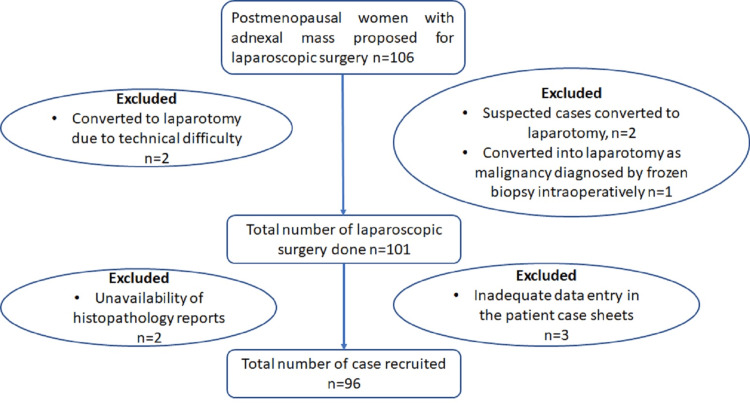
Aim The aim of this study was to estimate the frequent existence of unexpected ovarian malignant lesions after laparoscopic surgery for an apparent benign adnexal mass and assess its clinical and ultrasound characteristics in postmenopausal women. Methods We re-examined the hospital records of 96 cases of postmenopausal women who underwent laparoscopic surgery for benign adnexal mass over five years. The age of the patient, parity, ultrasound findings, tumor markers level, intraoperative findings, and histopathological report were collected. Pearson's Chi-squared test and Fisher's exact test were used for statistical analysis, and a p-value of <0.05 was accepted as statistically significant. Results Of a total of 96, benign adnexal mass was in 93 (96.83%), an unexpected ovarian malignancy was observed in two (2.08%) cases, and one (1.04%) had a borderline ovarian tumor. Tumor marker CA-125 was done for all those cases of adnexal mass in postmenopausal women, and not a single case was found to have above 35 IU/ml, defined as the cut-off value for CA-125. Statistically significant differences were observed between the benign and malignant groups in relation to symptoms (p<0.05), ultrasound score (p=0.001), and bilaterality (p=0.013) of the tumor mass. Conclusion In postmenopausal women, the critical concern for laparoscopic surgery of benign adnexal mass is unexpected malignancy. So it is essential to select patients carefully for laparoscopic surgery. If a benign-looking adnexal mass turned out to be malignant on the histopathological report, we should try to post the patient for subsequent staging laparotomy as soon as possible.
Keywords: adnexal mass; laparoscopy; post menopause; tumor marker; unexpected malignancy.
Copyright © 2023, Pegu et al.
Conflict of interest statement
The authors have declared that no competing interests exist.
References
-
- National Institutes of Health Consensus Development Conference Statement. Ovarian cancer: screening, treatment, and follow-up. Gynecol Oncol. 1994;55:0–14. - PubMed
-
- Evaluation of adnexal masses - correlation of clinical, Sonological and histopathological findings in adnexal masses. Radhamani S, Akhila MV. http://www.ijss-sn.com/uploads/2/0/1/5/20153321/ijss_feb_oa20_-_2017.pdf Int J Sci Stud. 2017;4:88–92.
-
- SEER Cancer Statistics Review, 1975-2011. Howlader Howlader, N N, Noone Noone, AM AM, Krapcho Krapcho, M M, et al. http://seer.cancer.gov/csr/ 1975- 2011/ 2014;2011
-
- Port-site implantation after laparoscopic treatment of borderline ovarian tumors. Morice P, Camatte S, Larregain-Fournier D, Thoury A, Duvillard P, Castaigne D. Obstet Gynecol. 2004;104:1167–1170. - PubMed
LinkOut - more resources
Full Text Sources
Research Materials
Miscellaneous