Review
. 2023 Sep 4;14(9):586.
doi: 10.1038/s41419-023-06119-x.

Exploring the crosstalk between endothelial cells, immune cells, and immune checkpoints in the tumor microenvironment: new insights and therapeutic implications

Affiliations
Review

Exploring the crosstalk between endothelial cells, immune cells, and immune checkpoints in the tumor microenvironment: new insights and therapeutic implications

Jianwen Fang et al. Cell Death Dis. .

Abstract

The tumor microenvironment (TME) is a highly intricate milieu, comprising a multitude of components, including immune cells and stromal cells, that exert a profound influence on tumor initiation and progression. Within the TME, angiogenesis is predominantly orchestrated by endothelial cells (ECs), which foster the proliferation and metastasis of malignant cells. The interplay between tumor and immune cells with ECs is complex and can either bolster or hinder the immune system. Thus, a comprehensive understanding of the intricate crosstalk between ECs and immune cells is essential to advance the development of immunotherapeutic interventions. Despite recent progress, the underlying molecular mechanisms that govern the interplay between ECs and immune cells remain elusive. Nevertheless, the immunomodulatory function of ECs has emerged as a pivotal determinant of the immune response. In light of this, the study of the relationship between ECs and immune checkpoints has garnered considerable attention in the field of immunotherapy. By targeting specific molecular pathways and signaling molecules associated with ECs in the TME, novel immunotherapeutic strategies may be devised to enhance the efficacy of current treatments. In this vein, we sought to elucidate the relationship between ECs, immune cells, and immune checkpoints in the TME, with the ultimate goal of identifying novel therapeutic targets and charting new avenues for immunotherapy.


Conflict of interest statement

The authors declare no competing interests.

Figures
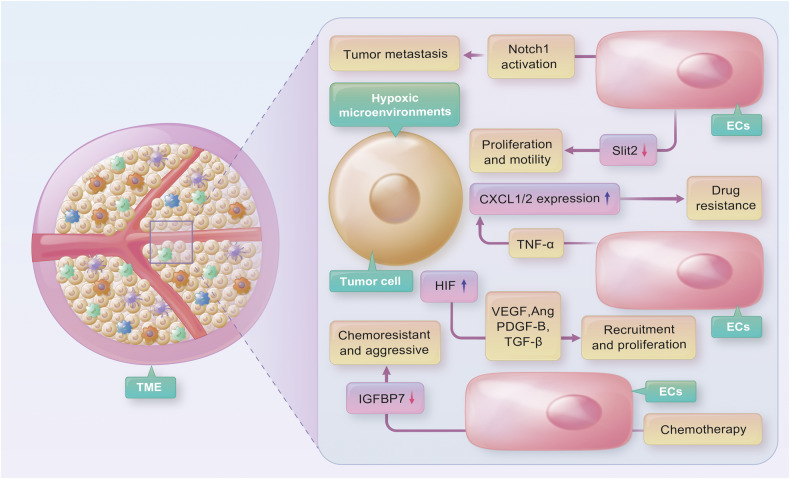
Fig. 1
Fig. 1. Tumor cells secrete several angiogenic factors (e.g., VEGF, ANG, PDGF-B, TGF-β) that promote the proliferation of endothelial cells (ECs).
A hypoxic environment potentiates the ability of tumor cells to stimulate angiogenesis via hypoxia-inducible factors (HIFs). Tumor cells activate Notch1 signaling in ECs, facilitating tumor cell metastasis. Additionally, ECs downregulate Slit2, promoting tumor proliferation and motility. Exposure to chemotherapeutic drugs induces ECs to secrete TNF-α and enhances CXCL1/2 expression in cancer cells, leading to the development of therapeutic resistance. Furthermore, chemotherapy suppresses the expression of IGFBP7 in ECs, resulting in the emergence of aggressive and chemoresistant tumor cells.
Fig. 2
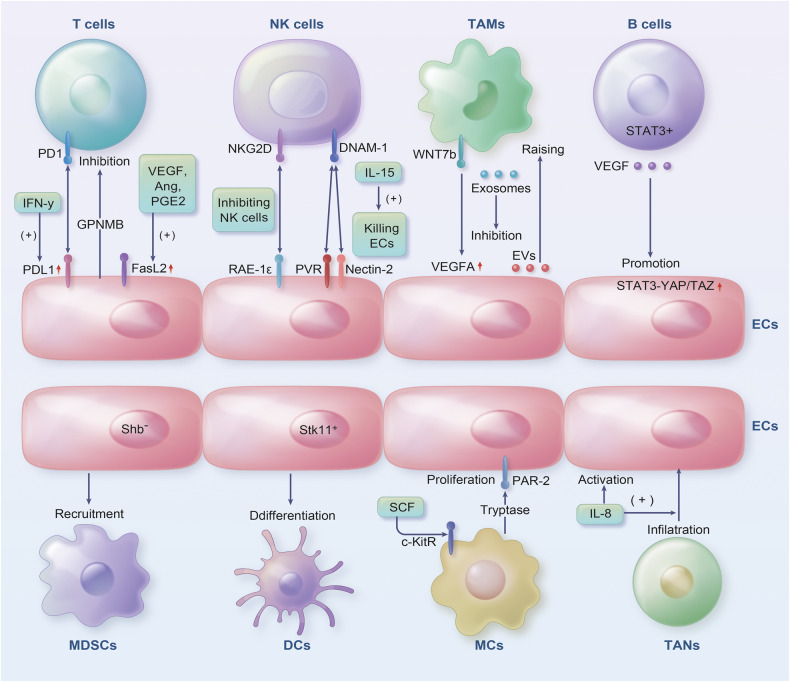
Fig. 2. The ECs and immune cells present in the TME engage in intricate interactions.
ECs induce tumor-infiltrating T-cell exhaustion through GPNMB. ECs express PD-L1, which binds to PD-1 present on T cells and inhibits their anti-tumor ability. PD-L1 was overexpressed by ECs in the presence of IFN-γ, inhibiting CD8+ T-cell accumulation within the TME. In response to VEGF, IL-10 and PGE2, ECs were induced to express FasL, which killed effector CD8+ T cells. NKG2D in NK cells is activated by RAE-1ε expressed from ECs, inhibiting the anti-tumor effects of NK cells. When DNAM-1 recognizes PVR and Nectin-2 on ECs, IL-15 activates NK cells to kill ECs. WNT7b produced by TAMs increases VEGFA expression in ECs. MiR-1420-5p, miR-183-5p and miR-222-3p released from TECs via EVs lead to local TAM increases. TAM-derived exosomes inhibit ECs migration via the miR-146b-5p/TRAF6/NF-kB/MMP2 pathway. VEGF produced in B cells activates STAT3 and promotes YAP/TAZ interaction, leading to ECs progression. The lack of Shb in ECs led to MDSCs recruitment. ECs with Stk11 deletion reduce mature DC numbers and spontaneous tumor formation. As a result of activation of c-KitR/SCF, MCs release tryptase, acting on PAR2 in ECs, triggering ECs proliferation. Due to IL-8 signaling, ECs are promoted, TANs infiltrating tumor sites migrate more efficiently.
Fig. 3
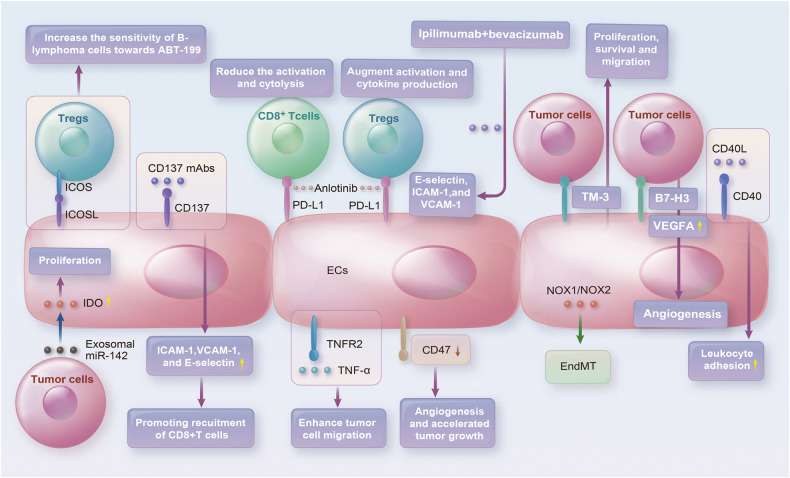
Fig. 3. Immune checkpoints associated with ECs interact with the TME to affect the tumor in a variety of ways.
In ECs, PD-L1 reduces CD8+ T-cell activation and cytolysis and increases Treg activation and cytokine production. Anlotinib inhibits PD-L1 expression in ECs. Ipilimumab blocks CTLA-4 and activates ECs. Overexpression of Tim3 in tumor cells leads to ECs tube formation acceleration. B7-H3-overexpressing tumor cells promote ECs angiogenesis. CD40/CD40L binding induces leukocyte adhesion to ECs. CD137 is present on ECs surfaces, and treatment with CD137 mAbs leads to increased recruitment of CD8+ T cells. ICOS/ICOSL-mediated interactions between Tregs and ECs increase the drug sensitivity of tumor cells. MiR-142-5p is transferred into ECs through tumor cell-secreted exosomes to exhaust CD8+ T cells through an increase in IDO expression. NOX2 promotes EndMT progression of ECs. TNF-α, through TNFR2 enhances tumor cell migration across ECs. A function-blocking CD47 antibody B6H12 modulates multiple EVs-mediated signals between tumor cells and ECs that are critical for tumor cell proliferation and metastasis.

References

    1. Lugano R, Ramachandran M, Dimberg A. Tumor angiogenesis: causes, consequences, challenges and opportunities. Cell Mol Life Sci. 2020;77:1745–70. doi: 10.1007/s00018-019-03351-7. - DOI - PMC - PubMed
    1. Al-Ostoot FH, Salah S, Khamees HA, Khanum SA. Tumor angiogenesis: current challenges and therapeutic opportunities. Cancer Treat Res Commun. 2021;28:100422. doi: 10.1016/j.ctarc.2021.100422. - DOI - PubMed
    1. Weis SM, Cheresh DA. Tumor angiogenesis: molecular pathways and therapeutic targets. Nat Med. 2011;17:1359–70. doi: 10.1038/nm.2537. - DOI - PubMed
    1. Yang C, Passos Gibson V, Hardy P. The role of MiR-181 family members in endothelial cell dysfunction and tumor angiogenesis. Cells. 2022;11:1670. doi: 10.3390/cells11101670. - DOI - PMC - PubMed
    1. Yang H, Lee S, Lee S, Kim K, Yang Y, Kim JH, et al. Sox17 promotes tumor angiogenesis and destabilizes tumor vessels in mice. J Clin Investig. 2013;123:418–31. doi: 10.1172/JCI64547. - DOI - PMC - PubMed

Publication types