


Increased temporal binding during voluntary motor task under local anesthesia
- PMID: 37666870
- PMCID: PMC10477203
- DOI: 10.1038/s41598-023-40591-x
Increased temporal binding during voluntary motor task under local anesthesia
Abstract
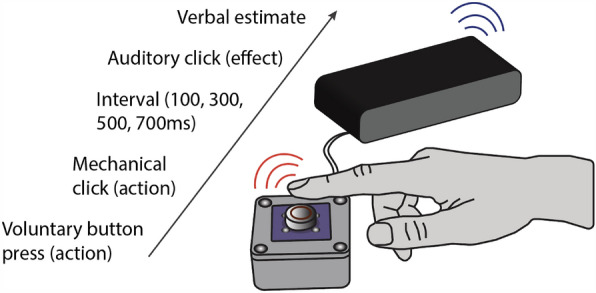
Temporal binding refers to a systemic bias in the perceived time interval between two related events, most frequently voluntary motor actions and a subsequent sensory effect. An inevitable component of most instrumental motor actions is tactile feedback. Yet, the role of tactile feedback within this phenomenon remains largely unexplored. Here, we used local anesthesia of the index finger to temporarily inhibit incoming sensory input from the finger itself, while participants performed an interval-estimation task in which they estimated the delay between a voluntary motor action (button press) and a second sensory event (click sound). Results were compared to a control condition with intact sensation. While clear binding was present in both conditions, the effect was significantly enhanced when tactile feedback was temporarily removed via local anesthesia. The results are discussed in light of current debates surrounding the underlying mechanisms and function of this temporal bias.
© 2023. Springer Nature Limited.
Conflict of interest statement
The authors declare no competing interests.
Figures

References
-
- Hoerl C, et al. Temporal binding, causation, and agency: Developing a new theoretical framework. Cogn. Sci. 2020;44:e12843. - PubMed
-
- Haggard P, Clark S, Kalogeras J. Voluntary action and conscious awareness. Nat. Neurosci. 2002;5:382–385. - PubMed
-
- Moore JW, Obhi SS. Intentional binding and the sense of agency: A review. Conscious. Cogn. 2012;21:546–561. - PubMed
-
- Suzuki K, Lush P, Seth AK, Roseboom W. Intentional binding without intentional action. Psychol. Sci. 2019;30:842–853. - PubMed
Publication types
MeSH terms
LinkOut - more resources
Full Text Sources
