Review
. 2023 Dec;34(4):531-544.
doi: 10.1007/s00335-023-10015-2. Epub 2023 Sep 4.

The alliance of genome resources: transforming comparative genomics

Affiliations
Review

The alliance of genome resources: transforming comparative genomics

Carol J Bult et al. Mamm Genome. 2023 Dec.

Abstract

Comparing genomic and biological characteristics across multiple species is essential to using model systems to investigate the molecular and cellular mechanisms underlying human biology and disease and to translate mechanistic insights from studies in model organisms for clinical applications. Building a scalable knowledge commons platform that supports cross-species comparison of rich, expertly curated knowledge regarding gene function, phenotype, and disease associations available for model organisms and humans is the primary mission of the Alliance of Genome Resources (the Alliance). The Alliance is a consortium of seven model organism knowledgebases (mouse, rat, yeast, nematode, zebrafish, frog, fruit fly) and the Gene Ontology resource. The Alliance uses a common set of gene ortholog assertions as the basis for comparing biological annotations across the organisms represented in the Alliance. The major types of knowledge associated with genes that are represented in the Alliance database currently include gene function, phenotypic alleles and variants, human disease associations, pathways, gene expression, and both protein-protein and genetic interactions. The Alliance has enhanced the ability of researchers to easily compare biological annotations for common data types across model organisms and human through the implementation of shared programmatic access mechanisms, data-specific web pages with a unified "look and feel", and interactive user interfaces specifically designed to support comparative biology. The modular infrastructure developed by the Alliance allows the resource to serve as an extensible "knowledge commons" capable of expanding to accommodate additional model organisms.


Conflict of interest statement

The authors declare no competing interests.

Figures
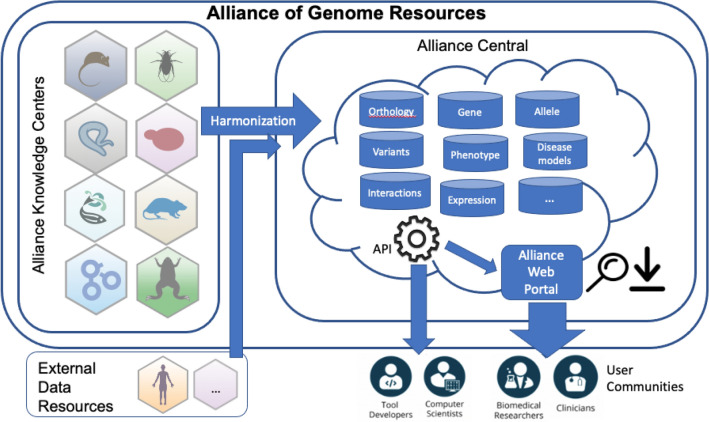
Fig. 1
Fig. 1
A graphical representation of the organizational units that comprise the Alliance of Genome Resources consortium. Knowledge Centers (aka, model organism databases or MODs) are organism-specific resources for expert curation of knowledge about a model organism’s genome. Data from external resources are integrated with genome annotations provided by the Knowledge Centers. Alliance Central is the platform for delivery of harmonized biological annotations to a diverse user community via the Alliance web portal and Application Programming Interfaces (APIs)
Fig. 2
Fig. 2
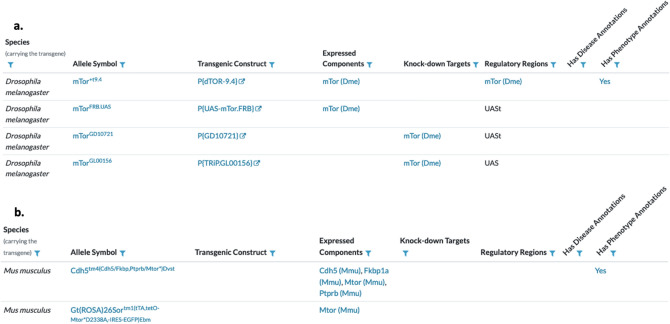
Example of the harmonized representation of transgenic alleles at the Alliance of Genome Resources. a Transgenic alleles of the mTor gene in Drosophila. b Transgenic alleles of the Mtor gene in the laboratory mouse. In the Alliance data model, transgenic alleles are represented by various components that can be populated with information in a species-specific manner which allows for representational consistency and completeness across all model organisms. Allele symbols conform to species-specific nomenclature standards. Transgenic constructs represent the transgene construct independent of the host organism following species-specific guidelines. Expressed components represent the genetic elements expressed by the construct which may be full or partial genes and may include both protein-coding and non protein-coding genes. Knock-down targets are elements in the transgene designed to interfere with the expression of another gene. The regulatory regions component includes genetic elements driving the expression of entities in the construct (e.g., upstream activation sequence, human cytomegalovirus, etc.)
Fig. 3
Fig. 3
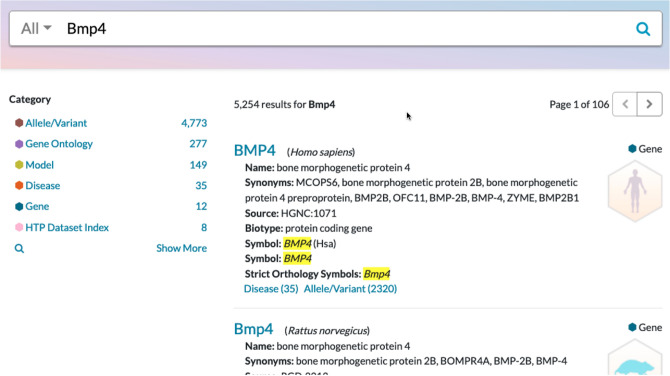
Partial screenshot of the Alliance web portal results page showing the search results for the BMP4 gene. The six major categories of data with counts of database records are provided on the left navigation panel. Users can refine their searches by selecting a category of interest which leads to the display of new facet categories and record counts. Alternatively, users can scroll through the search results and select a gene of interest to navigate to the relevant detail page in the web portal
Fig. 4
Fig. 4
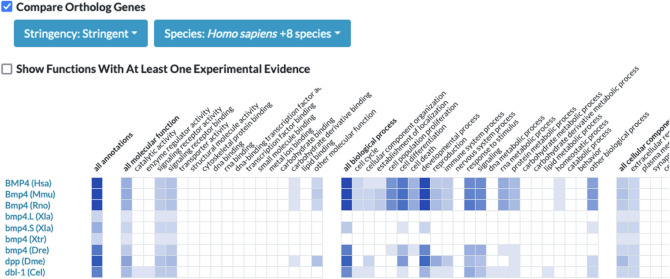
Screenshot showing the interactive annotation summary ribbon for functional annotations of orthologs of the human BMP4 gene. Each row in the ribbon is a different species. Each column is a grouping of terms from the molecular function, biological process, and cellular component categories of the Gene Ontology. The shading in the cells reflects the number of annotations to terms represented by the column. The darker the shading, the more annotations. Selecting a cell in the ribbon results in a table that shows the specific ontology terms and evidence used to make the annotation. Users can use the orthology settings to control which organisms are shown in the graphic
Fig. 5
Fig. 5
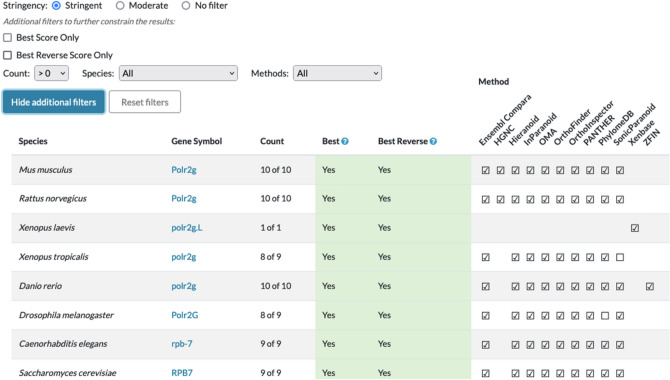
Screenshot of the orthology summary for the human POLR2G gene. By default, only orthologs with high stringency (as determined by DIOPT score) are displayed. Users can adjust the settings for stringency, species displayed, and orthology call methods used. Alliance orthologs are also available as a downloadable file and via the Alliance API
Fig. 6
Fig. 6
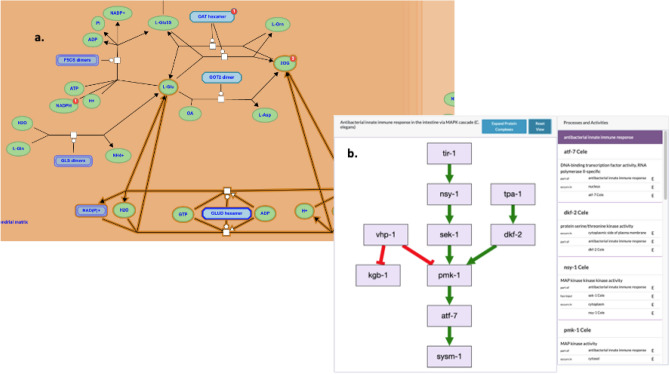
Screenshots showing pathway representation in the Alliance web portal. a Pathway summary display for glutamate and glutamine metabolism for mouse Glud1 from Reactome. The display is integrated into the gene detail pages and links out to the Reactome resource. b Gene Ontology causal activity model (GO-CAM) representation of the antibacterial innate immune response in the intestine via MAPK cascade biological process associated with the nsy-1 gene from Caenorhabditis elegans. The GO-CAM models link out to the Gene Ontology website
Fig. 7
Fig. 7
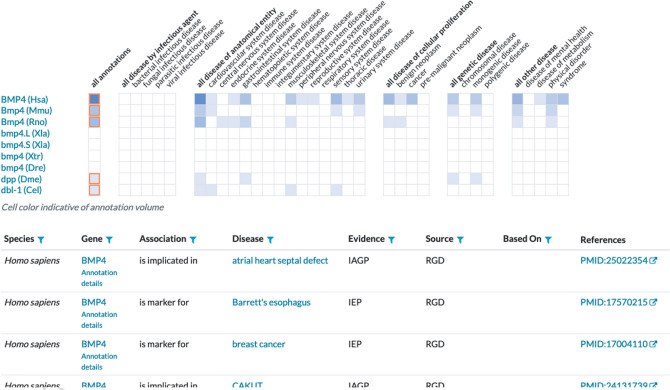
Partial screenshot of the comparative disease annotation summary on the BMP4 gene detail page. The comparative annotation ribbon display is linked to a summary of disease associations for the BMP4 gene. Disease annotations include the type of association, the disease ontology term, the evidence for the association, and the source(s) of evidence
Fig. 8
Fig. 8
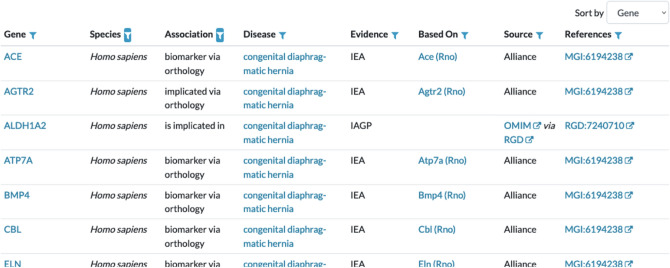
Partial screenshot of the results for a search of the disease term “congenital diaphragmatic hernia”. The results include genes associated with the disease, type of association and evidence, and the source(s) for the evidence

References

    1. Alliance of Genome Resources C The alliance of genome resources: building a modern data ecosystem for model organism databases. Genetics. 2019;213:1189–1196. doi: 10.1534/genetics.119.302523. - DOI - PMC - PubMed
    1. Alliance of Genome Resources C Alliance of genome resources portal: unified model organism research platform. Nucleic Acids Res. 2020;48:D650–D658. doi: 10.1093/nar/gkz813. - DOI - PMC - PubMed
    1. Alliance of Genome Resources C Harmonizing model organism data in the alliance of genome resources. Genetics. 2022 doi: 10.1093/genetics/iyad022. - DOI - PMC - PubMed
    1. Anderson WP, Apweiler R, Bateman A, Bauer GA, Herman B, Blake JA, Blomberg N, Burley SK, Cochrane G, Di Francesco V, Donohue T, Durinx C, Game A, Green E, Gojobori T, Goodhand P, Hamosh A, Hermjakob H, Kanehisa M, Kiley R, McEntyre J, McKibbin R, Miyano S, Pauly B, Perrimon N, Ragan MA, Richards G, Teo Y-Y, Westerfield M, Westhof E, Lasko PF. Data management: a global coalition to sustain core data. Nature. 2017;543:179. doi: 10.1038/543179a. - DOI - PubMed
    1. Bradford YM, Van Slyke CE, Howe DG, Fashena D, Frazer K, Martin R, Paddock H, Pich C, Ramachandran S, Ruzicka L, Singer A, Taylor R, Tseng WC, Westerfield M. From multiallele fish to nonstandard environments, how ZFIN assigns phenotypes, human disease models, and gene expression annotations to genes. Genetics. 2023 doi: 10.1093/genetics/iyad032. - DOI - PMC - PubMed

Publication types

LinkOut - more resources