


Identifying critical gaps in research to advance global surgery by 2030: a systematic mapping review
- PMID: 37667225
- PMCID: PMC10478287
- DOI: 10.1186/s12913-023-09973-9
Identifying critical gaps in research to advance global surgery by 2030: a systematic mapping review
Abstract
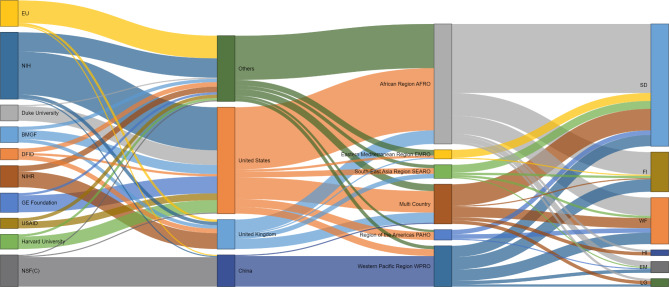
Progress on surgical system strengthening has been slow due to a disconnect between evidence generation and the information required for effective policymaking. This systematic mapping review sought to assess critical research gaps in the field of global surgery guided by the World Health Organisation Health Systems building block framework, analysis of authorship and funding patterns, and an exploration of emerging research partnership networks. Literature was systematically mapped to identify, screen, and synthesize results of publications in the global surgery field between 2015 and March 2022. We searched four databases and included literature published in seven languages. A social network analysis determined the network attributes of research institutions and their transient relationships in shaping the global surgery research agenda. We identified 2,298 relevant studies out of 92,720 unique articles searched. Research output increased from 453 in 2015-16 to 552 in 2021-22, largely due to literature on Covid-19 impacts on surgery. Sub-Saharan Africa (792/2298) and South Asia (331/2298) were the most studied regions, although high-income countries represented a disproportionate number of first (42%) and last (43%) authors. Service delivery received the most attention, including the surgical burden and quality and safety of services, followed by capacity-building efforts in low- and middle-income countries. Critical research in economics and financing, essential infrastructure and supplies, and surgical leadership necessary to guide policy decisions at the country level were lacking. Global surgical systems remain largely under-researched. Knowledge diffusion requires an emphasis on developing sustainable research partnerships and capacity across low- and middle-income countries. A renewed focus must be given to equipping countries with tools for effective decision-making to enhance investments in high-quality surgical services.
Keywords: Equity; Global surgery; Lancet commission on global surgery; Low and middle-income countries; Network analysis; Partnership; Research funding; World health organization health systems building blocks.
© 2023. BioMed Central Ltd., part of Springer Nature.
Conflict of interest statement
The authors declare no competing interests.
Figures

References
-
- Bickler SN, Weiser TG, Kassebaum N, Higashi H, Chang DC, Barendregt JJ et al. Global Burden of Surgical Conditions. In: Debas HT, Donkor P, Gawande A, Jamison DT, Kruk ME, Mock CN, editors. Essential Surgery: Disease Control Priorities, Third Edition (Volume 1) [Internet]. Washington (DC): The International Bank for Reconstruction and Development / The World Bank; 2015 [cited 2023 Apr 12]. Available from: http://www.ncbi.nlm.nih.gov/books/NBK333518/.
-
- World Health Organization. Surgical care systems strengthening: developing national surgical, obstetric and anaesthesia plans [Internet]. Geneva: World Health Organization; 2017 [cited 2023 Apr 12]. 57 p. Available from: https://apps.who.int/iris/handle/10665/255566.
Publication types
MeSH terms
LinkOut - more resources
Full Text Sources
Medical
