Review
. 2023 Sep 4;21(1):226.
doi: 10.1186/s12964-023-01223-z.

Retinoblastoma: present scenario and future challenges

Affiliations
Review

Retinoblastoma: present scenario and future challenges

Vishnu Vardhan Byroju et al. Cell Commun Signal. .

Abstract

With an average incidence of 1 in every 18,000 live births, retinoblastoma is a rare type of intraocular tumour found to affect patients during their early childhood. It is curable if diagnosed at earlier stages but can become life-threateningly malignant if not treated timely. With no racial or gender predisposition, or even environmental factors known to have been involved in the incidence of the disease, retinoblastoma is often considered a clinical success story in pediatric oncology. The survival rate in highly developed countries is higher than 95% and they have achieved this because of the advancement in the development of diagnostics and treatment techniques. This includes developing the already existing techniques like chemotherapy and embarking on new strategies like enucleation, thermotherapy, cryotherapy, etc. Early diagnosis, studies on the etiopathogenesis and genetics of the disease are the need of the hour for improving the survival rates. According to the Knudson hypothesis, also known as the two hit hypothesis, two hits on the retinoblastoma susceptibility (RB) gene is often considered as the initiating event in the development of the disease. Studies on the molecular basis of the disease have also led to deciphering the downstream events and thus in the discovery of biomarkers and related targeted therapies. Furthermore, improvements in molecular biology techniques enhanced the development of efficient methods for early diagnosis, genetic counseling, and prevention of the disease. In this review, we discuss the genetic and molecular features of retinoblastoma with a special emphasis on the mutation leading to the dysregulation of key signaling pathways involved in cell proliferation, DNA repair, and cellular plasticity. Also, we describe the classification, clinical and epidemiological relevance of the disease, with an emphasis on both the traditional and innovative treatments to tackle retinoblastoma. Video Abstract.

Keywords: Cell plasticity; Chemotherapy; Knudson hypothesis; Molecular targeted therapies; Retinoblastoma; Signalling pathways.


Conflict of interest statement

The authors declare no competing interests.

Figures
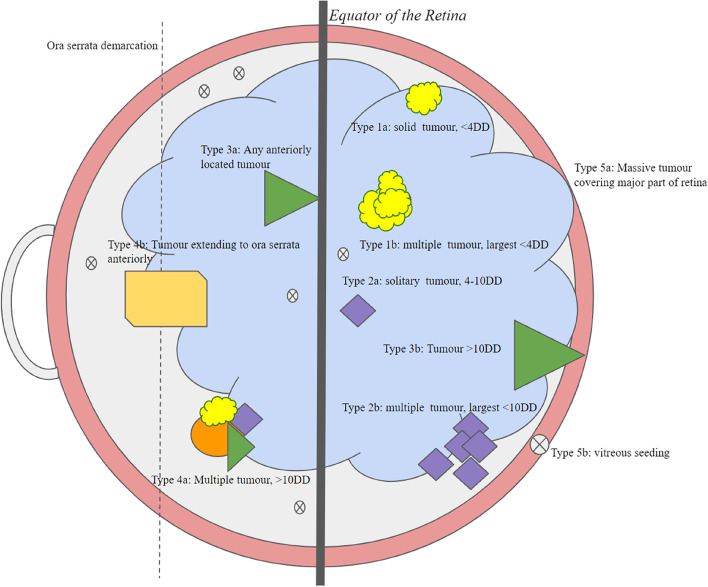
Fig. 1
Fig. 1
Pictorial representation for Reese Ellsworth’s Classification of Retinoblastoma. A graphical abstract of the Reese Ellsworth’s classification system prepared using arbitrarily chosen symbols to represent their corresponding groups within the classification system and to understand different demarcations of the eye. The 1a (yellow cloud shape) aims to represent a tumour behind the equator, solitary and less than 4-disc diameters in size; 1b (multiple yellow cloud shapes) aims to represent multiple tumours behind the equator of the retina with the largest tumour not exceeding 4-disc diameters.; 2a (purple diagonal shape) aims to represent a 4-10DD tumour behind the retina; 2b (Multiple purple diagonal shapes) represents multiple tumours between 4-10DD; 3a (Green triangle shape) aims to represent a tumour anterior to the equator of the retina; 3b (Green triangle shape in a different location) aims to represent a > 10DD tumour behind the equator; 4a (multiple shapes of varied colours) aims to represent multiple tumours with some of them larger than ten-disc diameters in size; 4b (yellow slip diagonal shape) aims to represent a tumour that is crossing the ora serrata; 5a (Large, undefined blue shape in the background) aims to represent a large tumour that covers more than half of the retina; 5b (X marked at the border of the figure and in multiple areas marked across the eye figure) aims to represent vitreous seeding of the eye
Fig. 2
Fig. 2
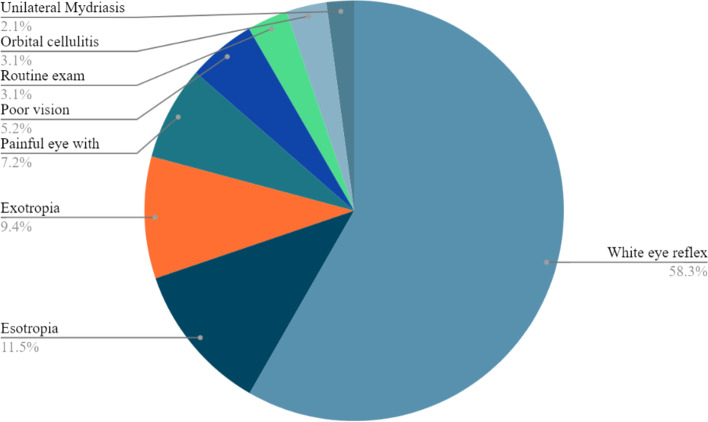
Symptoms of retinoblastoma. Pie chart representation of the presenting symptoms of retinoblastoma
Fig. 3
Fig. 3
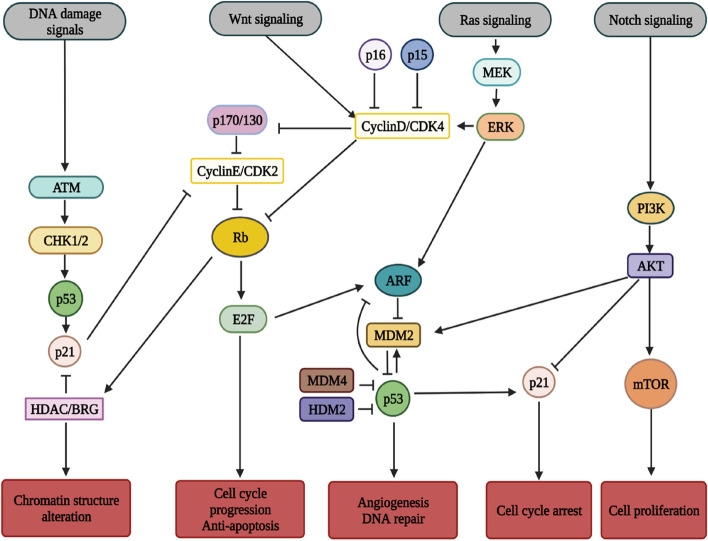
Retinoblastoma cancer signalling. Major signalling pathways that undergo concomitant deregulation during retinoblastoma (Created using Biorender) The abbreviations ATM (Ataxia Telangiectasia Mutated), CHK1/2 (Checkpoint Kinase 1/2), HDAC(Histone Deacetylase), BRG (ATP-dependent chromatin remodeler SMARCA4), CDK2(Cyclin Dependent Kinase 2), MEK(Mitogen-activated protein kinase kinase), ERK (Extracellular signal-regulated kinase), ARF (Alternate open reading frame), MDM2 (Murine Double Minute 2), MDM4(Murine Double Minute 4), HDM2(Human Double Minute 2), AKT (Protein kinase B), mTOR(Mammalian Target of Rapamycin)
Fig. 4
Fig. 4
Loss of Rb gene in retinoblastoma. Graphical abstract on how loss of Rb gene can deregulate metabolic pathways, cell cycle and epithelial to mesenchymal transition (EMT) leading to formation of cancer stem cell and in turn enabling the development of the tumor. (Created using Biorender)

References

    1. Snell RS, Lemp MA. Clinical anatomy of the eye. 2. Malden: Blackwell Science; 1998. p. 423.
    1. Munier FL, Balmer A, van Melle G, Gailloud C. Radial asymmetry in the topography of retinoblastoma. Clues to the cell of origin. Ophthalmic Genet. 1994;15(3–4):101–6. doi: 10.3109/13816819409057835. - DOI - PubMed
    1. Aerts I, Lumbroso-Le Rouic L, Gauthier-Villars M, Brisse H, Doz F, Desjardins L. Retinoblastoma. Orphanet J Rare Dis. 2006;1:31. doi: 10.1186/1750-1172-1-31. - DOI - PMC - PubMed
    1. Fabian ID, Sagoo MS. Understanding retinoblastoma: epidemiology and genetics. Community Eye Health. 2018;31(101):7. - PMC - PubMed
    1. Fernandes AG, Pollock BD, Rabito FA. Retinoblastoma in the United States: a 40-year incidence and survival analysis. J Pediatr Ophthalmol Strabismus. 2018;55(3):182–188. doi: 10.3928/01913913-20171116-03. - DOI - PubMed

LinkOut - more resources