


Antarctic snow algae: unraveling the processes underlying microbial community assembly during blooms formation
- PMID: 37667346
- PMCID: PMC10478455
- DOI: 10.1186/s40168-023-01643-6
Antarctic snow algae: unraveling the processes underlying microbial community assembly during blooms formation
Abstract
Background and aims: At the West Antarctic Peninsula, snow algae blooms are composed of complex microbial communities dominated by green microalgae and bacteria. During their progression, the assembly of these microbial communities occurs under harsh environmental conditions and variable nutrient content due to fast snow melting. To date, it is still unclear what are the ecological mechanisms governing the composition and abundance of microorganisms during the formation of snow algae blooms. In this study, we aim to examine the main ecological mechanisms governing the assembly of snow algae blooms from early stages to colorful stages blooms.
Methods: The composition of the microbial communities within snow algae blooms was recorded in the West Antarctic Peninsula (Isabel Riquelme Islet) during a 35-day period using 16S rRNA and 18S rRNA metabarcoding. In addition, the contribution of different ecological processes to the assembly of the microbial community was quantified using phylogenetic bin-based null model analysis.
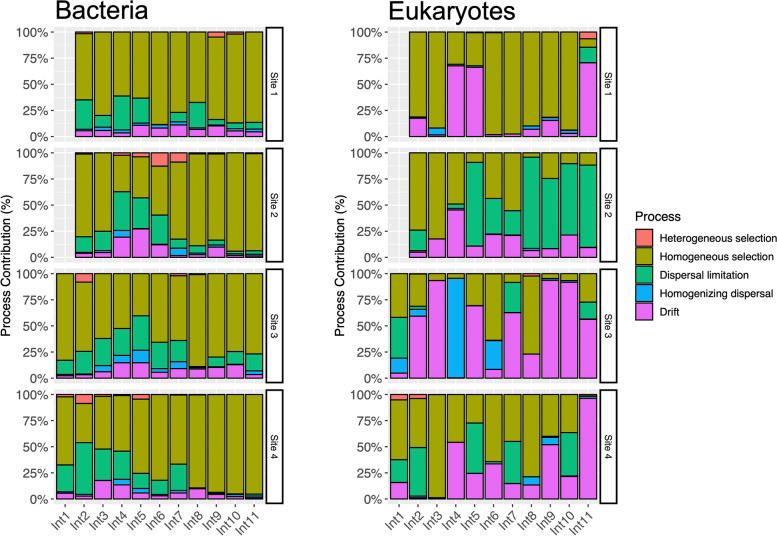
Results: Our results showed that alpha diversity indices of the eukaryotic communities displayed a higher variation during the formation of the algae bloom compared with the bacterial community. Additionally, in a macronutrients rich environment, the content of nitrate, ammonium, phosphate, and organic carbon did not play a major role in structuring the community. The quantification of ecological processes showed that the bacterial community assembly was governed by selective processes such as homogenous selection. In contrast, stochastic processes such as dispersal limitation and drift, and to a lesser extent, homogenous selection, regulate the eukaryotic community.
Conclusions: Overall, our study highlights the differences in the microbial assembly between bacteria and eukaryotes in snow algae blooms and proposes a model to integrate both assembly processes. Video Abstract.
© 2023. BioMed Central Ltd., part of Springer Nature.
Conflict of interest statement
All authors consent to the publication of this manuscript and declare no conflicts of interest.
The authors declare no competing interests.
Figures





References
-
- Abakumov E. Content of available forms of nitrogen, potassium and phosphorus in ornithogenic and other soils of the Fildes Peninsula (King George Island, Western Antarctica) Biol Commun. 2018;63(2):109–16.
-
- Banwell AF, Datta RT, Dell RL, Moussavi M, Brucker L, Picard G, Shuman CA, Stevens LA. The 32-year record-high surface melt in 2019/2020 on the northern George VI Ice Shelf, Antarctic Peninsula. Cryosphere. 2021;15:909–925.
-
- Benkman CW. Biotic interaction strength and the intensity of selection. Ecol Lett. 2013;16:1054–1060. - PubMed
-
- Bidigare RR, Ondrusek ME, Kennicutt MC, Iturriaga R, Harvey HR, Hoham RW, Macko SA. Evidence a photoprotective for secondary carotenoids of snow algae1. J Phycol. 1993;29:427–434. doi: 10.1111/j.1529-8817.1993.tb00143.x. - DOI
-
- Bodenhofer U, Bonatesta E, Horejš-Kainrath C, Hochreiter S. msa: an R package for multiple sequence alignment. Bioinformatics. 2015;31:3997–3999. - PubMed
Publication types
MeSH terms
Substances
LinkOut - more resources
Full Text Sources
