


When a caesarean section is necessary: Analysis of cesarean sections performed in the Republic of Turkey in 2022 in accordance with the World Health Organization Multi-Country Research Guidelines
- PMID: 37667478
- PMCID: PMC10478727
- DOI: 10.4274/tjod.galenos.2023.35919
When a caesarean section is necessary: Analysis of cesarean sections performed in the Republic of Turkey in 2022 in accordance with the World Health Organization Multi-Country Research Guidelines
Abstract
Objective: The aim of our study, in light of the World Health Organization Multi-Country Survey (WHO-MCS) data examining the data of the Ministry of Health for the year 2022, comparing the cesarean sections (C/S) performed in the Republic of Turkey (TR) with the WHO-MCS data, and comparing the number of cesarean sections applied more than the reference values.
Materials and methods: According to the database of the Turkish Ministry of Health, in 2022, 1166175 deliveries took place in the Republic of Turkey, and 706370 (60.5%) cesarean section deliveries were recorded as 365764 (51%) primary C/S. Using the Ministry of Health registration system based on the Robson classification.
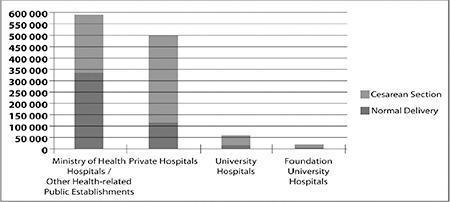
Results: The number and rate of C/S operations performed per birth in 2022 in TR (n=706370; 60.50%) were found to be significantly higher when compared to the number and rate of C/S on a global scale (n=246062; 21.10%), (p<0.001). When cesarean section operations performed in the Ministry of Health hospitals, private institutions, foundation universities, public universities and other public unit hospitals were compared with WHO MCS reference values and C/S ratios, 44.2% versus 24.7% (p=0.05), versus 77.4%, versus 34.2% (p<0.001), 74.3% versus 29.5% (p<0.001), 75% versus 35.8% (p<0.001), 69.3% versus 35.9% (p<0.001).
Conclusion: The amount of cesarean sections performed according to the total number of births in the Turkish Republic is relatively high and its cost nearly 1 billion 750 million TL.
Keywords: Republic of Turkey; World Health Organization Multi-Country Survey (WHO-MCS) data guide; cesarean section; normal birth; the year 2022.
Conflict of interest statement
Figures

References
-
- FIGO Working Group On Challenges In Care Of Mothers And Infants During Labour And Delivery. Best practice advice on the 10-Group Classification System for cesarean deliveries. Int J Gynaecol Obstet. 2016;135:232–3. - PubMed
-
- Robson MS. Can we reduce the caesarean section rate? Best Pract Res Clin Obstet Gynaecol. 2001;15:179–94. - PubMed
-
- Eyi EGY, Mollamahmutoglu L. An analysis of the high cesarean section rates in Turkey by Robson classification. J Matern Fetal Neonatal Med. 2021;34:2682–92. - PubMed
-
- Boerma T, Ronsmans C, Melesse DY, Barros AJD, Barros FC, Juan L, et al. Global epidemiology of use of and disparities in caesarean sections. Lancet. 2018;392:1341–8. - PubMed
-
- Guihard P, Blondel B. Trends in risk factors for caesarean sections in France between 1981 and 1995: lessons for reducing the rates in the future. BJOG. 2001;108:48–55. - PubMed
LinkOut - more resources
Full Text Sources
