


Endogenous endophthalmitis secondary to perirenal abscess
- PMID: 37667766
- PMCID: PMC10475336
- DOI: 10.1002/iju5.12601
Endogenous endophthalmitis secondary to perirenal abscess
Abstract
Introduction: Endogenous Endophthalmitis is a rare ocular infection but with poor visual prognosis for most patients. Its most frequent etiology is Klebsiella spp., associated with hepatic abscesses and less frequently with perirenal abscesses.
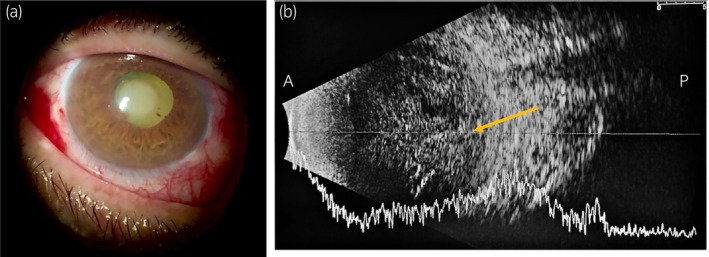
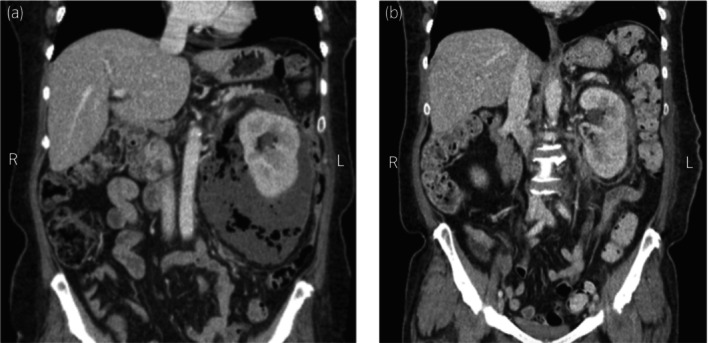
Case presentation: We present a 61-year-old woman with a history of poorly controlled diabetes mellitus 2 that consulted several times for acute pyelonephritis with torpid evolution, associated with endogenous endophthalmitis in her right eye that required evisceration.
Conclusion: Adequate management of acute pyelonephritis can avoid local or distant complications, such as endogenous endophthalmitis, an infection with poor visual prognosis that requires high clinical suspicion for timely management with better visual outcomes and lower morbimortality.
Keywords: acute pyelonephritis; endogenous endophthalmitis; perirenal abscess.
© 2023 The Authors. IJU Case Reports published by John Wiley & Sons Australia, Ltd on behalf of Japanese Urological Association.
Conflict of interest statement
The authors declare no conflict of interest.
Figures
References
-
- Jackson TL, Eykyn SJ, Graham EM, Stanford MR. Endogenous bacterial endophthalmitis: a 17‐year prospective series and review of 267 reported cases. Surv. Ophthalmol. 2003; 48: 403–23. - PubMed
-
- Jung J, Jang Y, Choi G, Min K, van Han K, Park J. A case of renal abscess associated with endogeneous endophthalmitis and septic pulmonary embolism by Klebsiella pneumoniae . Infect. Chemother. 2011; 43: 485.
Publication types
LinkOut - more resources
Full Text Sources
Miscellaneous