Review
. 2023 Dec;114(6):1220-1237.
doi: 10.1002/cpt.3044. Epub 2023 Sep 28.

PharmVar Tutorial on CYP2D6 Structural Variation Testing and Recommendations on Reporting

Affiliations
Review

PharmVar Tutorial on CYP2D6 Structural Variation Testing and Recommendations on Reporting

Amy J Turner et al. Clin Pharmacol Ther. 2023 Dec.

Abstract

The Pharmacogene Variation Consortium (PharmVar) provides nomenclature for the highly polymorphic human CYP2D6 gene locus and a comprehensive summary of structural variation. CYP2D6 contributes to the metabolism of numerous drugs and, thus, genetic variation in its gene impacts drug efficacy and safety. To accurately predict a patient's CYP2D6 phenotype, testing must include structural variants including gene deletions, duplications, hybrid genes, and combinations thereof. This tutorial offers a comprehensive overview of CYP2D6 structural variation, terms, and definitions, a review of methods suitable for their detection and characterization, and practical examples to address the lack of standards to describe CYP2D6 structural variants or any other pharmacogene. This PharmVar tutorial offers practical guidance on how to detect the many, often complex, structural variants, as well as recommends terms and definitions for clinical and research reporting. Uniform reporting is not only essential for electronic health record-keeping but also for accurate translation of a patient's genotype into phenotype which is typically utilized to guide drug therapy.


Conflict of interest statement

Conflicts of interest: C.A.B. is the founder and CEO of Sequence2Script Inc. H.H. is an employee of AccessDx Laboratories and a former employee of Translational Software. B.E.R. is an employee of Let’s Get Checked and owner of Phoenix Laboratory Consulting, LLC. H.M.D. is an owner of MD Omics Consulting, LLC. C.N. and S.V. are employed by PharmGenetix GmbH, a private laboratory providing PGx testing, reporting, and interpretation services. T.E.K. is on the Scientific Advisory Board of Galatea. M.S.P. is currently employed as president of Precision Medicine Advisers, Inc. and is a former employee of Sequence Bio, Inc. and Genuity Science, Ltd. A.J.T. is supported in part by RPRD Diagnostics LLC. All other authors declared no competing interests for this work.

Figures
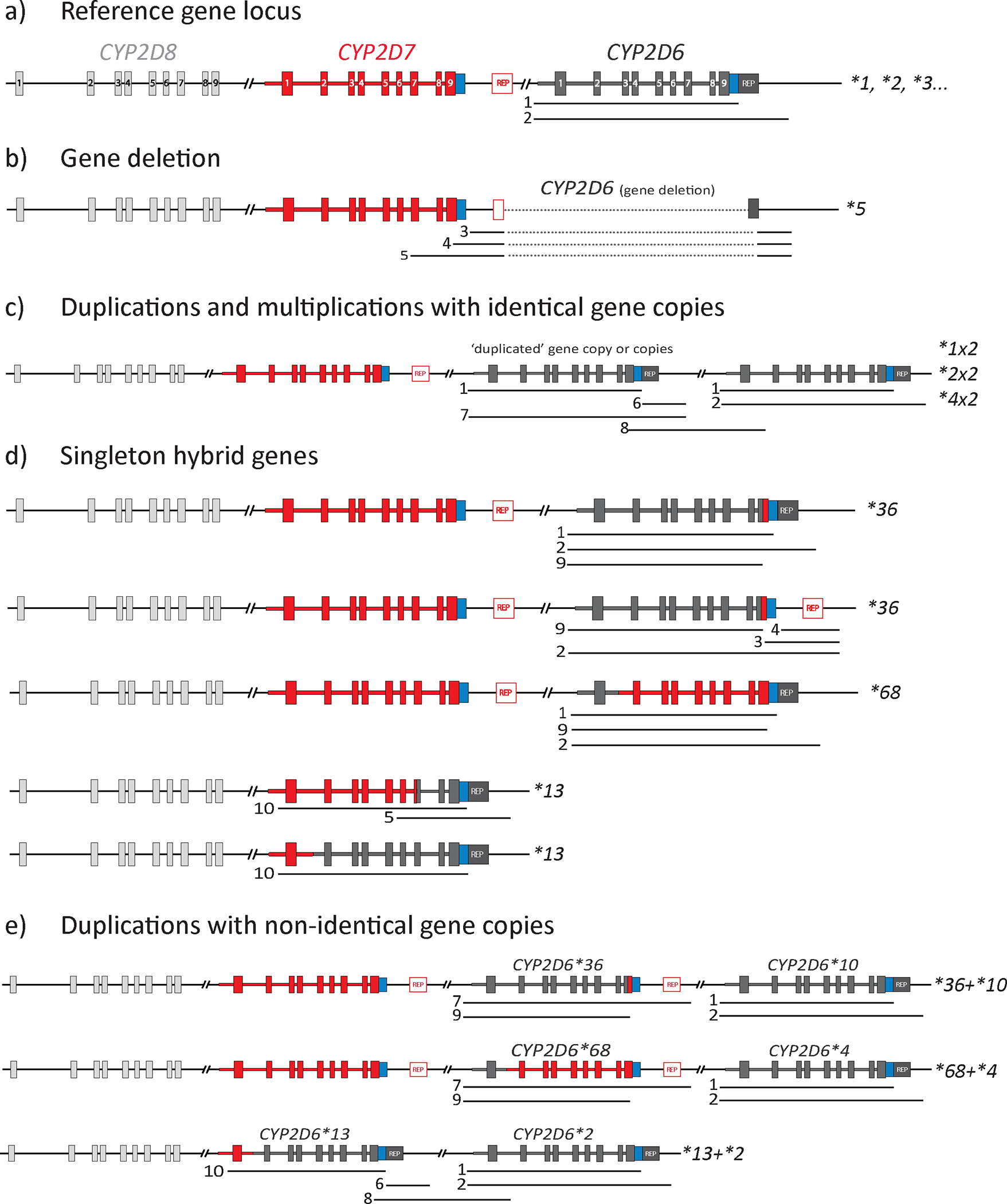
Figure 1
Figure 1. Overview of the CYP2D6 gene locus and structural variants.
Each structural variant (SV) can also be described as a copy number variant (CNV) (Table 1). The three genes within the locus are shown in dark gray (CYP2D6), red (CYP2D7), and light gray (CYP2D8); boxes within each gene represent exons (numbered in panel a). Regions that can be amplified by XL-PCR to detect and characterize SVs/CNVs are shown by numbered lines underneath allele representations (see Table 3 for detailed descriptions). Repetitive sequences (REP) are shown in red (1.6-kb spacer is present) or dark gray (spacer is absent). Panel a depicts the reference gene locus containing CYP2D6, CYP2D7, and CYP2D8; sequence variants within the CYP2D6 gene define numerous star alleles. Panel b depicts the CYP2D6*5 gene deletion. Panel c depicts SV/CNV alleles with two or more identical gene copies (identity being on the core allele level); examples include *1×2, *2×2, and *4×2). Panel d depicts alleles having a hybrid gene consisting of CYP2D6 and CYP2D7 sequences; these alleles may or may not have a full CYP2D7 gene copy in addition to the hybrid gene. Lastly, panel e provides a selection of alleles with two or more non-identical gene copies, one of which is a full CYP2D6 gene copy (normal, decreased, or no function), and one is a hybrid gene.
Figure 2
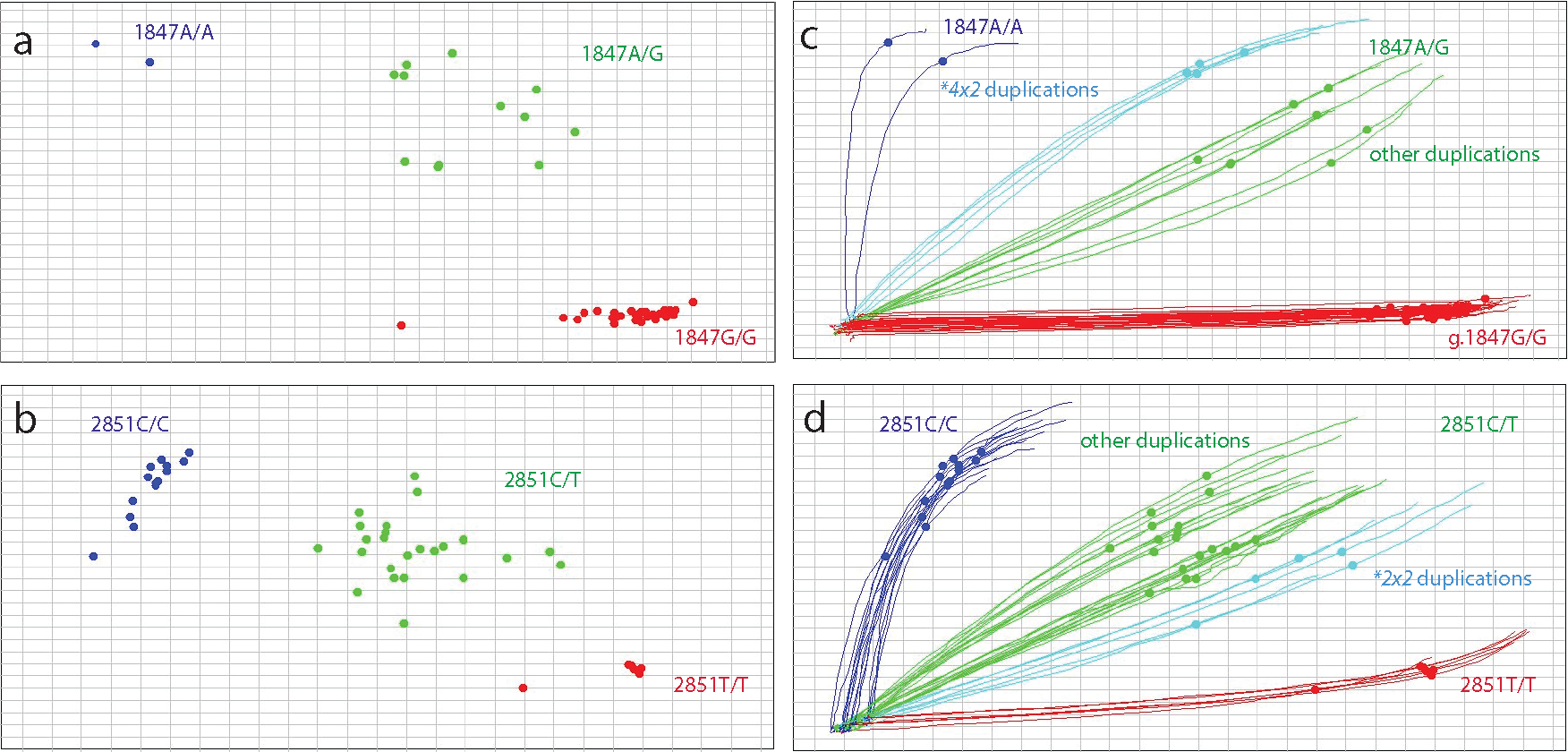
Figure 2. Real-time PCR genotyping assays can inform SV/CNV state.
TaqMan assay results for the CYP2D6*4 core variant (1847G>A, rs3892097, panels a and c) and 2851C>T (rs16947, panels b and d) which is a core variant of many star alleles, including CYP2D6*2, are shown to illustrate how signal ratios and clustering of real-time genotyping assays can inform copy number (CN) state at the variant site. The “traces” feature in panels c and d allows the identification of clusters representing samples with copy number variants. Individuals with a CYP2D6*4×2 duplication are highlighted by the light blue traces in panel c. These samples represent diplotypes such as CYP2D6*1/*4×2, *2/*4×2 or *4×2/*41) and form a distinct cluster between the homozygous 1847A/A and heterozygous 1847G/A clusters suggesting that the sample has a CYP2D6*4 duplication. As shown in panel d, samples with a CYP2D6*2 duplication such as CYP2D6*1/*2×2, *2×2/*4 or *2×2/*10), highlighted by light blue traces, cluster between the homozygous 2851T/T and heterozygous 2851C/T clusters. The TaqMan assay for 1847G>A produces more distinct clusters than those observed for 2851C>T. Clustering also improves with higher sample numbers, including samples with CN variants.
Figure 3
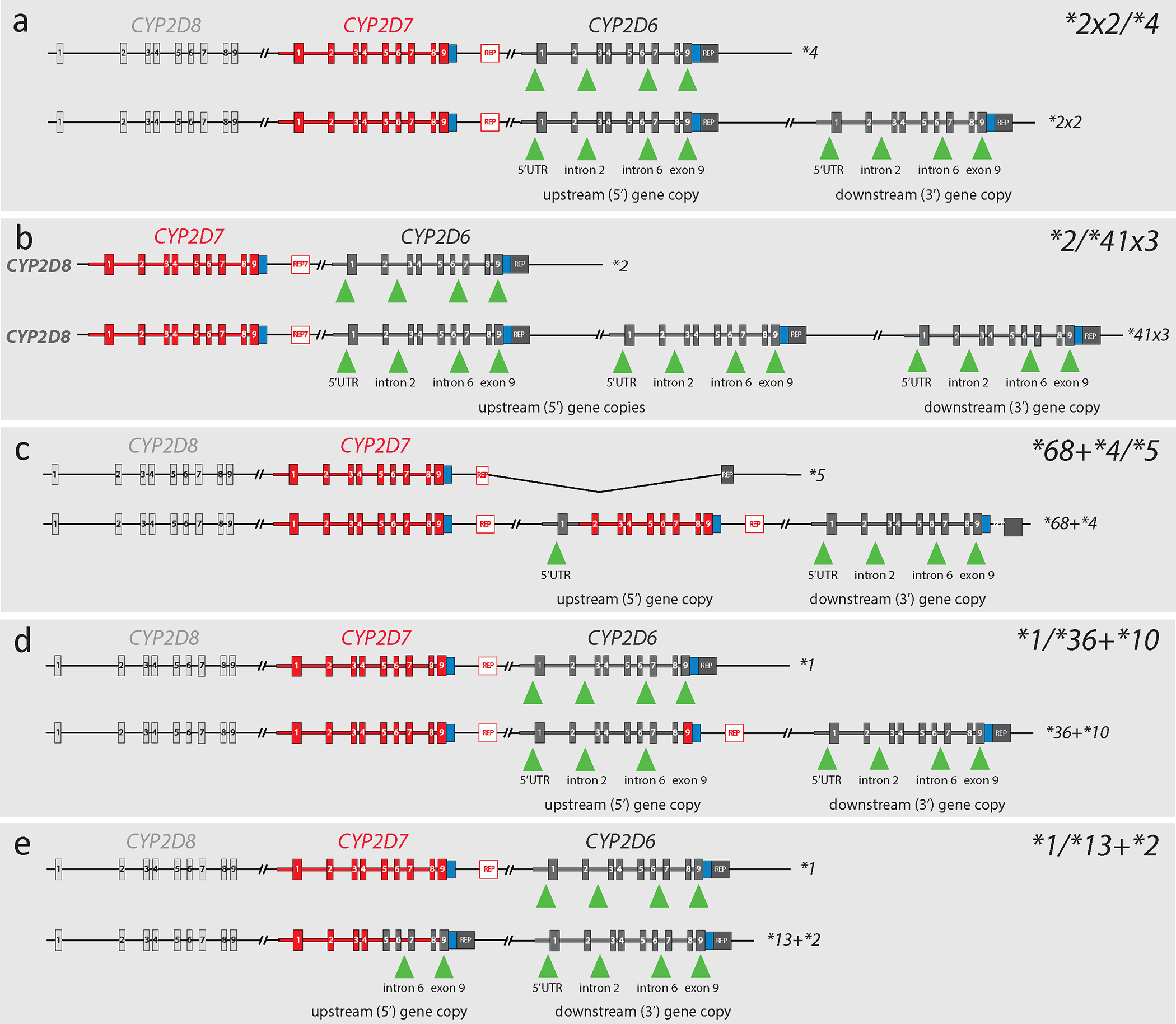
Figure 3. Graphical overview of CYP2D6 diplotypes containing structural variants.
Each panel shows both alleles of samples with SVs/CNVs detailing the regions commonly targeted by quantitative copy number assays. Graphs depict CYP2D6 (dark gray), CYP2D7 (red), and CYP2D8 (light gray) with boxes representing exons. Green triangles indicate the gene regions targeted by commonly used TaqMan copy number assays. Panel a shows Coriell sample NA23296, which was genotyped as CYP2D6*2×2/*4. This sample produces copy number (CN) calls of 3 for each interrogated region. Panel b depicts Coriell sample NA24217, which has a CYP2D6*2/*41×3 diplotype. This sample produces CN calls of 4 for each of the interrogated regions. Panel c shows Coriell sample HG01190, which was genotyped as CYP2D6*68+*4/*5. Because the CYP2D6*68 hybrid switches to CYP2D7 in intron 1, this sample produces CN calls of 1 when probed with intron 2, intron 6, and exon 9 gene copy number assays; in contrast, the assay targeting the 5’UTR produces a CN call of 2. Panel d represents Coriell samples NA23093 and NA18563, which were genotyped as CYP2D6*1/*36+*10. Because CYP2D6*36 has a CYP2D7-derived exon 9, the assay targeting exon 9 produces a signal only from the *1 and *10 alleles, yielding a CN call of 2; assays probing the other regions produce CN calls of 3. Finally, panel e illustrates Coriell sample NA19790, which was genotyped as CYP2D6*1/*13+*2. The CYP2D6*13 hybrid gene in this sample has CYP2D7-derived exons 1–4 and therefore does not generate a signal when probed with assays targeting the 5’UTR or intron 2. Thus, CN calls of 2 are produced for these regions, while the other two assays produce CN calls of 3. CN calls for these and other Coriell samples with SVs/CNVs are summarized in Table 3.

References

    1. Taylor C, Crosby I, Yip V, Maguire P, Pirmohamed M & Turner RM A review of the important role of CYP2D6 in pharmacogenomics. Genes (Basel) 11:1295, (2020). - PMC - PubMed
    1. Saravanakumar A, Sadighi A, Ryu R & Akhlaghi F Physicochemical properties, biotransformation, and transport pathways of established and newly approved medications: A systematic review of the Top 200 most prescribed drugs vs. the FDA-approved drugs between 2005 and 2016. Clin Pharmacokinet 58, 1281–94 (2019). - PMC - PubMed
    1. Caudle KE et al. Standardizing CYP2D6 Genotype to Phenotype Translation: Consensus recommendations from the Clinical Pharmacogenetics Implementation Consortium and Dutch Pharmacogenetics Working Group. Clin Transl Sci 13, 116–24 (2020). - PMC - PubMed
    1. Whirl-Carrillo M et al. An Evidence-based framework for evaluating pharmacogenomics knowledge for personalized medicine. Clin Pharmacol Ther 110, 563–72 (2021). - PMC - PubMed
    1. Nofziger C et al. PharmVar GeneFocus: CYP2D6. Clin Pharmacol Ther 107, 154–70 (2020). - PMC - PubMed

Publication types

Substances

LinkOut - more resources