


Protecting Personhood: A Classic Grounded Theory
- PMID: 37669352
- PMCID: PMC10626982
- DOI: 10.1177/10497323231190329
Protecting Personhood: A Classic Grounded Theory
Abstract
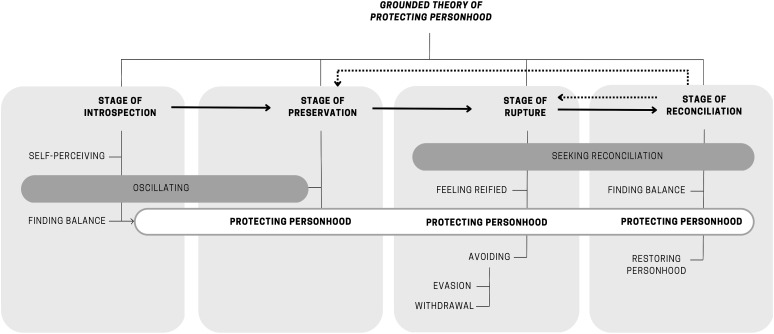
The importance of perceiving and considering patients as healthcare partners has been increasingly promoted. Healthcare systems around the world are now highly interested in patient engagement, participation, collaboration, and partnership. Healthcare professionals are advised that patients, as autonomous beings, should be active in and responsible for a portion of their own care. The study presented here focused on patients' perceptions of interprofessional collaboration. It was conducted using the classic grounded theory methodology. The theory of protecting personhood emerged as the core concept of hospitalized patients, cared for by interprofessional healthcare teams. This theory encapsulates the process hospitalized patients go through to find balance in their sense of self, oscillating between personhood and patienthood in the unfamiliar hospital environment. The process consists of four stages: the stage of introspection, during which hospitalized patients become aware of their self as a person and as a patient; the stage of preservation, when patients find a balance between the sense of personhood and patienthood; the stage of rupture, wherein patients experience an imbalance between their sense of personhood and patienthood; and the stage of reconciliation, in which personhood is restored. The theory of protecting personhood offers insights into a better understanding of hospitalized patients' experiences and strategies, revealing the importance of relationships, and the driving force of empowerment. This study is about patients' perspectives of interprofessional healthcare teams. A grounded theory process allowed the emergence of patients' concerns and expectations, leading to a substantive theory grounded in the patients' data.
Keywords: behavior; communication; doctor–patient; experiences; health; healthcare; holistic care; illness and disease; lived experience; methodology; nurse–patient; theory development; trust; users’ experiences.
Conflict of interest statement
Declaration of Conflicting InterestsThe author(s) declared no potential conflicts of interest with respect to the research, authorship, and/or publication of this article.
Figures
References
-
- Berntsen G., Chetty M., Ako-Egbe L., Yaron S., Phan P., Curran C., Lachman P. (2022). Person-centred care systems: from theory to practice. International Society for Quality in Healthcare (ISQUA). https://isqua.org/media/attachments/2022/10/03/person-centred-care-syste...
-
- Birks M., Mills J. (2022). Grounded theory: A practical guide. Sage.
-
- Calvès A. E. (2009). Empowerment: The history of a key concept in contemporary development discourse. Revue Tiers Monde, 200(4), 735–749. 10.3917/rtm.200.0735 - DOI
-
- Canadian Interprofessional Health Collaborative (CIHC) (2010). A national interprofessional competency framework. Canadian Interprofessional Health Collaborative. https://phabc.org/wp-content/uploads/2015/07/CIHC-National-Interprofessi...
MeSH terms
LinkOut - more resources
Full Text Sources
Medical
